The bigger they come … the harder they hit
THERE it was, in a nutshell. A headline in an English daily newspaper last month encapsulating the whole problem that besets professional rugby. ‘Injuries and fixture congestion brings game to the crossroads’ and sat atop an eloquent summation by Wales and Lions legend Gerald Davies of how the modern player is spending as much time on the treatment table as he is on the field of play.
The fact that more players are being injured more often and concern caused thereby was the gist of Davies’ opinion piece, which wrapped itself around an advert for the forthcoming England v Argentina Test at Twickenham on November 11.
And there, sharing his column on how player welfare is being sacrificed on the altar of relentless television exposure was the advert, picturing two rugby jerseys, English and Argentine, hanging on butchers’ hooks with the slogan between them: “How do you like your beef? Raw or minced?”
The ad bore the RFU’s corporate logo, England Rugby, which was ironic because, while one arm of the English governing body was trying to flog match tickets with the implied promise of, at least, extreme physicality at its headquarters, the RFU’s head of sports medicine was bemoaning the current descent into such combat.
As 23 out of England’s 40-man elite squad cried off a training camp designed to prepare for the autumn internationals against New Zealand, the Pumas and twice against South Africa, Dr Simon Kemp said: “The majority of these injuries are the sort of impact-related ones that appear to be a consequence of the ferocity of the collisions seen in the modern professional game.”
Wasps flanker Joe Worsley was one of England’s walking wounded, with a hamstring problem, but he described the training camp as being “like the Somme”.
His union boss Damien Hopley, the chief executive of the Professional Rugby Players’ Association, has called for urgent action to be taken to tackle the injury problem, and the RFU themselves have called on the IRB for a blanket 12-week playing break between seasons to allow players proper recovery time.
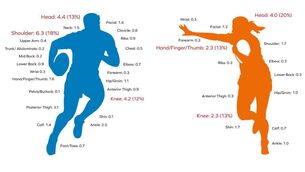
A study conducted by Dr Kemp, England fitness coach Dave Reddin and colleagues from the University of Leicester and published by the British Journal of Sports Medicine in October 2005 rated rugby as more dangerous than rugby league, Australian Rules football, soccer and ice hockey, showing that, on average, in every English Premiership fixture two players from each side were lost for 18 days.
Everyone agrees the game is facing a crisis but, as the Magners League and Guinness Premiership give way to the Heineken Cup, which will in turn pause for next month’s autumn internationals, the sport is still ringing its hands about how best to address the problem.
What is undeniable is that professional players are bigger, stronger and hit harder in the tackle, producing more injuries.
The RFU/BJSM study reported that England international forwards and backs in 2003 weighed, on average, 109kg and 90 kg respectively, compared with 100 kg and 83 kg for their counterparts in 1991. A greater proportion of that increased weight is lean body mass, meaning more force is generated in the collisions. There was also, the authors noted, a 30% increase in the ball-in-play time between 1995 and 2003, thus producing a significantly greater chance of injury per match.
Physiotherapist Paul Dowdeswell has worked with rugby players since 1982, first with Newport RFC, then with Swansea RFC from 1986 to 2003.
He now treats individual players privately, and is head of the Department of Rehabilitation at the Swansea NHS Trust as well as a provider for the Elite Cymru scheme for promising Welsh athletes. He is also in a perfect position to assess the change in physical demands placed on rugby footballers.
“When the game went professional and players were given salaries that were commensurate with that sort of professionalism the management expected more for their money,” said Dowdeswell. “Obviously to compete at the highest levels in Celtic League and Heineken Cup competitions the players needed to be fitter, stronger and work at a higher level.
“So training increased from a couple of times a week to training every day, sometimes two sessions per day, a track session in the morning and strength and conditioning in the afternoon. They were doing something once or twice every day plus the games. Without a doubt, when they turned pro, players did get bigger, bulked up, put on more power and got faster as well. The laws of physics will tell you you’re going to get bigger hits from that.”
Dowdeswell says it is not just impact injuries that resulted from the switch to full-time professionalism.
“Probably around about 50% of injuries are in the tackle situation but the other 50% would come from the non-contact stuff – pulled hamstrings, calves and tendonitis and so on, that would be associated with high levels of training.”
What is quite clear that this intensity in training and matches is all too much for players’ bodies.
“This is a big point in the players’ minds as well,” said Worsley. “There were some stats that came out from our union, the PRPA, that one player per club per season has their career finished through injury, one every year. And that at any one time 25% of players are injured. That’s huge and I don’t think there’s any other sport quite like that.”
Dowdeswell agrees.
“Defences have become much better organised and more rugby league-ish and you tend to see more powerful hits to the upper body and more double tackles coming in, which forces the body in two different directions and that can be very devastating.”
Former England and Lions scrum-half Matt Dawson retired last April at the age of 34, and is appalled at the high number of games played by rugby’s stars.
“Let’s get back to basics here,” he said. “We want players at their peak physical condition to perform. They’re entertainers and we’ve got to get them fit and get them strong and playing the best rugby possible but these guys can’t do that 35 or 40 games a year, it’s just ridiculous.”
The problem, especially in English rugby, is how to reduce playing time. Northampton Saints chairman Keith Barwell believes it is the international game that is the problem.
“Usually, when the RFU make decisions they don’t include the players,” said Barwell. “I mean, this is a simple situation. If you went back to the time when the game was amateur, there was only the five nations, there were no pre-Christmas internationals and fewer games.
“It’s actually the RFU who have been the pigs in the trough, who have almost doubled the amount of international games they put on and it’s now they who are saying ‘ooh, the players need more rest and the Anglo-Welsh (EDF Energy Cup) is a tournament too far’. Well, it’s not a tournament too far, there needs to be less international rugby.”
Ireland, along with New Zealand and Australia, centrally contracts its top players, thereby alleviating many of the problems facing the English game. IRFU director of fitness Dr Liam Hennessy has introduced a 10-week pre-season rest period and head coach Eddie O’Sullivan has control over how much rugby is played by his internationals at the provinces.
England does not have that option because the RFU was slow out of the gate at the advent of professionalism and ceded too much ground for its liking to the clubs. The clubs pay the wages and call the shots.
Players’ boss Hopley believes the main problem is the way the game is structured in England, rather than the number of matches played, saying too much rugby “is probably a bit of a red herring”. “I think we need to take a holistic approach as an industry and we are doing a lot of research.
“We conducted a survey of the players last season and I think 80% of the players felt that injuries were increasing in terms of severity. We need to look at training methods and rest times, and the psychological, emotional and physical strains placed on the players. It is a growing concern and something has to give. Unfortunately it always tends to be the players’ bodies.”
CONNECT WITH US TODAY



Be the first to know the latest news and updates