Collision course
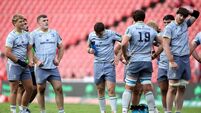
The debate over the relative merits of Munster and Leinster rugby has raged for well over 100 years. That intense rivalry is now set to scale a mountainous peak with a place in the Heineken Cup final at stake.
If Ireland’s recent feat in securing a second Triple Crown in three years offered evidence of the continuing well-being of rugby on this island, the fact that two of our provincial sides have reached the penultimate stage of Europe’s premier competition offers further confirmation of the quality on offer.
Leinster’s victory at the home of reigning champions Toulouse will go down as one of the greatest victories in Irish rugby history. Toulouse are acknowledged as the aristocrats of European rugby. To beat them on their home patch, scoring four tries en route, is a magnificent achievement.
While Munster’s victory over Perpignan was achieved by more traditional means, the significance of two Irish sides in the last four will not go unnoticed. In a week when Serge Blanco questioned the large participation of the Celtic nations in the tournament, the Irish have more than proved their value to the competition.
Munster’s achievement in reaching yet another Heineken Cup semi-final will only be appreciated over the coming weeks. Perpignan are an accomplished outfit and were certain to ask questions of Declan Kidney’s men. It has been a difficult period for the Munster squad. The emotion that accompanied the minute’s silence for former playing colleague Conrad O’Sullivan said everything about the esteem in which this young player was held by his team-mates.
Munster’s quest for European success has endured many obstacles on the way. When news of Ronan O’Gara’s hamstring strain hit this paper on Saturday morning it was dismissed by many as an April Fool’s gag. It was no such thing. O’Gara’s participation in this game was in doubt right up to the morning of the match. When he lay prostrate from a further knock early in the second half, Munster’s position looked perilous. To his immense credit, O’Gara played through the pain barrier and offered direction when it was most needed.
In every sport there are games when one is happy to take the victory and move on. This was one of those occasions from a Munster perspective. Without ever achieving anything close to their true potential, Munster’s ability to grind out a victory against a formidable opposition was highly significant.
Perpignan laid down an immediate marker in turning over possession from the kick-off and the subsequent first line-out on Munster’s throw. In a game of intense physicality, Munster’s greater experience was the difference between the sides. Despite constant pressure they never panicked.
Munster dominated for large periods of this game but were unable to translate that superiority on the scoreboard. Perpignan, not unlike Wasps two years ago, were more than happy to concede the cynical foul within scoring range and deprived Munster of any worthwhile continuity. When referee Nigel Whitehouse finally issued two yellow cards against Nicholas Mas and Nicholas Durand, Munster’s inability to capitalise on their numerical advantage could have cost them dearly, particularly if Mathieu Bourret had slotted two very kickable second-half penalties. Those misses proved very costly in the end.
The opening 10 minutes of the second half were the most significant of the game. Two penalties by O’Gara helped sooth the nerves, but it was Munster’s ability to absorb pressure metres from their own line that proved most significant.
Munster’s scrum has been targeted by many of the top teams in this tournament. Yet, when it mattered most, the front row were magnificent. Munster defended two five-metre scrums as if their lives depended on it. When they survived that onslaught, Perpignan’s frustration was best demonstrated by the sin binning of scrum-half Durand. The Catalan side ceased to be a force from that moment onwards.
When it mattered most Munster’s big names performed, none more so than Paul O’Connell, Donncha O’Callaghan, Peter Stringer and O’Gara. Mick O’Driscoll also made a major contribution when introduced for the injured Denis Leamy.
With less than three weeks to the mother of all battles against Leinster, this Munster team have work to do. It is a rarity in the modern game for a team to dominate the line-out to the extent that Munster did and still struggle for victory. The loss of Barry Murphy and the injury to O’Gara reduced Munster’s effectiveness behind the scrum.
The two Celtic league matches between now and the semi-final will take on far more significance as Munster seek to assess the merits of the rehabilitated Christian Cullen, Mike Mullins and Rob Henderson. While Tomas O’Leary displayed admirable character in his first competitive outing in the centre, it would be unfair to place him there against the twin threat of Brian O’Driscoll and Gordon D’Arcy.
Leinster’s success in Toulouse was a deserved reward for positive attitude. All week, in the build up to this game, Michael Cheika displayed a belief that was more than complemented by his team’s performance on the field.
Felipe Contepomi once again displayed an infectious confidence that has rubbed off on Leinster’s outstanding backs. In the heat of battle proven campaigners Brian O’Driscoll and Shane Horgan once again stepped up to the mark. Contepomi’s confidence to run from deep, from a position where most out halves would have sought the sanctuary of the touch line, in the build up to Denis Hickie’s second-half try offered a statement of what this Leinster team is about.
The most significant factor in Leinster’s consecutive away victories against Bath and Toulouse has been the performance of their much-maligned front five. While the scrum was under intense pressure, they competed strongly at the lineout and the breakdown. Once again Keith Gleeson was outstanding and his harassing of Freddie Michalak led directly to the try for Cameron Jowitt, which turned the game. Beside him, Jamie Heaslip further undermined his growing status in Irish rugby.
At this juncture, Leinster look better placed to secure a place in their first Heineken Cup final. Their capacity to score from anywhere makes them a very dangerous proposition. However, if any side is geared to stop them up front it is Munster. Come to think of it, I can’t think of any side that would want to beat them more.
The results of the weekend ensure an Irish presence in the final at the Millennium Stadium in Cardiff next May. The right to fight for the ultimate prize will dominate rugby debate in this country over the coming weeks.