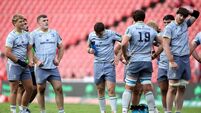
Provincial glory reliant on strong clubs
Having highlighted concerns in this column recently with regard to the future of many of our contracted players post-World Cup, the spotlight has now shifted worryingly to those occupying the positions directly below the international squad.
Events of the past few weeks indicate an alarming trend in the departure of quality provincial squad members. Ulster duo Justin Fitzpatrick and Mark Blair have decided to follow the route taken by Trevor Brennan last season and head for more lucrative pastures in France. While I can understand such players in their late 20s opting to maximise their earning capacity abroad, it is a very worrying trend to see some of our best young talent exercising the same option. Connacht has seen the departure of two of the country’s most promising young players, with Gavin Duffy set to join Harlequins and Johnny O’Connor moving to Wasps; and this was followed up last week with the announcement that Munster’s Mick O Driscoll is off to Perpignan.
Much has been written about the lack of options available to Munster when looking to their bench against Toulouse. This does not reflect on the players who occupy those positions, more on the perilous state of the finances available to the Irish sides.
More than ever, rugby has become a 22-man game. When England won the Grand Slam in Dublin, they started the game with five Lions on their bench. With Leinster struggling to contain the Perpignan pack in their European semi-final, what would their management have given for the option to spring Brennan and Bob Casey from the bench? Unfortunately, at the end of last season they chose to ply their trade elsewhere.
The lack of real strength in depth has been a major factor in Munster’s failure to take the final step in winning the European Cup. That is why the loss of O’Driscoll to Perpignan is even more alarming. At 24 years of age, O’Driscoll’s best rugby is ahead of him. One can understand the frustration of having to compete with the likes of Paul O’Connell and Donncha O’Callaghan for a place.
However, he has started a very high percentage of games this season and the competitive nature within the squad has resulted in him playing the best rugby of his career. Indeed, his performance against Gloucester in Thomond Park was his finest in the Munster jersey. All would be better served by O’Driscoll staying in Ireland and exerting more pressure on the existing second-row partnership.
Without this strength in depth, the provincial sides will struggle in Europe. The competitiveness of our provincial sides has been paramount in retaining the services of Ronan O’Gara, Peter Stringer, Denis Hickie and Brian O’Driscoll. Any reduction in that will only serve to make it easier for our established internationals to fly the coop when their contracts expire at the end of next season.
Of even more concern to Munster’s future should be the failure of any of their club sides to attain a top-four spot in the All Ireland League. Limerick now only boasts two First Division clubs due to the relegation of both Young Munster and UL-Bohemian in successive seasons. While Dolphin’s promotion is some compensation, it is imperative for Munster the clubs stay competitive.
There is no question the foundation for Munster’s recent success can be traced to the dominance of Shannon, Garryowen, Cork Constitution and Young Munster in the first eight years of the league. A competitive instinct and the will to win were nurtured in the club arena. Any dilution in these characteristics will be to the determent of Munster in years to come.
There is no question the clubs have borne the brunt of the success enjoyed by our provincial sides in recent times. Even the AIL semi-finals last weekend failed to capture the imagination of the rugby public. Closer to home the Munster Senior Cup final between Midleton and Shannon on Monday became one of the best-kept secrets in the fixtures calendar. That was a pity as it was an excellent game and, overall, the clubs deserve better.
Unless the IRFU can address the situation that sees our prominent provincial squad members departing, then the likelihood of any of our provinces winning the Heineken Cup will become even more remote. If they fail in their duty to provide a meaningful role for the clubs, then all the success of recent seasons could be undone.
CONNECT WITH US TODAY



Be the first to know the latest news and updates