NZ leave us black and blue
With 15 changes to the team that dispatched Grand Slam holders Wales with ease, O’Sullivan’s first reaction must have been one of relief.
Any side minus the services of Tana Umaga, Dan Carter, Chris Jack, Jerry Collins and Joe Rococoko must, in theory, be seriously diminished. That said, the prospect of losing to what many saw as a shadow New Zealand side must have also induced a sense of trepidation for O’Sullivan’s management team. Damned if you do, dammed if you don’t.

Henry’s selection policy has created something of an outcry back in New Zealand. The notion of All Black Test jerseys being distributed to all and sundry has created minor hysteria. However, my former Lions companion has a clear vision of where he wants this New Zealand squad to be when the World Cup comes around in 2007. On the back of this performance he is well down the road to achieving his ultimate goal.
In the process, he also managed a con job on the Irish public given that eleven of the All Blacks starting team on Saturday enjoyed game time during the test series against the Lions. In truth, Henry had selected both teams for the opening games against Wales and Ireland before the squad ever left home. The side that played against Ireland had prepared fully for this game for the last two weeks.
Despite the complete change in personnel, the pace, power and distribution skills that were so evident in the series against the Lions looked even more awesome in the flesh.
In particular, every one of their forwards looked completely at ease with ball in hand.
On Friday evening I met up with my former comrade in arms and his management team. When news filtered through that a fire had broken out in Lansdowne Road, there was a genuine fear that their assault on the Grand Slam had literally gone up in smoke. It was a revealing insight into their psyche.
Despite the pre-match tensions, New Zealand’s haka was treated with respect from the majority in attendance. In fact, the spontaneous outburst of the Fields of Athenry at its conclusion surpassed Australia’s efforts at Waltzing Matilda and even the Welsh signature tune Bread of Heaven. Sadly, after that the crowd had little to cheer about.
For Ireland to have any chance of competing, it was imperative that they dominate primary possession. In this respect there was cause for optimism as the Irish front five were infinitely more experienced with a collective 211 caps against New Zealand’s 72.
In recent years, Ireland’s platform for success invariably came from dominance in the line out. With this in mind, New Zealand refused to kick directly to touch in an effort to frustrate the home side. So successful was this ploy that Shane Byrne was only afforded three throws in the entire first half. This showed the manner in which the visitors were in control. More worryingly, Ireland managed to lose two of those. The only measure of consolation was Donnacha O’Callaghan’s success in pilfering a number of New Zealand’s throws.
Ireland’s scrum was also encountering serious difficulties, not helped by the fact that the back row failed on a number of occasions to bind with the front five. This seriously diminished the power of Ireland’s engagement.
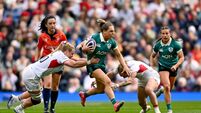
With a surplus of possession, New Zealand’s numerous ball carriers wreaked havoc on Ireland’s defence. Such was the explosive power displayed with menacing regularity from Sione Lauaki and Ma’a Nonu that it invariably took two or three bodies to stop them. Their ability to play the ball out of the tackle inevitably led to overlaps across the pitch.
Ireland also fell into the same trap as Wales last week in attempting to play a wide game from too deep in their own half. Ronan O’Gara is one of the best tactical kickers on the international stage but on Saturday he seemed strangely reluctant to put boot to ball. Perhaps they were too wary of the counter attacking ability of New Zealand’s back three.
When Ireland failed to capitalise on their best period of pressure prior to the break, New Zealand reacted in the only way they know how - an outstanding breakaway try from Sitiveni Sivivatu. At half time the game was well and truly over.
While Ireland displayed characteristic courage and resilience in the second half, one could only sit back and admire the multi-skilled nature of the All Blacks.
Watching New Zealand over the last few years, Aaron Mauger in midfield has been an unsung hero. He is the guy that makes things happen. His range of distribution skills was unrivalled by any of the home side and two outstanding 30 metre passes off his left hand were true poetry in motion. When Piri Weepu secured a perfect mark on the retreat five metres from his goal line under severe pressure, one fully recognised the gulf in class between the two sides.
The most frightening aspect of Saturday’s display was the realisation that when Henry sits down to select his starting 15 to face England next Saturday, it is likely that no more than five of last Saturday’s team will make the starting blocks. As a safety valve, the New Zealand bench was packed with experience should the need arise. The fact that Jack, Carl Hayman and Mils Muliaina finished the game in their tracksuits said every thing about Ireland’s challenge.
By way of contrast, Eddie O’Sullivan has very little scope for manoeuvre when he announces his side to play Australia. He will be thrilled by the display of Denis Leamy who was Ireland’s best forward. Injuries dictate that changes will be minimal but I would love to see Andrew Trimble get a run at some stage.
On Saturday, Ireland may have finished the game with three Bests on the field of play, but were distinctly second best on this occasion.