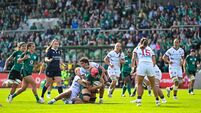
Wallabies promise to go flat out in attack
The tournament to date has been an orgy of try scoring with cricket scores being routinely posted (sometimes even on cricket grounds), but history shows that once the business end of the Rugby World Cup swings into view, crossing for five points can be as difficult as advanced algebra.
Four years ago, it was an awesome defence that conceded just one try against the USA Eagles that provided the bedrock for the Wallabies' world title and in '95 it was the boot of Joel Stransky that claimed the Webb Ellis Cup for South Africa. Even Australia's first final back in '91 was won by soaking up an inordinate amount of English pressure in Twickenham. The present World Cup sees the trend taking on an unwanted but very familiar form as Wallaby centre Elton Flatley has noted. "The biggest games so far at the tournament England-South Africa and Argentina-Ireland have been very close with not a whole lot of tries being scored," Flatley said. "In those games, teams haven't been playing attacking rugby. It's been the old game of chess, chipping away for playing territory, being a bit conservative and not wanting to be the team that makes the mistake of letting points in. Whether the trend continues, who knows? We're going out to play attacking rugby when we can and put on a full, all-round performance against Ireland."
Flatley's back-line cohort Joe Roff sees things in a more positive light and is hopeful that the emphasis on spreading the ball wide continues into the business end of the tournament.
"Certainly, from an outside back's point of view you don't want games to tighten up and become kickfests, games that are won and lost on goals," the winger admitted. "Certainly at the moment there's been a real emphasis on attacking play and scoring tries and that's been really healthy for the whole tournament. Hopefully that'll continue for the next few weeks."
Australia's attacking play has been devastating after a stuttering opener against Argentina when a litany of dropped balls and knocks-on prevented the hosts from racking up an impressive score at Telstra Stadium.
The opposition since, Romania and Namibia, may have been among the worst teams in the competition but the manner in which second-string Australian XVs relentlessly pummelled the pair of minnows was no less effective. Lote Tuqiri, who scored a hatful of tries against the Namibians in Adelaide, has barely made the bench for the Irish clash while Chris Latham, Australia's Super 12 and Test Player of the Year in 2002, can't even get on the replacement sheet.
"There's definitely room for improvement," Roff said ominously during the week. "More than anything the litmus test is going to be this weekend against Ireland and the rest of the tournament from here on in."
Yet can the Wallabies hope to make history by retaining their title with a more expansive game ? Roff, for one, believes they can. "I definitely think so and I think that's a superb outlook on the game, that you can win matches that way," he said.
"These days there's a real emphasis on defence You're coming up against flat-line defences where you're provided with far less opportunities than five years ago. Because of that, you have to really make the most of those opportunities and capitalise on them.
"You'd hope the World Cup final is not won on the strength of one man's kicking game but, having said that, most of the finals so far have been and you can't deny that fact. In that sense, trying to win a World Cup by scoring more tries is probably an idea a little out of left field but it could work."
Despite the talk about playing 'the beautiful game', the Australians have shipped some embarrassing defeats in the last 12 months, but Roff feels his side are on the right track.
"It's definitely something we needed to work hard on coming into the World Cup and Ireland are going to have a lot more of an attacking emphasis than some of the teams we've played in the last few weeks. Argentina didn't play as expansively as we thought they would and they are great opportunists, but one of the great plus points we took out of that game was that we didn't give them the opportunities to create try scoring chances." Ireland should have something to say about whether the Wallabies can hope to continue that ambitious policy.