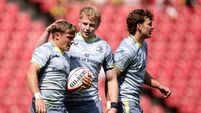
Quality Irish side deserve to bask in limelight
The Herculean efforts of our provinces in the Heineken Cup in the recent seasons, allied to some outstanding victories on the international stage, has elevated interest in rugby to unprecedented heights.
In last year’s Six Nations, Ireland entered the last day of the tournament with a winner-takes-all clash with England for the championship and Grand Slam. England proved too strong on the day. It is a tribute to this current squad that their consistency of performance sees them in line for Triple Crown glory this Saturday. There is also an outside chance of championship success. On the day, I have no doubt we would all settle for the Triple Crown.
Inevitably, Saturday’s game has evoked memories of the glory years of the 1980s when Ireland secured Triple Crown and championship success in 1982 and 1985 along with a share in the championship in 1983.
The amazing thing about these successes was they were achieved by two totally different sides, playing contrasting styles of rugby.
The 1982 side was structured around a vastly experienced pack of forwards affectionately known as ‘Dad’s Army’. Moss Keane quipped at the time that the reason I was selected was to reduce the average age of the pack. The foundation of that success was laid when Ireland toured Australia in 1979 and became the only country from the home nations to record a test series victory down under. A reflection of the strength of the forward unit was that all eight represented the Lions at some stage of their careers.
As a raw 22-year-old it was a fantastic experience to play beside some of the greats of Irish rugby. The back row combination of Fergus Slattery, Willie Duggan and John O’Driscoll remains one of the strongest ever to represent this country.
The sequence of games in ’82 mirrors that of today’s outfit. Having beaten Wales in the opening game in Dublin, Ireland went to Twickenham with low expectations in the public’s mind. For the majority of people, the outstanding memory of that game was Ginger McLoughlan’s try in the corner, when he modestly proclaimed that he pulled the entire Irish pack over the line with him.
The economic environment at the time was in stark contrast to the Celtic boom that this country enjoyed in recent years. As a result, many Irish were exiled in London. After the game I remember visiting one of the Twickenham bars with Moss Keane, a dangerous journey at any time. I will never forget the reaction of some of the Irish public who approached us with tears streaming down their faces. For those exiled in England, that victory meant so much.
Given that Ireland had not won the Triple Crown since 1949, the hype in the build up to the game against Scotland was incredible. We were training at Wanderers’ headquarters on Merrion Road on the weekend prior to the game, and over 2,000 people attended. I can still see coach Tom Kiernan putting us through an intense physical examination. Willie Duggan, not known for his fitness levels, approached Tommy and suggested that if he didn’t stop running the legs off him, he might suffer the embarrassment of vomiting in front of the watching hordes. Thankfully he relented.
The game itself was a tense affair dominated by the boot of Ollie Campbell, the outstanding player on the Irish side. While my abiding memory at the final whistle was one of relief, the reaction around the country was incredible. That Irish side remained together for a further two seasons, sharing the championship with France in ’83 and completing its collection with the Wooden Spoon in 1984. As a consequence, a number of that great team retired at the end of the season.
The class of ’85 contained seven players who won their first cap in that season. Mick Doyle was now coach and, recognising the quality of the backs at his disposal, dictated that Ireland would play an open expansive game, keeping the ball in hand at all times. The opening match was due to be against England, and it famously prompted their coach Dick Greenwood (Will’s father) to make the immortal prediction that Ireland would have to undergo a “brain transplant” to change their style of rugby. That came back to haunt him.
Coincidentally, as in ’82, our opening game of the tournament was postponed due to snow.
The forwards contained only three survivors of the ’82 vintage, captain Ciaran Fitzgerald, Phil Orr and yours truly. In the build up to the postponed England game, we trained with Doyle’s ‘give it a lash’ style in mind. There was a remarkable spirit of adventure in that side but nobody was too sure how the new running philosophy would work.
The postponement of the England game meant it would take longer to find out. Further doubts were created by the fact that our first game was now against Scotland in Murrayfield, who had won the Grand Slam the previous year. Remarkably in the first minute, Ireland ran from deep and would have scored but for a knock-on in the corner by Hugo MacNeill. Ireland won a remarkable match with a last ditch try from Trevor Ringland.
After a 15-15 draw with the French in Dublin (thus denying a potential Grand Slam) we travelled to Wales where Ireland had not won since 1967. That game was won in the dressing room of the old Cardiff Arms Park. 15 minutes before kick off, you could hear the remarkable Welsh singing.
In the past, this had effected some Irish sides. This young group of players found it inspiring and vowed to link arms and sing along with the Welsh national anthem. The performance of the Irish back line that day was outstanding and led to a famous victory.
Two weeks later the postponed England game remained as the only obstacle to Triple Crown glory. With a philosophy of running the ball, you can imagine the disappointment when the heavens opened three hours before the game. The spirit and character within that side was largely responsible for coming from behind to win with the fantastic Michael Kiernan drop goal.
This Saturday, Ireland bid to become only the seventh in Irish rugby history to achieve Triple Crown success. After their remarkable win against England in Twickenham, they deserve their place in the history books. Only four Irish captains have shared those Triple Crown successes.
Our skipper, Ciaran Fitzgerald was a truly inspirational figure, highly respected by all the players. Since the day he entered the Irish squad, Brian O’Driscoll has possessed the Midas touch. Remarkably, he now has an opportunity of leading Ireland to history on the day he wins his 50th cap. What a milestone that would be.