When defeat becomes a national crisis
As a consequence of last Saturday’s defeat to Gloucester, it looks as if this season will be no different.
In the aftermath of such a defeat, the prophets of doom emerge with increasing regularity.
Yet on closer examination, Munster’s progress in this competition is very much in their own hands. At the half way stage of pool qualification, only three of the 24 competing sides remain unbeaten.
One of those, Edinburgh, is an unlikely addition given that no Scottish side has ever reached the quarter finals of the Heineken Cup to date.
The man who may have most cause for concern after the weekend sequence of games is national coach Eddie O Sullivan.
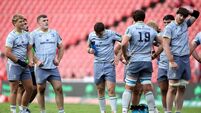
In recent times, the Irish pack has been made up exclusively of players from either Munster or Leinster. Yet both forward units played second fiddle to opposition that is likely to provide only one English forward, Trevor Woodman, in the Six Nations championship.
On the international stage, Ireland’s lineout is hugely competitive at the best of times and highly rated at that level.
Similarly both Munster and Leinster have always been extremely efficient in this phase of play. The fact that both experienced difficulties over the weekend can directly be attributed to the lack of preparation time available to the squads as a result of the demands of the national team over the Christmas period.
More than ever, success at the lineout depends on the ability of the mini units of jumper, lifter and thrower working in unison.
Success is very much dependant on constant repetition on the training ground. With the benefit of a further weeks-uninterrupted training, I expect both sides to produce a far more cohesive performance from this phase of play in the return matches this weekend.
As a result of demands imposed by the build up to the World Cup, Ireland’s national players have spent 23 weeks in hotels in 2003.
Restrictions imposed by hotel living, allied to the constant travel, can be very draining mentally. Certainly, many of Munster’s terrier-like forwards looked tired and deflated as the game entered the final ten minutes. Given that they were still chasing a bonus point at that stage, this was surprising.
By way of comparison, Ulster with only four in the national squad, looked razor-sharp in their annihilation of Leicester in Ravenhill on Sunday. Their pack were outstanding from start to finish and blitzed the Leicester eight despite the presence of Ben Kay, Martin Johnson and Neil Back.
If anything Leicester’s world cup winning trio looked absolutely drained. Despite scoring thirty three points and four tries, Ulster’s most amazing achievement was the manner in which they kept Leicester scoreless, particularly in the second half when the Tigers played with the aid of a gale force wind.
While Ulster’s two most consistent performers over the past number of seasons, David Humphries and Andy Ward, were once again outstanding, some of the younger brigade also made a positive impression.
Ireland is currently awash with promising back row forwards and the Ulster duo of Roger Wilson and Neil Best are certain to challenge for international honours over the coming seasons.
For Leicester, Sunday was a truly humbling experience. Nowhere was this more obvious than when the cameras focused on former Leicester greats, coach Dean Richards and chief executive Peter Wheeler.
The intriguing thing about this stage of the Heineken Cup is that the opportunity for redemption presents itself within seven days. It will be interesting to see how many sides can achieve back-to-back successes next weekend.
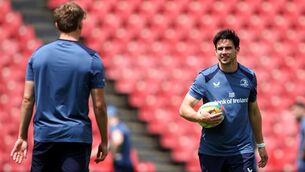
Certainly the Gloucester defeat last weekend will have the effect of focusing the minds of the Munster forward unit.
All eight are proud individuals with a proven track record. They will quickly want to put the record straight and show that the performance at Kingsholm was a blip. Saturday’s game will be totally different from the challenge that Munster faced in the corresponding fixture 12 months ago.
Given that the margin of victory had to be 27 points, Gloucester never really believed they could lose by such a score.
That comfort zone induced a hidden degree of complacency. They will hardly be as naive second time around. On this occasion any victory will suffice for Munster as I firmly believe they will win the remaining two games in their group.
The most interesting aspect to emerge from last weekend’s round of matches is that all the pre-tournament favourites have now been beaten.
Along with Munster and Toulouse, many people’s favourites for the competition, London Wasps were shocked when losing at home to the Celtic Warriors. This result was the biggest shock in the Heineken Cup since Toulouse lost to Ebbe Vale in 1999.
The newly formed district sides may have failed to capture the imagination of the Welsh public, but they are certainly performing on the field. At this stage, Llanelli, Gwent Dragons and the Celtic Warriors are all strongly placed for qualification.
At the World Cup, Wales emerged with enormous credit. This pattern is now continuing through the districts and their national side will once again be a force in the Six Nations Championship.
With less than five weeks to go to Ireland’s opening fixture, against France, it is imperative that both Leinster and Munster revert to winning ways next weekend. Ireland’s ability to compete in the Six Nations over the past number of seasons has been founded on solid performances in the January rounds of the Heineken Cup.
Success breeds success. It would be somewhat ironic therefore, if the demands of the national team impact to such a degree that the provinces struggle. Next weekend is pivotal to our representative season at all levels.