One of those ‘I was there’ days
All week Eddie O’Sullivan stressed that if Ireland had sufficient belief in their collective ability, then they would win.
When it mattered most, that inner confidence came to the fore.
From the last scrum of the game, Ireland’s playmaker in chief, Ronan O’Gara, signalled his intention to Brian O’Driscoll that there was space in behind the England back line. His chip was measured to perfection. The gods, who had smiled favourably on Ireland’s sporting aspirations all week, provided the perfect bounce for the chasing O’Driscoll.
When the ball was finally released to the supporting Shane Horgan he had no more than a fighting chance of scoring in the corner. To his eternal credit, he used every inch of his 6’4” frame to engineer one of the most important tries ever scored by an Irish winger.
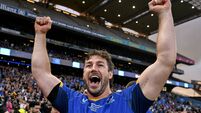
Incredibly Ireland plucked a victory and an eighth Triple Crown from the jaws of defeat in the last play of the game. In years to come those fortunate enough to be there will recall the heroic deeds of Paul O’Connell, Shane Horgan, David Wallace and others to their grandchildren. It was that kind of game.
It was also fitting that the last match of the 2006 Six Nations tournament would eventually provide a contest of true international quality, characterised by intense physicality, huge commitment and drama.
I have never seen an England side under so much pressure taking the field in Twickenham. In times past, victory over a visiting Irish team was almost taken for granted. In their minds only the margin remained the issue. Remarkably, Ireland have now recorded three successive victories over the reigning world champions, two in their own back yard.
Given the pressure surrounding everyone connected with the England camp, the try by Jamie Noon in the opening two minutes provided the best possible start. Not for the first time, Ireland’s inability to cope with an English kick-off resulted in a score for the home side.
When Ben Cohen compiles his personal highlights on video post retirement, this game will hardly feature in the collection. His inability to cope with an innocuous punt down field directly resulted in a questionable opening try for the ace poacher Horgan. If that score was responsible for lifting the collective Irish spirits, the inspirational rendering of The Fields of Athenry that followed was equally significant. It must have given the players a massive lift on the field.
To their eternal credit, Ireland recovered from the concession of Noon’s early score to control matters in the opening half. During that period, they mixed their tactics perfectly. Once again the lineout provided a stream of possession and had England under constant pressure. The superb maul generated much-needed yardage against the wind and when Ireland opted to move it wide, they looked far more dangerous than their hosts.
It was also a source of some inspiration that Leicester’s points machine Andy Goode was finding it difficult to translate his club kicking form onto the international stage. In times past, Jonny Wilkinson converted any penalty with seamless ease, as England would build a score to undermine the confidence of all opposition. Never before was the absence of England’s World Cup hero more obvious. In a game as tight as this, any penalty miss was sure to count.
Not for the first time this season, Ireland were also guilty of squandering point-scoring opportunities when opting for quick tapped penalties from kickable positions.
Playing against the wind in that opening half, Ireland’s performance was by far their best of the season. O’Gara’s kicking in that opening period was inspirational and exploited the defensive weakness of England’s back three of Tom Voyce, Mark Cueto and Cohen.
Observing from the stands, it was a source of huge inspiration that despite operating under intense pressure the Irish players looked far more comfortable on the ball. Where the massive English forwards looked for collisions at all times, their Irish counterparts attacked space. In this respect, no one did better than Jerry Flannery and David Wallace. At times they looked like auxiliary backs and one could see why Declan Kidney experimented with placing Wallace in the back line during an injury crisis.
It must have been a massive comfort for this Irish side to reach half time with a three-point lead having faced the elements. On the wall outside the Irish dressing room a series of signs are judiciously placed to remind all visitors of England’s greatest victories on home turf. On this occasion it only provided inspiration for the Irish.
On the resumption, England played their best rugby for some time when their pace and power asked serious questions of Ireland’s defence. The strength of their scrum and driving maul was also creating serious problems, a point recognised by Eddie O’Sullivan by the early introduction of Donncha O’Callaghan.
Every game has its crucial moments. This was no different. When England squandered a kickable penalty opportunity for a lineout in the corner, the arrogance that characterised the Woodward era reemerged.
When Paul O’Connell stole the resultant lineout from England’s throw, every Irish person in Twickenham rose to their feet. It was truly inspirational. In such moments, games are won and lost, legends are born. While England subsequently scored through Steve Borthwick, the “never say die” attitude, exemplified by O’Connell in that incident, swept through the team.
When it mattered most, Ireland’s key individuals held their heads. On one occasion Mike Tindall spilled the ball yards from the Irish line when a try seemed on. Not so long ago, Ireland would have buck rooted the ball into touch. This time, despite regaining possession in his own in-goal area, O’Driscoll had the composure to move the ball wide to O’Gara who cleared it 40 metres upfield.
When Andy Robinson introduced the cavalry in the shape of Lions trio Steve Thompson, Danny Grewcock and Matt Dawson for the final quarter, Ireland faced the ultimate test. When their arrival coincided with the harsh sin-binning of Simon Easterby, it looked as if Ireland’s fate was sealed.
Under Martin Johnson, England didn’t know how to lose. On a famous day for Irish rugby, this sixth sense sat more comfortably on the shoulders of Ireland’s experienced players. When O’Gara orchestrated Ireland’s last minute winning salvo, all around me people spoke of the luck of the Irish. In sport, you make your own luck.
This Irish side have enjoyed mixed performances throughout the season without ever reaching their true potential. But when it mattered most, they delivered. To win a Triple Crown away from home in such circumstances must provide huge confidence for the future. That’s for another day. For the moment this team has provided a special memory, one that means all Irish present will be proud to say “I was there”.