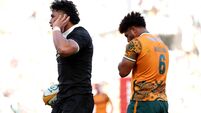
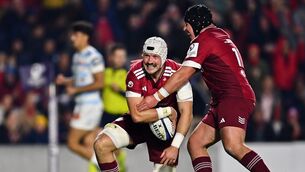
Tactically we got it spot-on
For Wales, the drawn expressions were those of men facing the firing squad on their return to the valleys.
The past fortnight has been a difficult period for both teams for different reasons. Ireland’s defeat in Paris and the manner of their first-half performance left many question marks hanging over their current wellbeing.
A victory by 26 points over the Grand Slam holders has addressed many of those questions.
Acting Welsh coach Scott Johnson had talked up his side all week and promised that when the going got tough Wales were more than ready for the challenge. Alas, the fallout from the “Ruddockgate” affair has proved too much. This was also the day that the accumulated loss of so many players to injury finally took its toll on the Welsh. Nowhere was this more obvious than in the leadership stakes where the absence of talismanic captain Gareth Thomas certainly told.
Scotland’s victory over England at Murrayfield on Saturday presented Ireland with the perfect opportunity of re-launching their assault on this year’s championship after the defeat in Paris. Yesterday’s victory has injected a renewed confidence within the squad for the challenges that lie ahead.
From the outset of this season Eddie O’Sullivan has attempted to alter the manner in which Ireland play. If in the past Ireland relied heavily on a kicking game, in recent times they have reverted to the opposite extreme in an effort to achieve more width. Yesterday Ireland achieved the perfect mix and tactically were spot-on. When they drove their first lineout at 20 metres one suspected that the lessons of Stade de France had been absorbed.
That said, the opening 20 minutes was fraught with danger when Ireland once again were very slow out of the blocks. Wales dominated the opening period to such a degree that serious questions were being asked of Ireland’s defence. Mentally, Wales were right on their game and when Mark Jones scored after four minutes the home side were in trouble. Little did we think that it would be their only score.
Without question, the loss of Stephen Jones after 19 minutes had a traumatic affect on the visitors. Already without Thomas, Shane Williams, Tom Shanklin and Kevin Morgan, Wales could ill afford another injury. Even more telling was the fact that his replacement Gavin Henson has been an absentee from the Welsh squad for the last 11 months. This at times controversial figure, looked devoid of confidence from the moment his arrival was greeted by a chorus of boos.
One suspected that not all the detractors were Irish.
Thereafter the Welsh performance collapsed. Jones had been central to the positive opening by Wales and the excellence of his continuity game asked serious questions of Ireland’s defensive organisation. By way of contrast, Henson kicked where Jones would have passed.
As the game progressed Henson became a forlorn figure and got little support from his teammates.
Ireland, playing with the aid of a strong wind in the first half, weathered the early storm and grew in confidence as the half progressed. Denied possession in the opening stages, it took 23 minutes before they entered the opposition 22. It was a source of tremendous satisfaction, therefore, that they managed to score their opening try from their first period of sustained pressure. When Denis Leamy was held up over the line from another quick tapped penalty, shades of Paris re-emerged. However, from the ensuing scrum David Wallace was positioned in the number eight slot and his power provided Ireland’s opening score. From that moment onwards Wales were in trouble.
The Irish lineout was excellent throughout and had Wales under extreme pressure. In this respect Malcolm O’Kelly was outstanding and responded to recent criticism with a solid performance. Alongside him, Donncha O’Callaghan also had another excellent outing and his workrate from start to finish was superb. More importantly, Jerry Flannery’s line-out throw-in was spot on and he is emerging in recent months as a quality international.
Given the difficulties experienced by Ireland in the opening quarter, Eddie O’Sullivan would have been thrilled to reach half-time with a six-point lead.
When Shane Horgan scored four minutes after the resumption, the game was over as a contest. As Ronan O’Gara was preparing to line up his conversion attempt, Welsh loose head Duncan Jones hobbled off almost unnoticed. With his departure, the Welsh scrum, which had looked menacing early on, ceased to be a threat. Indeed, Ireland even managed to secure the only ball against the head.
With points difference likely to decide this year’s championship, Ireland will be slightly disappointed that despite controlling both territory and possession throughout the second half period they failed to score another try until deep into injury time. With a long delay due to an injury to Marcus Horan, Ireland understandably lost their momentum. Overall, O’Sullivan will be delighted with the response from the players and can look forward with confidence to this season’s surprise package, Scotland.
It was very evident that once the Irish forwards produced quick ball this current back line can be devastating. Shane Horgan was magnificent in defeat in Paris and on this occasion was worthy of his man of the match award. It was also encouraging to see Andrew Trimble recover from a difficult start to impose his undoubted talents on proceedings.
While Scotland will provide a different type of challenge to that experienced yesterday, Ireland can now move forward with confidence.
For the Welsh the bitterness that has dominated the last two weeks will only get worse.
CONNECT WITH US TODAY



Be the first to know the latest news and updates