Broken up in every sense: The extra weight too many jockeys carry
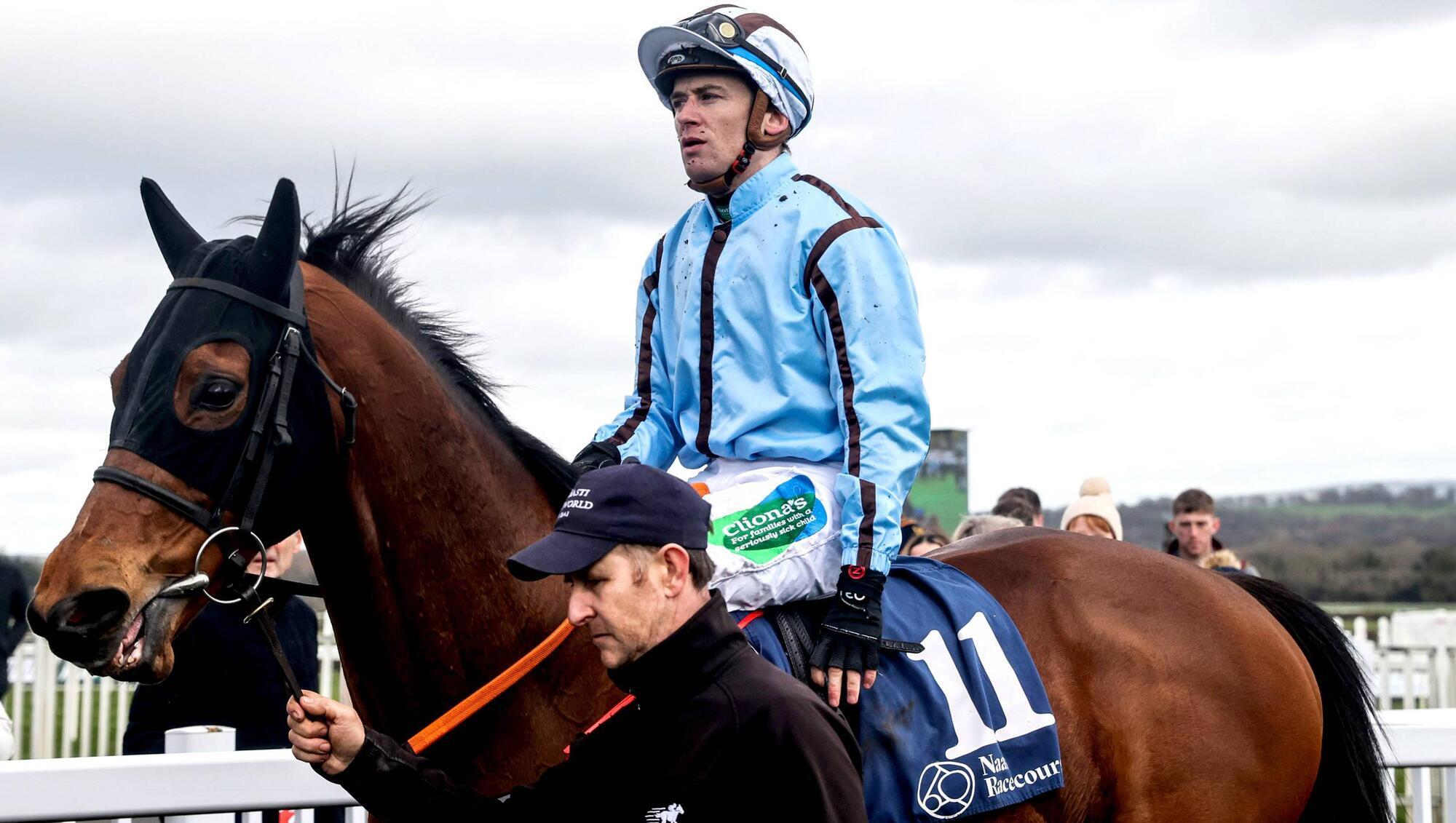
STEPPING BACK: Mark Enright onboard Chazzesme after winning the King Of Change Handicap in Naas in March. Pic: INPHO/Tom Maher
We all know the difference between the type of sportspeople revered by supporters and those deemed worthy of a place on the pedestal by colleagues.
The athlete who scores the most goals is the star but the inner sanctum values character and selflessness. Think Will O’Donoghue and Bonner Maher. Think Peter O’Mahony. Think Alexis Mac Allister.
Think Mark Enright.
The Limerick jockey draws the curtain down on his professional career in the saddle in fitting style with a ride at in the Tattersalls Irish 1000 Guineas at the Curragh on Sunday.
He only turned 31 last week and began the year in red-hot form, registering ten winners for the year before Friday night’s action at HQ, six already in the turf season.
Enright has had a good career as a jockey, one of a select group to ride winners at every track in Ireland, prestigious races such as the Galway Plate among them over fences before going for a significant and literal change of pace by committing himself full-time to the Flat game, where he added a Group 3 to his CV. Prior to Friday night, he had booted home a total of 220 winners.
But the freelance grind has taken its toll. The tormenting ritual of hot baths, starvation and dehydration to make weight for too many horses with no chances leaves a physical and mental mark. So too the miles in the car and the long days.
Then there’s processing the disappointment of not getting rides, especially when jocked off a horse you won on last time out, with a higher profile pilot getting the nod. It’s an occupational hazard for the journeyman but you would want to be made of stone to not be hurt by losing another potentially career-making association.
And let’s not forget the injuries, which given there is a new crop of jockeys licensed every year to go with the existing bunch, means you become yesterday’s news very quickly.
Enright broke his back twice, his legs, hands, arms, shoulders, collarbones.
It’s a cocktail that amounts to your trademark Chinese water torture scenario. No wonder studies have shown jockeys to have a far higher incidence of depression than what is normal for high-performance sportspeople, a category that in itself has elevated issues of mental health compared to the general populace. One, funded by the IHRB and carried out by Waterford IT PhD student Lewis King, found that eight out of ten Irish jockeys met the criteria for common mental disorder.
Sadly, two jockeys, Grand National winner Liam Treadwell and James Banks, took their own lives in England in 2021 and 2020. The dangers are clear and present.
Fish, as he is known universally, didn’t set out to become a mental health advocate. He wasn’t being a team player when breaking this particular weigh-room taboo and admitting he suffered from depression. He didn’t even know he was sick. He was just in despair. He wanted the pain to end and in his mind, overdosing on the pills he had been stocking up over a period of time was the only way to do that.
It was early in 2015, as he walked to his home in Kildare town after a couple of pints. Over the previous three days, he had said his goodbyes to all his friends, not that they knew that was what was happening as they partied.
Mark Walsh was one he had not met though. So when he spotted the car outside the house as he passed, he went in. Enright broke down crying over a cup of tea. Walsh contacted Adrian McGoldrick, who was then the IHRB senior medical officer, and the ‘The Doc’ arrived within minutes. It didn’t take him long to make a diagnosis and arrange treatment at St Patrick’s University Hospital.
With the help of counselling and anti-depressants, plus a few other tools he has developed, the father-of-one is unrecognisable from the man who could take no more.
We know all this because he has spoken about it in interviews, shattering the destructive wall of silence that was founded on misplaced masculine pride and a pathological fear of showing weakness, by explaining his recent absence from the saddle.
Many more followed and the awareness is stratospheric compared to what was for many, a dirty little secret. Only a little over a fortnight ago, Enright featured in a short film by Dale Leadon Bolger, When Horses Run, that aired on Virgin, focusing on the demands of being a professional Flat jockey.
With McGoldrick first and then his successor, Jennifer Pugh, driving the process, many of the studies funded by the IHRB have been the basis for the HRI-funded supports put in place in the intervening years, which include the rolling out of a wellness app, a 24-hour helpline and access to world-renowned sports psychologist Ciara Losty. Ireland is a world leader now in the area of mental health support for jockeys.
****
He wasn't trying to be a hero but that is Enright’s legacy as he hangs up his boots.
Among the pursuits that have given him great joy in recent years is following the Limerick hurlers as they won four of the last five All-Irelands. Seamus Flanagan is a clubmate and the now-retired Shane Dowling is a good friend. Dowling is a passionate racing fan and Enright got him involved in ownership, with the Jenny Lynch-trained Dagoda running at the Curragh on Friday night.
Enright will not make his county’s make-or-break Munster clash with Cork on Sunday, as the Guineas takes place ten minutes before throw-in.
“I’ll miss the start of the game but I’ll be rushing off to catch as much of it as I can somewhere,” says a smiling Enright. “Hopefully it will be after a good run with Aspen Belle for Fozzy (Stack). If we could be placed it would be great.
“I’ve had great time following the hurlers. Hopefully they’ll get through it and I’ll get a few more days out following them during the summer.”
Now living in Trim, he has been riding out primarily for Stack and Ger Lyons and emphasises how important their support has been in the past couple of years. Overall, there are too many good people to mention and he doesn’t want to insult anyone but the late Dessie Hughes, Mouse Morris, John Nicholson, Davy Russell and Robbie McNamara are just some of those that mentored him over the years.
And, of course, McGoldrick.
He had planned on calling it quits at the end of the winter all-weather season but Stack, who is renowned for starting the turf year well, persuaded him to hang on for a little while longer. It has worked out well but now is the hour.
“I’d no job. If I’d a yard of 30, 40 horses to ride I’d love to keep going and stay doing it, but when you’re freelance driving around the place it’s too hard. It’s impossible. I’d be looking at lads the last couple of years retiring and saying, ‘I never worked a day in me life. I have to start working now.’ I feel like I’ve worked every day of me life, you know?
“I was thinking about it a long time. The sweating is fucking torture. And with the saunas gone – and they’re probably gone for a good reason – but I just found it very hard.
“Just say I was going to Fozzy’s of a morning, I’d be doing my sweating here at half-seven, eight o’clock the night before, getting out of the bath at half-ten. Up then at half-five, drive down to Fozzy’s, ride a load of horses’ work. Just say drive to Sligo then or some place. My ride mightn’t be till 8pm but I’m dehydrated all day. I just found that very hard and it was probably all for one shot anyway, you know?”
Making weight had never been an issue over jumps. But the injuries just kept piling up. While he’d have to work harder to make weight on the level, and he would miss the rush of firing a horse at an open ditch at 30mph, not being catapulted into the ground and being stood on by a passing horses on the other side was the prize.
“Bottom weight over jumps was never any issue to me but I kept getting broke up. Three times in (2019) I got broke up. I broke my shoulder in the Irish National (in April), then on the Wednesday at Galway (at the end of July), I broke my shoulder before the Galway Plate. I was stood down and I went to (surgeon) Paddy Kenny and said, ‘I’ve a ride in the Galway Hurdle (the next day) and I’ve a couple of good rides for the rest of the week.’ He said, ‘Get John Butler, the physio, to strap you up and you’re going to have to take a month off after this to let the shoulder heal again.’
“I finished second in the Galway Hurdle on one of Henry de Bromhead’s (Due Reward). Went out on the Friday, got another fall and was sore. Filled up with painkillers and went out to ride in the Blazers. I fell at the second fence, broke my back and made shite of everything.
“Then I was only back a while and I got a fall in the Troytown (in November). The horse stood on my stomach and I’d to get an operation. So I missed most of the season and by the time I did get back, I’d nothing to ride. So I said we’d give the Flat a go.”
Winning on Hell Left Loose at Laytown in November 2021 meant he had been victorious on every course in the land.
“That was a big thing. Dare I say it, a lot of lads wouldn’t even think about it but it was something I was trying to do a couple of years and Laytown only happens once a year… it was good to get it done.
“The Galway Plate was brilliant. I rode in two Grand Nationals, which I never thought I’d do. I rode over the Aintree fences four or five times. Great buzz. Really enjoyed that.
“I rode a winner in my father (Jerry)’s colours in Dundalk over the winter for Jenny Lynch and Barry Cash, which was great.”
But all that couldn’t sustain him.
“Lads say you only need to find one to get you to the next level. I found plenty of them but you win maidens on them, or you find them at home in the gallop but they’ll get the top boys to ride them. It’s easy find them, but it’s not easy to get on ‘em.
“Now the craic was mighty in the weigh room. I love that bit of craic with the boys.”
Such as the time when an unnamed colleague arrived in moping after it had all gone wrong in the previous race and Rory Cleary directed him to “Go down to Fish there, he’s tablets for that.”
Some might wince at that, but it was important for Enright after he returned to action that he would be treated no differently to before. Cleary showed there was no stigma. The buy-in and use of the mental health supports being made available to Irish jockeys is proof that they see no weakness in Enright. Only strength.
“Before I came out about it, there was nothing there, as such. I didn’t even know what it was, to be honest. And now there is so much being done for it and it’s being spoken about a lot.
“To me, the world was over. ‘Where do I go from here? I’m in a hole; how do I get out of it? There’s no way out.’
“Then I’d a man sitting beside me writing down stuff on a notepad and I’m bawling crying and next thing he turns around and says, ‘Yeah. All good. We’ll have you sorted in no time.’ That man. He’s some man. Words can’t describe him really.”
The spectre remains in the shadows the whole time but Enright is now equipped to keep him there, for the most part. If he has woken up and the form isn’t good, or the sweating has really gotten him down, he’ll go for a walk, or put on a Spotify playlist. His six-year-old old daughter offers the most soothing balm.
“Sophie has been a massive help. She doesn’t care. Sometimes, if I have to, I’ll Facetime her when I’m away and feeling down. She’s giving out that the head has fallen off Barbie, or ‘I can’t find my hair bobble.’ It brings you back down to earth again.”
The lifestyle and the realities of his job just weren’t helping him though.
“It’s everything building it up. There’s the sweating but declaration mornings, for a freelance jockey anyway, can be the worst. You’re thinking, ‘I wonder will I ride that,’ and someone else is on it. You might have five mornings of declarations a week and three of the five will be, ‘Jesus, I’ve no ride,’ or ‘Why am I not riding that?’ or ‘What did I do wrong on that the last day?’ That’s hard. Whereas if you had a job with a yard of 30 or 40 horses, at least you’d be able to look at the entries and say, ‘I’ll be riding that.’ I’ve never had that.
“I probably just had enough of that. I’d love to keep doing it, because I love race-riding, I love the weigh room and I enjoy going racing but it takes its toll after a while.”
No matter what your level of talent, confidence is shattered by riding slow horses. Every decision, in a race where milliseconds can make a difference, is second-guessed. It’s self-perpetuating then. No-hopers, losers, confidence on the floor, less opportunities. Rinse. Repeat.
That’s all behind him now. He has a few plans in the pipeline and hopefully won’t be lost to racing, whatever the future entails. He likes the idea of pursuing a new path while still young, rather than having fewer options in ten years’ time.
It is heart-warming to hear him speak enthusiastically about what lies ahead.
“I don’t like the word retirement. Old people retire. I’m stepping away. I’m not going buying a house in the south of France. I’ll still be working for a living. I’m turning a page, I’m not closing the book.
“I was a long way from a very good, natural rider and I made do with what I had. I tried my best and sometimes your best isn’t good enough. I wouldn’t say we succeeded but we didn’t fail either. I emptied the tank. I gave it everything and we’d great craic doing it as well.
“It’ll be lovely to be able to say, ‘I’m going there Sunday week,’ and not be worrying about will I be riding or won’t I be riding. Just being able to make plans. Being able to say, ‘I’m definitely going to that,’ rather than having to wait until Friday morning to find out. I’m looking forward to that.”
Simple pleasures, taken for granted. And well deserved.
Not all heroes wear capes.