Sean Levey was the first black jockey to do pretty much everything
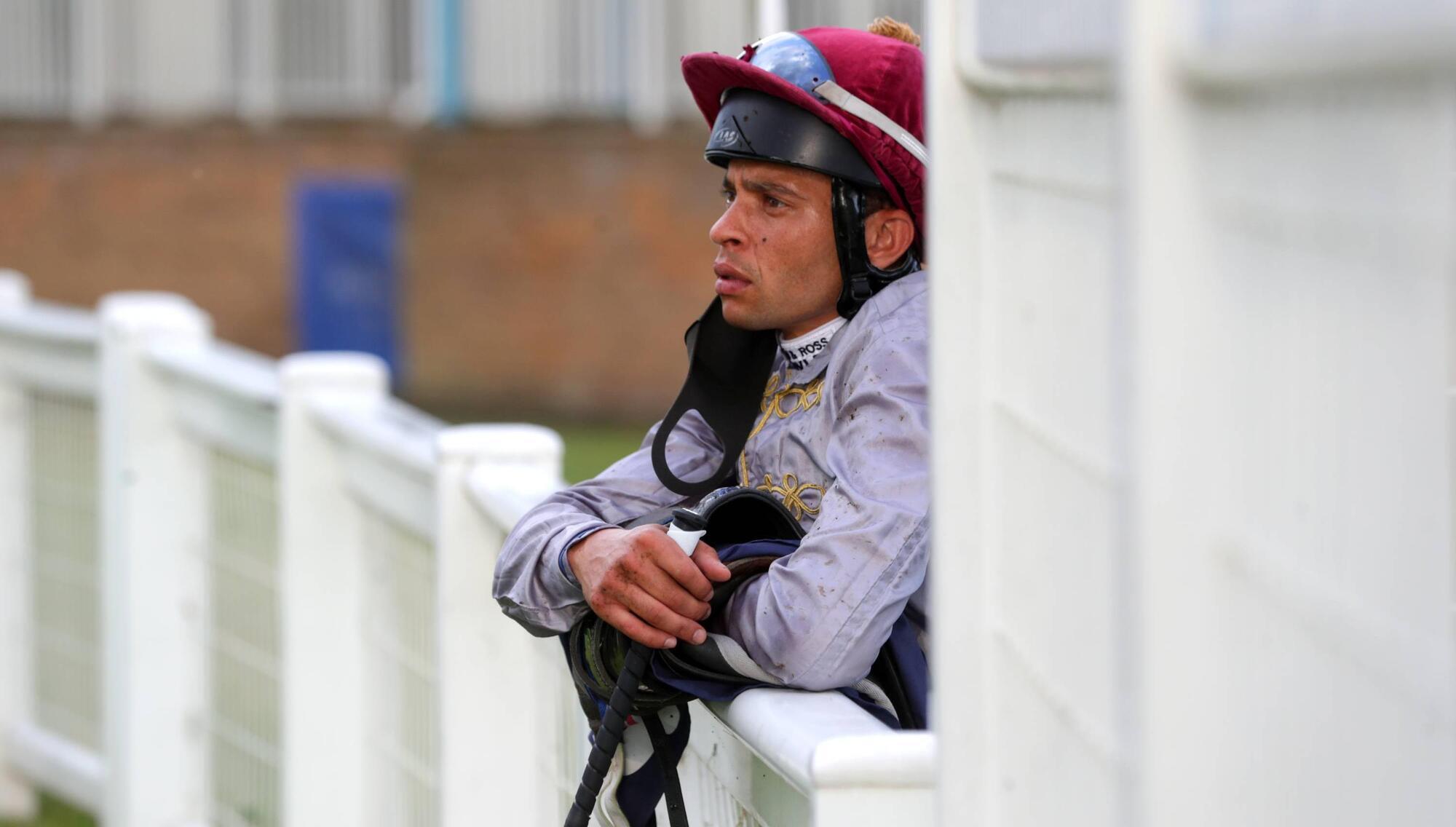
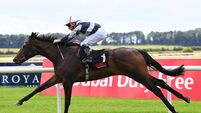
DREAMING OF GLORY: Sean Levey would like nothing better than to ride a Group 1 winner in Ireland. ‘It’s one thing I’d love to tick off my bucket list,’ he says. Pic: David Davies-Pool/Getty Images
The cacophony of glass shattering from ever greater heights has been a joyous soundtrack to horse racing in recent years, even if the sport’s slight self-congratulatory tone surrounding the stunning feats of Rachael Blackmore and Hollie Doyle have grated at times. After all, those ceilings didn’t erect themselves.
Of course Blackmore and Doyle’s record-breaking achievements have been built on the gradual gains of others that were in themselves, monumental, from pioneers such as Jean O’Connor and Helen McDonogh right through to Nina Carberry, Katie Walsh, and Hayley Turner.
For some reason, particularly given that there hasn’t been that level of painstaking evolution for black jockeys, what Sean Levey has been doing has gone a little more under the radar. But then that was how it was for the initial trailblazing women too and unlike non-Caucasians in this part of the world, they form half the population.
Levey was the first black jockey to do pretty much everything. For starters, he was the first to ride in Ireland, where he won four group and listed races as a youngster based with Aidan O’Brien at Ballydoyle and rode in Irish Classics, as well as the Prix de l’Arc de Triomphe. He was the first to participate in the Epsom Derby (finishing fifth in 2016), the first to win a Classic and thus a Group 1.
No more than Blackmore, he isn’t doing it to be a totem but realises the power of a visible role model. It will be a lengthy process, he maintains, but the time will come when there will be more black riders in these parts.
He doesn’t view racism to be the primary stumbling block, or for it to be any more prevalent within racing than in general society. Black people haven’t seen it as a viable option for them yet but seeing him prosper at the highest level on a consistent basis should gradually chip away at that.
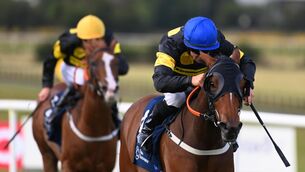
The 34-year-old has booted home 37 group and listed winners and is now hitting his peak. Certainly, the ride on Aristia to bag his fifth Group 1 in the Prix Jean Romanet in Deauville last Sunday was the work of a pilot oozing with self-belief, a masterclass in tactical nous and pace judgement from the front.
He had a willing partner, the four-year-old sticking her neck out to just deny Bansha conditioner Paddy Twomey his first Group 1 triumph with the Billy Lee-ridden Rosscarbery. Victorious trainer, Richard Hannon praised the man who has been connected with East Everleigh and Herridge Stables in Wiltshire for more than a decade.
“Sean has given her a lovely ride and it was his idea to make the running,” he said. “Our last five Group 1 winners, he has ridden them. It is great for him – he is a very good jockey.”
The African-born, Tipperary-reared son of a Dublin man and Eswatini woman delivers his own verdict in an accent that he describes as “all over the place” as a result of spending a third of his life each in Swaziland, as Eswatini was until 2018, Ireland and England respectively.
“It was fantastic. They’re hard to come by. I thought she had a chance in that race as a lot of things suited her on the day, with the draw, the track and the ground. At the same time, she was after stepping on from a great run (when second) behind a very good filly of the Gosdens’ (Nashwa) in the Nassau. You’d have been wrong to write her off.
“On a flat track with a big, long swooping bend, we decided if we got a chance to dictate in a race with no pace in the race, that it would be of benefit to us.”
As Mike Tyson said, everyone has a plan until they get punched in the mouth but there is now a higher level of analysis in racing than would have been the case in the past, particularly with the advent of sectional timing. Utilising that along with ground conditions, pace, draw bias and a slew of other factors for both your own horse and the opposition to formulate plans A, B and C is helping riders find that extra per cent or two that all high performance athletes are chasing.
“You’re talking about a sport where seconds can mean a lot. A couple of seconds can mean a length. At the top level anyway, that’s enough to win or lose. I think a lot of sports have gone like that, haven’t they? You’re talking the evolution of sport, you only have to find a second to put you in front and that’s the way racing is gone because that’s how competitive it is. With the information there to be sourced, I think you’re doing yourself an injustice by not taking it in.”
The first winner came courtesy of I Key for O’Brien in a two-year-old maiden at Cork on July 31, 2005. Three years later, Levey booted home his first listed and group winners on the interestingly-named Hindu Kush and Psalm. In 2010, he registered 16 successes in Ireland but Johnny Murtagh, Colm O’Donoghue and Seamie Heffernan were ahead in the pecking order and the trainer’s son Joseph was already making a name for himself.
So he took the plunge and made the second big move of his life in 2011. Initially, he went to David O’Meara for six months but then switched to the south west to link up with Richard Hannon Snr and he has been there since, becoming an ever more vital cog in the operation as the licence passed onto Richard Hannon Jnr.
Levey hit the ground running and he has accumulated more than £9.8m in prize money for connections in his time across the water. He began with 34 winners in 346 rides in the first calendar year. That figure rose to 66 two seasons later and he has been in and around that mark ever since, with 73 from 568 rides at a 13 per cent strike rate in 2017 the high water mark in terms of quantity.
This year, he is operating at 14 per cent, a rate he managed in 2015 and 2019, and prior to yesterday’s card at Ffos Las, was already on 54 winners, with triumphs at Royal Ascot and York’s prestigious festivals included.
That’s important because quality is what really gets the juices flowing. In that respect, 2019 was a breakthrough. Among the 66 winners were four from Billesdon Brook, the 1000 Guineas the obvious highlight.
“I was so long riding,” he recalled earlier this week. “Everyone’s dream at the start of it all is to ride a Derby winner. Then over time it turns to any Classic, and then it turns to any Group 1 will do. There was no doubt I was at the stage of any Group 1 will do, but that’s racing, right? As luck would have it, you ride a 66/1 shot and it ends up winning a Classic for you.
“I felt a great sense of relief because I was starting to think I’d never get a bloody Group 1.”
******************************
It was all a far cry from him when he and his younger brother Declan crawled around a course in Swaziland’s Ezulwini Valley on their hands and knees, hopping over two-and-a-half-foot jumps to show their horses how to it should be done.
His late father, Mick told that story on an episode of Mono, RTÉ’s ground-breaking series showcasing the new, multi-ethnic Ireland. Aired in April 2005, it profiled the Leveys’ fantastic story.
Mick was born into a family with no background in horses and when they were young, they moved to Croydon. He got a job with renowned trainer Ron Smyth.
“He ended up riding in Germany and Switzerland, and then life got him to Africa!” He met Tini in Swaziland and as he revealed in Mono, secured her hand in marriage with a dowry of 17 cows. He would describe it as “an absolute bargain”.
Seán and Declan came along, though Seán became Sean as explaining the ‘fada’ was a non-runner. And the horses were there from the start, with Mick building Swaziland’s first racecourse, though it wasn’t necessarily love at first sight for Sean.
“In Africa, my dad had racehorses. He trained them and then he retrained them into showjumpers because that’s what the market demanded. I’ve been around horses ever since I was a kid. I sat on horses when I was very young but never took to it. But because I was never forced into it, I kind of found my own way back into it.”
Wanting to create a better future for his clan, Mick moved them back north, first to Croydon but after a couple of months, settling in Cashel.
“My dad actually went back into racing with Tony Martin but Tony referred him to Ballydoyle because he thought it might suit him a bit better.”
Sean began riding out at Ballydoyle at 13 and spent a couple of years pony racing before signing on as an apprentice. He considers his former gaffer to be on a different level to most.
“It’s his mindset I suppose and I think that’s what attracted (John) Magnier and the Coolmore team to hire him in the first place. He had a record in Piltown before he ever started training them bluebloods down in Ballydoyle. You’d be going a long way to find someone like him. Add his work ethic. His will to evolve as time changes. He’s extremely meticulous in what he does and he understands everything. It’s very hard to see all that in one person.
“You have someone like that and then you have the Coolmore business behind you. He’s in the business of training stallions and trying to find them every year. It comes with a lot of support and there’s no doubt he’s training the best breed of horses in the world but some trainers wouldn’t be able to pull it off like he does and take the pressures of having to create a stallion every year.”
The best he sat on?
“Me and Aidan used to debate it. He used to say Rip Van Winkle but I thought George Washington had the most raw ability.”
One can only imagine the shock to the system for his mother when landing in cold, damp Ireland. Sadly, Mick died of cancer just a few years later, having watched Sean’s first ride at The Curragh. But Tini made the adjustment.
“I suppose she didn’t know what to make of it. When you grow up in Africa and you step over to this side it’s a completely different world but definitely one she has enjoyed over time.”
He doesn’t recall the impact being significant on him, apart maybe from the cold and rain. Sure, he looked different to everyone else but the same had applied in Swaziland, where he was constantly reminded of being ‘latte’ due to his mixed heritage, much lighter skinned than his peers and his three half-siblings from his mother’s previous relationship.
“I grew up in Africa where there’s not many people look like me there either. It wasn’t as if I was experiencing it for the first time. Everybody was experiencing me for the first time, but vice versa, not so much. I was after living through it so I was equipped enough for it.”
Amateur psychologists might wonder if he has a sense of belonging anywhere but Levey doesn’t feel the need to over-analyse it.
“It’s different stages of your life. I’d always have a great deal of me that’s from Africa and Swaziland for that matter, because obviously, I grew up there till I was 12. But then Ireland, you nearly look at it as a completely different life. It was a time when you’re becoming a young man and I took a lot in. Hence my accent is all over the place! But I thoroughly enjoyed it.
"That’s where a lot of my friends lie and it was also where I started my first career. In England, I do have family here but it’s where I come to work. So I’d always be drawn quite a bit to Ireland and maybe more so Swaziland. I don’t know… the world’s a small place nowadays.”
He has enjoyed seeing Rhadisat Adeleke and Israel Olatunde representing Ireland at the European Championships, and even Dami Hope in Love Island. It is, he says, a reflection of an increasingly multi-cultural society globally, not just in Irish terms. We don’t see much of that in British and Irish racing though, despite Levey’s ground-breaking accomplishments but he is not downbeat about that.
“Ultimately, it’s going to improve but you’ve gotta understand, horses and racing them is something Irish people and English people, this part of the world, have been doing for millennia. Whereas if you look at Africa and African people, it’s far from their culture. It’s becoming a new culture and hopefully if you open the doors to it, it will happen but it will take time.
“Black people within racing are a minority, no doubt. It’s not that they don’t exist. They do exist. You go to Barbados, the whole place is like that. Basically, it’ll take time for that to turn into a normal scenario over here.
“There’s no point going around saying there’s racism in racing. Well, there’s racism in everything to a certain degree but in racing not so much. The game itself is very diverse. Horses are bred all over the world, people own them from all over the world and people ride them from all over the world. Just because black people are a minority within it doesn’t mean that it’s racist.”
***********************
There are a lot of topics of discussion around the sport right now, with small fields, terrible prize money and just too much racing. From a jockey’s perspective, the whip rules are due to change later this year. Among the most notable is the prohibition of the crop’s use in the forehand position and the ultimate sanction of disqualification in the case of extreme breaches.
“I thought, especially when Ireland said they wouldn’t be following suit as regards the whip rules being changed were concerned, they were right because the level we are at now was at that sweet spot,” he opines.
Interference has become a hot topic too, with the lack of sufficient deterrents seemingly encouraging some dangerous manoeuvres on the track, though stewards are loathe to place them in that category. Like in many sports, it is the lack of consistency in application of the rules that is seen as the biggest problem.
“I think they should be a bit stricter on a certain degree of things but I think when it comes down to it, the stewarding is what the issue is because it differs so much from track to track or day to day. It’s the level of inconsistency that worries a lot of people. As far as a rider is concerned, that’s where the problem lies.
“The stewarding lacks a certain degree of professionalism and maybe a good deal of insight. It’s like what Ted Walsh said about the number of strikes for a whip, (that they) should never have been a thing. It was just an easy thing to suggest for the public but at the end of the day, you know when someone is using the whip in a wrong way and someone is using a whip in the right way. Turning it into a numbers game took away from the issue.”
He doesn’t know yet if he will be participating in the Longines Irish Champions Weekend at Leopardstown and The Curragh on September 10-11. The last time he did so, was in 2009, riding Rockhampton as pacemaker for Fame And Glory and Mastercraftsman against Sea The Stars in the Irish Champion Stakes. But there was no overturning John Oxx’s superstar.
“He was too good. He was way too good.”
Scoring a big one over here would be a dream come true.
“It’s one thing I’d love to tick off my bucket list. To come back to Ireland and have a Group 1 winner. Especially with the family being over there. There would be a sense of doing it on home soil.”
A source of pride for us all.