The National that took 48 hours to run
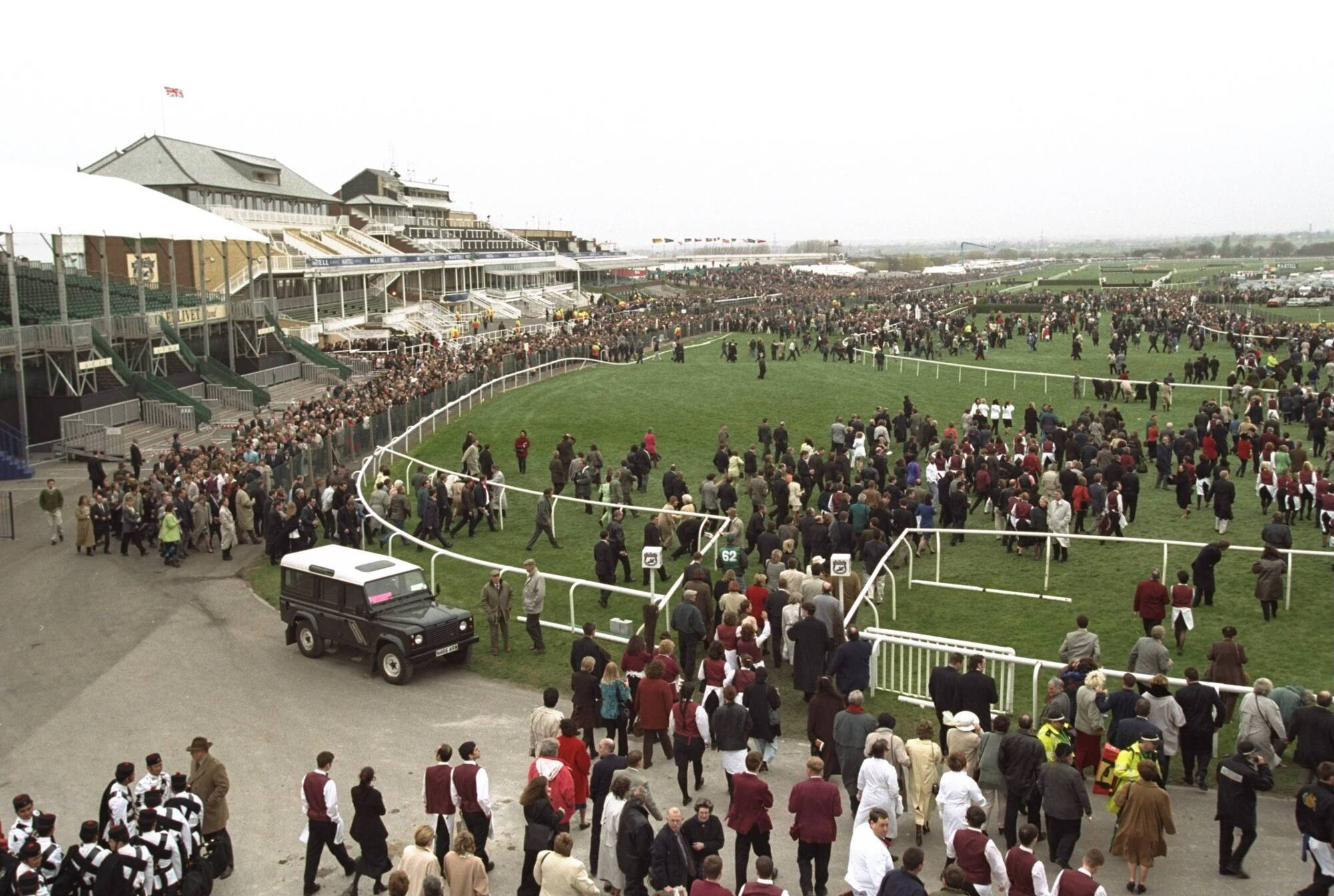
Racegoers leave Aintree after an IRA bomb scare forced the postponement of the 1997 Grand National. Picture: Mike Cooper /Allsport
At around the time that racehorse trainer Jenny Pitman was weeping bitter tears live on British television, it dawned on the Irish jockey, Mick Fitzgerald, that his father, Frank, had gone missing in action.
It was the first Saturday in April, Grand National day, 1997. Twenty-five years ago, exactly.
Pitman, the first woman to train an Aintree National winner with Corbiere in 1983, had been intercepted on her march through a car park by Des Lynam, one of the three finest sports broadcasters rooted in County Clare. (The other two are Michael O’Hehir and Marty Morrissey).
Lynam asked her to describe her feelings about the disaster that was then unfolding before her and the half-billion global viewers who had tuned in to watch the world’s most famous horserace. Even at the best of times Pitman was not the type to leave a passionate opinion to remain unexpressed and this was far, very far, from the best of times.
An hour earlier, at 2.49pm precisely, a caller using a recognised code word had phoned Liverpool University Hospital with information that there was a bomb placed at Aintree racecourse and it was timed to explode at 4pm. Three minutes later a second warning, again using a valid code word, was phoned directly into police headquarters in Bootle.
The forces of law and order acted decisively, immediately ordering the evacuation of 60,000 spectators, initially to the course infield and soon after from the course completely. Everybody was ordered to leave their possessions, their horses, and their cars and leave now. This included Mick Fitzgerald’s Dad and Jenny Pitman.
Seething and sobbing, Pitman addressed Lynam’s question.
“I’m afraid that these people are very sick,” she spat. “If you could have seen the scenes back there when we had to leave our horses! Anybody, anybody involved in such an act is unbelievable. Don’t tell me that these people love horses. Don’t tell me that these people love animals. Don’t tell me that these people are in anyway human because they’re not. We have the lunatic element and we cannot give in to them.”
Pitman’s rush to judgement and her condemnation of animal rights activists for the bomb threats went unchallenged by her interviewer and the ‘I’ word was still being carefully avoided, on camera at least.
Not one of the speakers or commentators had yet said ‘Ireland or ‘IRA.’ Not until an open mike picked up comment by a passing spectator, a local man judging by the accent, venting his frustration. “Fuckin’ Irish bastards,” he yelled, just as the clerk of the course, Charles Barnett, approached Lynam and informed him, on camera: “Des, this is tragic. There have been two coded bomb warnings received by the police and there is no possibility of taking any chances. Consequently, we’re going to abandon racing and make a further announcement later. Everybody here, including you from the BBC is to leave the course and get out on to the public highway immediately."
Until 2.49 the day had been progressing seamlessly and at Aintree Racecourse all seemed well with the world. This was the 150th staging of the great race and the legendary commentator Peter O’Sullevan was being honoured on his retirement with the unveiling of a bust close to the parade ring by Princess Anne.
Incredibly, O’Sullevan had called a third of all those Nationals and the applause was polite and the tributes warm. But outside the Aintree bubble, politics and society in Britain were a little more agitated.
The 1994 ceasefire had ended with the Canary Wharf explosions and the British government were flatly refusing to re-engage with the peace process unless there was a verifiable decommissioning of all IRA weaponry. There was a general election campaign ongoing that was to result weeks later in a Tony Blair landslide and the physical force element of Irish republicanism wanted to remind the electorate that they hadn’t gone away, you know.
They decided that banjaxing a high-profile British sporting spectacular such as the Grand National would serve their cause, somehow. In the heat of the moment the possibility of IRA involvement had never occurred to Pitman.
“My mind was in whirl,” she later wrote in her autobiography. “Because of the trouble at Aintree with the animal rights people over the years I imagined that it was something to do with them. It might sound naïve but because of the strong Irish connection with horse racing the thought that the IRA might target us, or the horses, never crossed my mind.”
Many other things were crossing the minds of the Irish as the day unfolded. Istabraq’s jockey Charlie Swan, like a courageous fireman rushing into places that others were rapidly leaving, detoured back into the stands to rescue a plastic bag full of betting money that his boss and mentor JP McManus had left behind.
The Oscar-winning actor with deep ties to Dingle, Gregory Peck, an enthusiastic jump racing fan, found himself sitting on a plastic mushroom outside a local McDonalds restaurant enjoying a burger and a banana milkshake while discussing developments with some fellow evacuees.
And by that stage Mick Fitzgerald too was meandering towards the public highway, still dressed for work in his riding boots and breeches, colours, and an overcoat. That’s when the rush of concern washed over him. He was meant to be looking after his father.
“Suddenly it hit me.” he later wrote. “My Dad, where the hell was he? He could have been anywhere (and) I had no idea how or where I was going to get to see him again. He probably had had a good few pints already, he could have been anywhere, he was probably half-pissed, happy out, he couldn’t have cared less about bomb scares.”
One of Fitzgerald’s companions made a plan. He knew a lady called Edi Roche who lived close to the course and they could go to her place for a quiet drink while things settled down. He wasn’t the first to have that idea however and Edi’s home was already thronged when they got there.
Fitzgerald continues his story.
“I struggle in the door, through a load of bodies into the sitting room to where the drink is and, lo and behold, no fuss, serving the drink is Frank Fitzgerald, barman. He looked at me. ‘All right?’ Typical of my old man. What crisis? He took a drink for himself and sat down.”
A loose horse is always one of the most unpredictable elements in jump racing. Uncontrollable, mind of its own, can either fall, flee, or finish. That Saturday night in Liverpool there were hordes of loose jockeys, uncontrollable, still in riding gear, cavorting in nightclubs until the sun came up. They awoke next morning, mostly on hotel room floors or bathtubs, to learn that the blitz spirit had kicked in overnight and Britain would not be bullied by anybody. (‘We’ll fight them on The Bechers!’ ran one tabloid headline.) The National was to be run on Monday, a one-race card, free admission, and to be broadcast by the BBC. The Prime Minister was even coming.
A dozen jockeys spent Sunday in whatever sauna they could find, sweating off their unexpected party weight and hangovers. Lord Gyllene under Tony Dobbin, who had sensibly gone home to his own bed on Saturday, won easily.
The first and only Monday Grand National had been won by a man from Northern Ireland.