Colm Greaves: How does racing bounce back from its horror year?
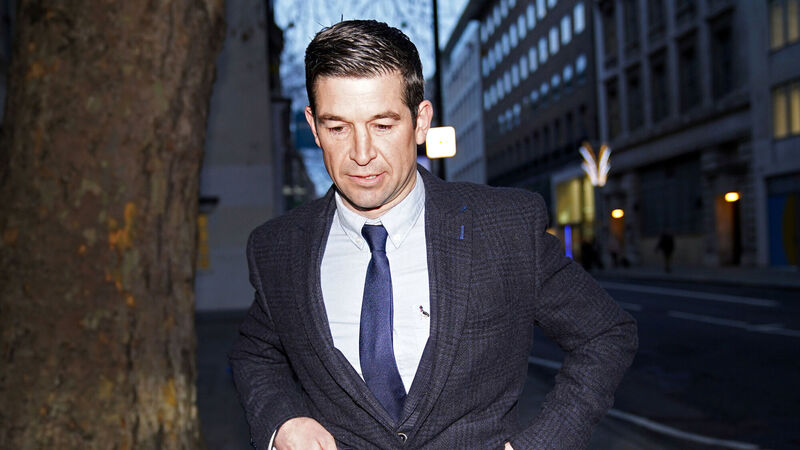
Jockey Robbie Dunne leaving the British Horseracing Authority Headquarters in London after being banned for 18 months. Picture: Yui Mok
Given the heartache her family inflict on the poor woman in a normal year, 1992 must have really been some class of nightmare for Britain’s Queen Elizabeth. In her end of term speech to the great and good of London, she lamented that “it is not a year on which I shall look back with undiluted pleasure. In the words of one of my more sympathetic correspondents, it has turned out to be an annus horribilis.”
- The Department of Agriculture, supported by the Gardaí, conduct a highly publicised raid on premises in Kildare. Animal remedies, unlicensed for use in Ireland, were found in the possession of the Scottish-based equine therapist John Warwick. None of the tested horses were subsequently found to have any trace of an illegal substance in their system, but the optics are dreadful.
- Irish racecourses remain Covidly closed to spectators for much of the year causing serious tension among many of the excluded, bill-paying owners. Frustration is directed at HRI whose efforts at political lobbying on their behalf are not thought to be nearly as robust and energetic as they should have been.
- Jim Bolger hurls another of his infamous fragmentation grenades at the reputation of Irish racing. Bolger has never been known to call a spade an agricultural implement, but this was strong even by his standards. “There will be a Lance Armstrong in Irish racing,” he said in a interview, “I know who they are; if I had responsibility for rooting out cheats, I’d have them rooted out in six months.”
- He subsequently declined an invitation to expand on his inferences to an Oireachtas committee but his accusations still linger over Irish racing like a bad smell.
- A photograph of Gordon Elliott sitting astride a dead horse is made public during the lead up to the Cheltenham festival. Ructions ensue, high dudgeon reaches record level altitudes and while animal rights activists point and shout, Elliott gets a six-month stint on the naughty step for his moment of thoughtless insensitivity.
- Charles Byrnes, trainer of a (now) seven-year-old gelding called Viking Hoard, is also banned for six months as punishment for leaving the horse unattended in the stables at Tramore three years ago. The absence of oversight enabled an unknown intruder to administer a pre-race jumbo-sized dose of sedatives to the horse which could have been perilous to horse, rider, opponents and spectators alike.
- The creeping illness called ‘Cheltenham centricity’ increasingly infects the rhythm and tempo of the National Hunt season. Lucrative weekend graded races, particularly in Britain, attract small, uninteresting fields as trainers become even more reluctant to challenge their better horses before March. Historic races that were once much-anticipated programme milestones are now often little more than damp squibs. The imbalance in the programme and its impact on the distribution of scarce prize money presents a longitudinal threat to the health of the sport and its attractiveness to new owners.
- Little comfort is found in international news. Medina Spirt, trained by Bob Baffert, wins the Kentucky Derby, but is subsequently disqualified after a positive dope test. This is Baffert’s fifth violation in a year and the 31st of his career in total. Federal interest in the standards of governance in US racing deepens. At the High Court in London, damning findings of fact were made against one of Flat racings most prominent international owners, Sheikh Muhammed in his treatment of his family. Meanwhile, back in California last month, Medina Spirit drops down stone dead during routine exercise.
- Also in the High Court, ex-jockey Freddie Tylicki wins a £6m lawsuit against a former colleague, Graham Gibbons, for causing a fall in a race at Kempton in 2016 that left him with catastrophic injuries. The case was won on technical legal arguments but the supporting witness testimony on both sides did little to add to the reputation of the sport. Jockey Jim Crowley, who was also brought down in the incident, said he had noticed a smell of alcohol on Gibbon’s breath prior to the race, yet he stayed quiet and still chose to ride against him. Another rider, Pat Cosgrave, said that he had relied on the “code of conduct” afterwards and “not get involved” and tried to “stay as neutral as possible”.
- And it is the hallowed code of ‘self-regulation’ in the jockey changing room that remains front and centre of horse racing coverage as the year turned. 2021’s most high-profile and lurid story is the harassment of a young woman, Bryony Frost, by a senior male colleague, Robbie Dunne. The saga has been front page news for weeks, most recently for the tone-deaf reaction of Frost’s trade body, the Professional Jockey’s Association (PJA), who in an act of monumental stupidity attempted to remain neutral between (proven, not imagined) victim and aggressor.
There have been significant recent changes in the executive leadership of Irish racing. The head of the regulatory body, (IRHB), Denis Egan, stepped down in September and his successor has yet to be named.