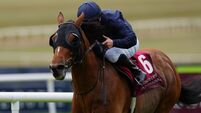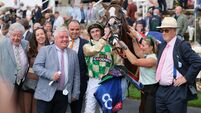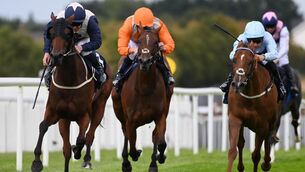
It is the end of May and racing from the Curragh is on TV. They are down at the start for a premier handicap and Lobo Rojo is not cooperating. As time ticks on, it seems obvious that the four-year-old will not be participating.
But clearly, stalls handlers are like soldiers at war. They don’t want to leave anyone behind. Even at risk to personal safety.
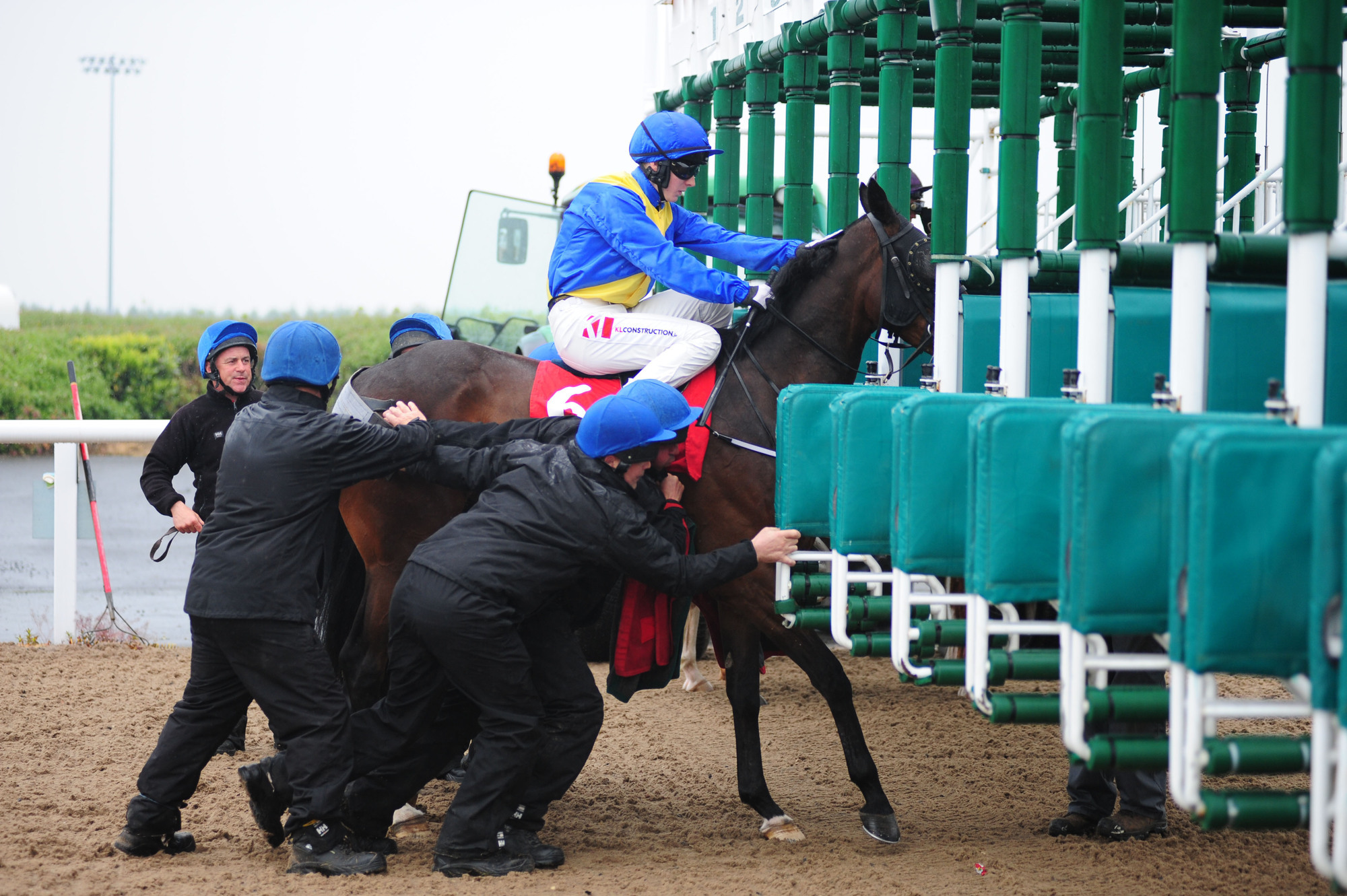
I instinctively put my hands to my face and watch through my fingers as two more brave souls slid behind Lobo Rojo, who has been playing fast and loose with his hooves.
“You mad bastards,” I murmur to myself, feeling a mixture of horror and awe.
Lobo Rojo didn’t win but the owners got their run and some prize money. They could thank the stalls handlers risking injury for that.
It is 55 years since starting stalls were introduced to Ireland, for five and six-furlong races at the Curragh. Stalls have been used for all flat races on every track in Ireland since 1969.
Pat Brennan is racing services manager at Horse Racing Ireland. It’s a wide-ranging role that includes responsibility for licensing of bookmakers and the regulation of on-course bookmakers and betting shops. The starting stalls team also comes under his remit.
“They are the backroom of the engine,” is how Brennan describes stalls handlers. “Everyone sees the race, and the excitement of that, but these people are earning their corn when they’re getting 20 two-year-old colts into the stalls.”
There are 32 stalls handlers on the roster. Lynne McLoughlin became the first female to lead horses in at the Curragh last April but given the number of women working with horses around the country, she won’t be the last.
“She took to it like a duck to water,” says Brennan of McLoughlin’s debut. “We buddy them up with someone and then let them on their own after five or six races. She was ready to go after one.
We don’t take anybody on that hasn’t huge experience with horses. They must have a huge knowledge. You don’t realise the bravery of these people with the things that can go wrong.
Thanks to Pat, I got to spend some time down at the seven-furlong start at Leopardstown eight days ago.
An average race day will see 12 handlers on duty. Bigger field sizes will increase that to 15 or 16. You have leaders, pushers and jumpers. The leaders are smaller and more agile, leading horses into the stalls and having to crouch down under the front to get out and around for the next horse. The bigger lads are at the back when a bit of heft is required.
The jumpers? We’ll get to that.
Manny Behan is the team leader. His father Pat did it before him and got him the job. John Wixted is another following in the footsteps of his father, Dick, and Pat Keating’s dad, John, was a team leader before Manny.
“I go into the weigh room after I arrive and I meet the starter there with the card,” explains Manny about the pre-racing preparation. “We have the list of horses, the non-runners, the order of the draw and we mark out the various instructions, whether they go first or last or if they’ve issues.
“If you have a lad that’s difficult to load, we’d go first with them. If a lad gets a bit messy in there, we try leave it as late as possible. The lads all know what stalls they’re on, we give them out at the start, dole them out in odds and evens.
“All different things can go wrong. Horses can rear up, act up and fall down. Horses try and get under the gate, fall over in the stalls. In Thurles a couple of years ago, a horse got his leg caught and they had to get an angle grinder to cut him out. He was okay afterwards. But you need a good horseman around in situations like that.
A lot of the lads are working with horses, day-in, day-out. They know the ins and outs of it.
A glance at the notes sheet around the horses makes interesting reading.
‘Kept rearing when loaded. Load late.’
‘Reluctant to load. Load first (dismounted).
‘Loaded ok, became restless when loaded. Hold when loaded and load late.’
‘**BEWARE RUSHES IN**’
Initially, that last one doesn’t look like it needs four asterisks and capital letters. Isn’t that what you want them to do?
“The leader could be plastered to the stalls if you weren’t ready. We’d have to get the power hose,” explains Manny with a grin.
So move quickly then.
The first race is a two-year-old maiden and two horses get very upset. The alacrity of the handlers’ reaction is illuminating. A minute before they would have been leaning against stalls, joshing and chewing the fat.
Once the horses arrive it’s serious business. They need to get the horses in quickly but there can be no hint of stress or tension because it transfers. So they chat to jockeys, they pat horses, they check girths and tack. They exude calm but are constantly alert and aware of everything going on around them.
When it kicks off, they’re like ninjas. ‘All hands on deck’ is the motto. Two jumpers are on either side of the stall. Former jockey, Tim Carroll, brother of Wednesday’s Royal Ascot-winning pilot Gary, is one of them. They pull the horse’s ear and bit to prevent it trying to get down under the gate with Billy Lee on its back. They would also be hauling the jockey out if there was a danger and are constantly communicating with the pilot. The pushers are forcing the gate open behind to enable the horse to back out.
The ferocity of Nawraq’s kicking is quite something, as is the noise, despite the padding. It is no surprise that he has suffered cuts and scratches and is withdrawn after a veterinary inspection.
Point Gellibrand is next in and whether the delay or Nawraq’s antics have gotten to him, he is very anxious upon entry and reacts similarly. It is more difficult to get him to reverse back out of the stalls. He is so wound up, his front legs are almost tucked back in under his hind legs. But with such knowledge in this little corner of Foxrock earth, it happens. He too, is withdrawn.
Later on, you see hoods fitted on some horses in a bid to literally pull the wool over their eyes, others might have a rug on, so they don’t feel the side of the stalls. But most of the time it is human nous that gets the job done.
Benji Coogan is another ex-jockey who is joined by his brother George as a stall handler. Benji is in his 60s now, having ridden all over the world from America to Cyprus and plenty in between. His best day in the saddle was winning the Group 3 Cornwallis Stakes at Royal Ascot on Up And At ‘Em for his brother Jimmy. Benji has been riding work for Dermot Weld for 25 years. He is a stalls handler for eight.
“You saw your first example, two horses lost the cool in the stalls,” reflects Benji. “Highly-strung horses. The lads all know the job, what to do in an emergency like that.
“Most of the horses are very well-schooled. You just get the odd horses. It’s individuals I suppose, like bold children. You have to be sympathetic with a lot of those young horses. Take them as easy as possible.
I love this job. It’s second nature to me. I’m working with horses since I’m 12. There’s nothing you can’t handle or can’t do.
Benji is a leader. Derek Kelly is a pusher. Manny agrees that being a pusher is like being a hurler going into contact. “The closer you are, the safer you are. Get in good and tight.”
Derek, who has ridden in over 100 races between point-to-points and bumpers, has learned the trade and like Benji, is in thrall to it. “You don’t think of the dangers as a pusher, it’s like being a jockey. I broke my leg twice riding. It’s life; whatever happens, happens, isn’t that it? I learned off Paul Barrett, he’s probably the best in the business. Manny did it before him.
“They show you where to go. If you go down too far with the puller, they kick out, if you go too high, the same. You need to just it slide it down five or six inches below the dock of the tail and give a good pull from there and you should have no hassle. You’re learning off the best. They know every trick in the book.”
Being acquainted with the horses from travelling the country is vital and helps with the recidivists.
“You’ve All The Mollies there, the boys would know her well,” Derek notes. “She’s a bit tricky. They’d give her a chase, come sneak down the side of the stalls. Give her a few shouts, slide in and close the gates. I’d say if she was somewhere else, in England, they mightn’t get her in at all. She’d shake hands with you!”
The jockeys certainly know the importance of the handlers.
“They’re unbelievable,” says Leigh Roche, described by Manny as one of the real characters along with Rory Cleary when it comes to a bit of banter at the start. “The team they have there, they’ve some brilliant lads. And we need them. You see the first race. Billy Lee’s horse starts going mad and there’s two lads up, straight away, and they had him caught. Without them, some horses would be rearing and would be back over on top of you. Without them, we’re lost.
“If the horses tries to go down when you’ve your feet in the irons, you’re still on them, you’re trying to pull their head up. The lads are in, grabbing them in front or grabbing their tail. And if you hit the ground, they’re in quick to pull you out of it. It happened in the Curragh, the horse flipped over and the jockey landed in the stalls. The boys had her pulled out sharpish. She got a kick in the legs but it could have been a lot worse.
“The key to the lads is they know horses.”
“I’ve had a few a bit hardly in the stalls and the lads would be so quick to be up to help you get the horse under control,” concurs Dylan Browne McMonagle. “If they weren’t quick, you’d be in a great bother because it’s not a big area when a horse panics. So they’re a massive help to keep them relaxed.
“You can have a good laugh at the start too. That’s very important. If everyone was quiet and didn’t say nothing, it would be a bit awkward. It’s nice when the lads are talking to you, it keeps you relaxed. If you’re ever a bit nervous they soon chill you out and make you feel comfortable. They’re a massive help.”
Joe Banahan is the starter on this day, the man who liaises with Manny before racing, and during.
“Everything that makes racing work is a cog in the wheel. When you’re watching on television, people don’t realise that every little thing makes it possible to run smoothly to get the race off on time. This is one cog but a very important cog,” notes Banahan.
“It’s a two or three-minute job but they have to be 100 per cent focussed. They know what they’re doing and get stuck into it and then they can relax in between races. They’re a well-oiled operation.”
It is time to move on, having seen this well-oiled machine in operation under pretty significant stress testing. These are heroes of the sport who have a passion for horses, enjoy each other’s company and realise the importance of what they do.
“There’s a lot of expensive horses going into those stalls,” as Manny puts it. “They all have to be looked after.”
So they are.

No obligation. Ts&Cs apply.