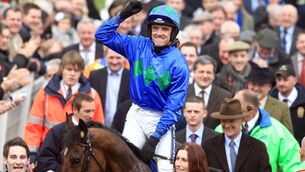
Timing is a gift possessed by all successful sportsmen and women. This is especially true for jockeys. In a race, the best ones know when to slow the pace, when to up it, when to change position, when to wait, when to go for broke. It’s an instinctive thing, this special sense or feel. And if they’re lucky, they get the chance to use this precious gift one last time when their own race enters its final furlong.
The happy ending
Covid-19 meant Barry Geraghty didn’t get to emulate his friend and rival Ruby Walsh by finishing up in front of a packed — and grateful — Punchestown crowd after one final sprinkle of stardust.
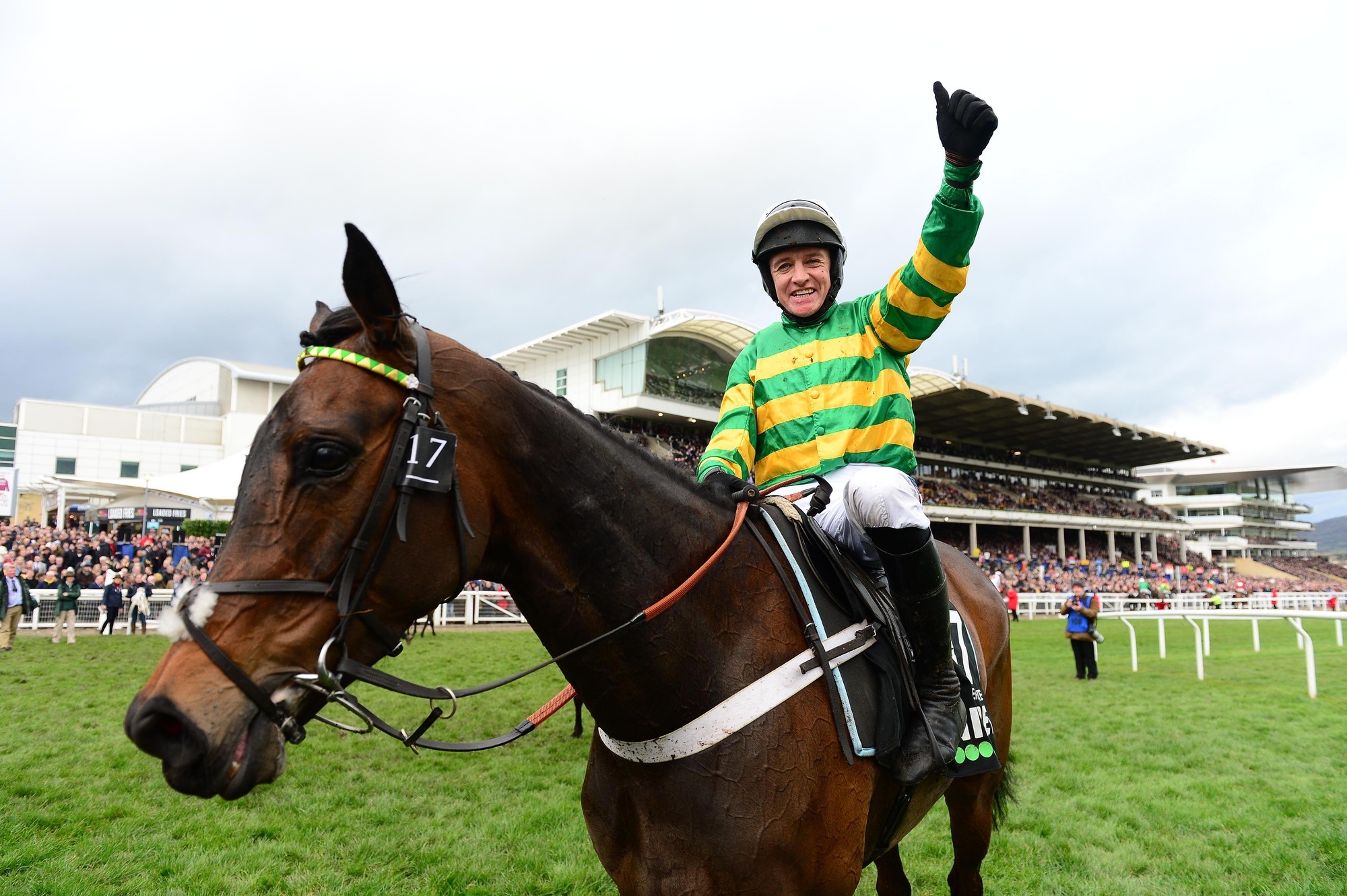
But like Walsh, Geraghty bowed out at top, riding five winners at Cheltenham last March to take his final Festival tally to 43. Four months later, Geraghty announced his retirement via Twitter, a picture-perfect snap of him with wife Paula, daughters Síofra and Órla, and son Rían accompanying a simple message of gratitude to all those who helped along the way.
He has kept himself busy in the months since, his autobiography True Colours, written with the assistance of Niall Kelly, providing a riveting account of the highs and lows of a 24-year career that yielded 1,920 winners. And once or twice a week he rides out for Gordon Elliott, throwing his leg over some of the finest horses in training. He’s a happy man, content that he got out on his own terms having proved his brilliance on the biggest stage one final time.
“You come to the stage in life where you can’t be a child forever,” he says of the decision to call it quits.
I loved it, I loved it all the way through, it was a brilliant way to make a living, doing what you love, and the kick never gets old because you’re at the playground every day. But there comes a stage when you think: ‘This can’t go on forever’. So for that reason retirement sits comfortably with me.
“A lot of realisation went into that over the last few years. I knew I was down the back nine but it was only last December that I started thinking: ‘Maybe, this is a good time.’
“I knew when I went to Cheltenham that it was my last Cheltenham. So for the week to go the way it went, it couldn’t have gone any better, with the exception of Defi Du Seuil, who didn’t perform. Everything else, you couldn’t have asked for better.
“I was tempted to pull the plug on the Friday of Cheltenham but three weeks later I’m thinking the other way and three weeks after that I’m realising: ‘Yep, it’s the right thing to do.’ That gave me great peace of mind, to go through that process because even if I had got through the full season and called it a day at Punchestown, it still would have been a sudden stop. To have got those weeks to really take stock left me in a real comfortable position, it made it easier to accept and move on.”

Finishing with a flourish helped too. Epatante gave Geraghty a record-equalling fourth Champion Hurdle success before the Meath man gave Champ one of the great Cheltenham rides to come from a different parish to win the RSA Novices’ Chase.
“In a situation like that, I’d compare it to Bobs Worth’s Gold Cup, you’re nursing away on a horse like him. We jumped the third last, and the two leading horses get away from you and you know if you commit all at that point that you’re not going to finish. You’re trying to coax them into it, waiting for them to come alive because, if you put the pressure on too soon, you’ll get 150 yards and boom, you’re gone. It’s an instinct or a feel you have.
“I saw Minella Indo fluff the last which is a tell-tale sign of a horse on gas fumes. I knew when he fluffed it, I was beginning to get going and those lengths evaporate when you’re on a horse that can finish versus the horse that’s tired. It flip-flops, like it did with Bobs Worth in the Gold Cup when he went from six or seven lengths down to winning by seven.
“To be three lengths down in the RSA with probably 60 yards to go, knowing you’re going to win, that’s a good place.”
He ended his Cheltenham love affair with a handicap hat-trick as Dame de Compagnie won the Coral Cup, Sire Du Berlais retained the Pertemps Network Final before Saint Roi landed a gamble in the County Hurdle in what would ultimately prove Geraghty’s final race. Not bad for a man who was then 40.
Asked if he feels he was a better jockey at that point in his career than he was in his mid to late 20s, the reply is emphatic:
No doubt and results reflect that. I had five winners, no second, and one third so anything that had a chance of winning won. And the five horses I won on, I can’t guarantee I’d have won on those five horses in my late 20s.
“You’re constantly analysing, analysing your position, analysing where everything is, the pace, the ground, your timing, where you want to be — the computer is running flat out from the time you get up on your horse. Your position at the start, everything, every little thing has a consequence. You’re trying to be in the right place at the right time at every point in the race. And that comes from experience. That’s probably what gave me the most fulfillment because I’d had my ups and downs over the years. You couldn’t ask for a better way to sign off — it was the perfect week really.”
Like the call to retire, the decision to do an autobiography was made after a lengthy thought process.
“I had been approached a good few times over the years and it didn’t really interest me, I was never really into fellas writing an autobiography three years into their career as you don’t really have the story to tell,” he explains.
“But I knew at that point that I had the story, I hadn’t got my head around retirement but I remember reading the first draft and going through the list of injuries and thinking to myself: ‘I think this is a good decision.’ Listing the injuries brought it home.
“You’re at a point of your career where you have a story to tell, you’ve seen the highs, you’ve seen the lows, it’s something people can relate to. It’s easy to talk about glory days but it’s overcoming adversity and coming back again and I suppose when people can connect with that then you have a story.”
The darkest hour
Overcoming adversity is a central theme of True Colours. It opens with a vivid account of Geraghty’s worst injury, a badly broken leg sustained when Peregrine Run fell in the Topham Chase at Aintree the day before last year’s Grand National. The physical pain was bad but it was nothing to the mental agony he endured in the moments before the medics arrived on the scene.
“I was screaming for morphine just to put me in a better place,” he remembers. “Obviously, I was in a lot of pain and the pain brings its own negativity. I’m on the ground and my leg is twisted inwards. It looks horrific and it feels horrific and you’re thinking: ‘Is this where it ends?’
“I’ve been at the playground all my life and I hadn’t got my head around finishing at that stage. I didn’t want to finish, but was this going to be taken out of my hands? There was a lot of realisation in a very short space of time.”
Of all the injuries Geraghty sustained in the latter part of his career, this was the worst, the presence of a frame on his battered leg adding to his misery.
“The frame was brutal. I wrote in the book about getting up in the morning after it had all settled down overnight. You’d have an average night’s sleep. You’d hit the bed at 10 o’clock wiped out and then you’d wake at three or four when you’d turn and that’s it then. You’re awake for the rest of the night.
“And when you go to get up at seven or eight o’clock and drop your foot out of bed, the bloodrush down to your foot, it’s a film of blood. That was horrific. Get out of the bed, get down the stairs, get to the couch and get your foot back up in the air and drain it back again. It was the worst I’ve ever dealt with. By far.
“I had wires through my shin, below the knee, midway and two in my ankle and then there was a screw at the top of the shin, midway, and one into my ankle so, as you would get moving, the wires would start tearing and swelling and weeping. The more movement you got, the worse that got. You obviously want to move because you want to be more productive and you’re advised to move to promote healing so it was a double-edged sword.”

JP McManus and his racing manager Frank Berry visited Geraghty in hospital the evening he suffered his leg break, bringing a pyjamas and some fruit, a simple gesture he greatly appreciated. He then flew the stricken jockey back to Ireland on his helicopter to allow him to get surgery back in Ireland.
A year earlier, relations were far more strained. In an exchange at Punchestown in April 2018, McManus asked his then-retained jockey if he was retiring. After Geraghty insisted he had no such plans, McManus dropped a bombshell, telling him:
Some of the trainers aren’t happy with how you’re riding. We’re not going to have a first jockey next season.”
It was an exchange that left Geraghty reeling, one that prompted him to ask Paula if he should in fact call it a day. Looking back now, Geraghty is eternally grateful for his wife’s intervention in that moment of crisis.
“I was completely in a haze as regards what I was going to do or what I should do. If ever there was words of wisdom needed, what she said to me was so right. She said: ‘You can retire today, you can retire in a month, you can retire in six months, whenever you want.’ If you were looking for a bit of clarity, I couldn’t have asked for better. She’d only have loved for me to walk away at that point having had all the injuries I’d had at that stage but on that occasion, and the whole way through my career, she was brilliant.”
Crucially, McManus had also thrown down the gauntlet, telling Geraghty to “prove them wrong”.
It probably stood to Geraghty that he’d been in a similarly tricky position back in 2007 when he felt like “racing’s forgotten man”, a remarkable situation for a man who had by then twice been Ireland’s champion jockey, won an Arkle and the Champion Chase twice on Moscow Flyer, a Gold Cup and the King George twice on King King, and a Grand National on Monty’s Pass.
“That was hard, really hard.” he says of that period. “Moscow wasn’t the same horse and Kicking King got injured after winning the King George in 2005 and he never really got back to where he was. Because I hadn’t committed to Jessie (Harrington), Edward (O’Grady), or Tom (Taffe), their second jockeys were poaching in on my patch which was understandable. It’s very hard to turn the tide and the tide was going out rapid.”
The comeback
Geraghty wasn’t to know at the time that stroke of good fortune that would reignite his career would come masked as another body blow. He thought he’d be riding Catch Me in the 2008 Champion Hurdle but Paddy Monaghan, who was involved with the horse, had other ideas, deciding Geraghty was unlucky for him. Geraghty looked set for a watching brief until his agent, Ciarán O’Toole, secured him a ride on Punjabi, the outsider of two Nicky Henderson runners.
Punjabi would defy odds of 25-1 to finish third and a few weeks later there would be a vacancy at Seven Barrows after Mick Fitzgerald suffered a career-ending injury. And when Geraghty won the Punchestown Champion Hurdle on Punjabi he effectively secured the job as Fitzgerald’s replacement at one of the most successful stable’s in Britain.
“Paddy Monaghan was the important part of it,” Geraghty recalls with a laugh. “Punjabi was obviously the result and it was so important but I’ve always looked and laughed at it when Paddy Monaghan wouldn’t let me ride Catch Me and I wound up riding Punjabi instead. And Paddy in turn asked me to say thanks for the Henderson job.
“So Punjabi probably never got the credit because Paddy was getting it. But Punjabi was the sliding doors moment. He was a 25-1 shot in the Champion Hurdle and he finishes third and you win on him at Punchestown and that straight away puts you in the box seat for the job with Nicky.”

At Seven Barrows, Geraghty was reunited with a horse he had bought as an unnamed yearling in November 2006 before selling him in May 2009. Bobs Worth would go on to Grade One success at three successive Festivals, the hat-trick completed with victory in the 2013 Gold Cup. It should have been one of the highlights of Geraghty’s career but victory felt “hollow” as he couldn’t stop thinking about the fate that had befallen John Thomas McNamara the previous day.
“To call it strange or weird would normalise it too much. It was hollow. Everything with Bobs Worth was amazing but that day, it didn’t matter. And still now, it wouldn’t bring the same joy as other days because there was no joy in the day.
JT was a fella I was very friendly with, I probably got closer to him through his injury because he would be on the phone a lot and I’d visit him a lot whereas, before that, you’d meet him once or twice a month at the races. He was someone I always got on brilliantly with and had a good connection and for that to happen, he was 38 at the time, he had a wife and three kids and you’d seen horrific injuries before and the impact it has. So, no, on the day, the Gold Cup didn’t matter. It was a great race to win but it will always be the day after JT got his fall.”
On a happier note, Geraghty will be able to tell the grandkids he rode two of the greatest two-milers chasers ever seen. Just don’t ask him to choose between Moscow Flyer and Sprinter Sacre.
“Moscow was massively important for my career. You can narrow down the best you have ridden in all divisions and to get a horse like that at 20 and bring you to the top table and have him for five years there, you couldn’t ask for a better stepping stone to the big time.
“The Tingle Creek in 2004 was probably the best race I’ve ever ridden in as you had three superstars at the time line up and all three ran to form. The Champion Chase he won later that season was a procession in comparison. Azertyuiop didn’t turn up and Well Chief ran okay but Moscow dotted up. But in the Tingle Creek the gloves were off, it was a proper scrap and he was only ever doing as much as he had to. That’s why I could never split him and Sprinter because you never knew what Moscow had left in the tank. To hold his form for so long, there must have been some point in the middle where he was an absolute aeroplane.”
Sprinter Sacre was unquestionably more flamboyant and Geraghty remembers his 2013 Punchestown victory at the end of a season in which he had dominated the two-mile division as one of his greatest days. Not just because Sprinter Sacre was special but because it was a big-race on home soil. There would be no frantic dash to the nearest airport. He could savour the moment in the company of those mattered most.
“That day at Punchestown was brilliant and he was brilliant. The day was magic. Paula was there. Síofra, our eldest, was there, Órla was probably too young, we might have had a babysitter for her, but that success on home turf I longed for because things had dried up for me in Ireland before I got the job with Nicky.
“I was enjoying all this success in England and it was brilliant but you’re running out the door, winning the Hennessy, for example, on Bobs Worth or Triolo D’Alene and you’d ride one in the bumper at maybe quarter to four and you would be on the 5.45 out of Heathrow. It was always a rush.
“You wanted to get home and to have that success so the days that would stand out for me, Cheltenham aside, would be Sprinter in Punchestown, Bobs Worth in the Lexus Chase at Leopardstown, Shutthefrontdoor in the Irish Grand National and probably Tigris River in the Galway Hurdle. They were big boxes to tick and days you could really enjoy because you really get to savour that moment among the people you’ve grown up with rather than running out the door to catch a flight home.”
That longing for home meant that when the offer came to replace the retiring AP McCoy as McManus’s retained jockey in 2015, it was an opportunity he couldn’t turn down.
“At the time, it offered me Ireland and I’d had a taste of it, a good taste of it, with Sprinter in Punchestown and I knew what I was missing. It offered me the chance to have the best of both worlds.
“My life had gone very much loaded towards England where I’d be busy on a Saturday but I could also be there Wednesday, Thursday, Friday, and on a Monday and I could be home on a Sunday with a good meeting at Leopardstown and no ride.
“Because you’re fully committed to a big job in England, you weren’t getting the potentially good horses in Ireland because you won’t be available to ride them come Cheltenham so it was depriving me of opportunities here. You’re doing a four or five-day week in England and nothing in Ireland on a Sunday when you’d rather two or three days in England and a good day on Sunday which was what the opportunity offered.
“At the time it came, it probably came at a good time. Taking the job with JP provided more of a balance.”
Life in the famous green and gold silks wouldn’t always be plain sailing but when it was over, Geraghty could reflect with pride that he had risen to the challenge McManus had set that day in Punchestown. “Prove them wrong.”
He did just that.

- True Colours by Barry Geraghty with Niall Kelly is published by Gill Books and is available in all good bookstores and online.

Subscribe to access all of the Irish Examiner.
Try unlimited access from only €1.50 a week
Already a subscriber? Sign in