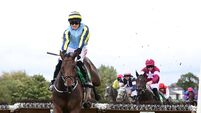
Gambler threatened to kill Breeders' victor Conduit
A gambler was given a suspended jail term today after he threatened to kill dual Breeders’ Cup Turf winner Conduit unless he was withdrawn from a race.
Andrew Rodgerson, 26, warned the stud manager in Ballymacoll Stud Farm in Dunboyne, Co Meath not to run 2008 St Leger winner Conduit in a valuable Group One race at Ascot after he forgot to place an accumulator bet on behalf of a syndicate.
He panicked when he realised that victory for Conduit in last July’s King George VI and Queen Elizabeth Stakes would lead to the syndicate expecting winnings of £50,000 (€55,800), Bolton Crown Court in England heard.
Rodgerson, of Balderstone, near Rochdale in England, sent a series of text messages and emails to Peter Reynolds, the general manager for the Ballymacoll Stud Farm, which owned Conduit.
Ten days before the race he texted Mr Reynolds: “Dear Peter, we would just like to warn you should Conduit run in the King George then the horse will be killed.”
Five days later he followed up with an email to the general manager, which read: “Dear Peter, I don’t believe you are taking the threat of death to Conduit very seriously.
“We want the horse removed from the King George this weekend. If you cooperate the horse will live.
“There are people living in and around Newmarket who are ready and willing. There will also be people around at Ascot on Saturday.”
Police in the Newmarket area were informed and Rodgerson was arrested at his home address just two days before the King George. He admitted making the threats.
Rodgerson pleaded guilty to threatening to commit damage at an earlier hearing after an initial charge of blackmail was dropped.
Sentencing him to 34 weeks in jail, suspended for two years, Judge Angela Nield said he had embarked on a “foolish escapade”.
She accepted his actions had no practical consequences in that Conduit lined up for the King George and actually went on to claim victory, but she said a message of deterrence had to go out.
“If offences such as this are not dealt with seriously than the (horseracing) industry will be undermined and those who work in it risk their livelihood being damaged and the manner in which they operate being altered for good,” she said.
Duncan Wilcock, prosecuting, said Conduit was a high-profile horse in the care of Newmarket trainer Michael Stoute, who had already earned more than £1m (€1,100) in prize money before the King George and for insurance purposes was worth £750,000 (€838,000) at the time.
He stood to win a further £1m (€1.1m) if he won the Ascot contest and was favourite to do so, he added.
Co Meath-based Mr Reynolds informed Stoute, who also trained the kidnapped racehorse Shergar, after receiving the initial text message on July 15.
Later the same day he received an email from Rodgerson which said he had claimed to have overhead a conversation in a bar in Manchester which referred to Conduit being killed if he raced in the King George.
Mr Wilcock said: “At that stage Mr Reynolds became more concerned about the threats and contacted the local police in the Newmarket area.”
On July 20, Rodgerson sent the email which complained that Mr Reynolds was not taking the threat to kill “seriously”.
Police acted swiftly and soon found the defendant, who sent the messages from his own mobile phone and laptop computer.
When interviewed he confessed he had had a gambling habit since the age of 19 but the problem had grown worse in the past 12 months, Mr Wilcock said.
He explained he was involved in a betting ring where people would ask him to place money on horses and obtain the best available odds.
Rodgerson was required to place three or four bets per day with a usual wager being up to £400 (€447) each way on a horse.
“This particular bet was an accumulator where other horses had already won and if Conduit won then Rodgerson said he would be in debt to the syndicate for £50,000 (€55,800),” said Mr Wilcock.
“He explained he had made a mistake on one of the bets he should have placed.”
Joseph Hart, defending, said Rodgerson had been impressed by friends at his local cricket club who liked to gamble and place “clever bets” on horses.
“Betting on horses seemed somewhat glamorous and it was all rather exciting,” he said. “He was put in touch with a syndicate – some who he knew, while others were more shadowy and they were the people putting up much of the money.
“The syndicate would tell him when and where to put money on and get the best odds. This was a clever series of bets and it required quite precise timing because the odds changed so rapidly.”
Rodgerson mistimed the Conduit bet though, when he had a busy day at work in his job at a local travel agency, he said.
Mr Hart said: “He forgot and did not put it on at the right time and with the right company and he realised if Conduit won he would owe this syndicate more than £50,000 (€55,800).”
Already in financial difficulties because of his gambling, he was “utterly terrified” with the consequences of not paying the money back.
He said: “These were powerful men, he thought these were shadowy men. He thought perhaps they would be people who would hurt him.
“So initially he lied to them that someone had taken the betting slip but then the syndicate said they would find him.
“The panic continued and he committed this frankly unsophisticated and deeply stupid crime.
“Yes, it is a valuable horse. However, nothing that Mr Rodgerson did stopped the horse running. He made absolutely no attempt to carry out the threat. He probably does not even know where Newmarket is.”
Mr Hart said the possibility of a custodial sentence had brought his client to the “edge of a breakdown”.
He was a man who had no previous convictions who had a “thoroughly good upbringing” which was quite religious and anti-gambling, he added.
His parents were in court to support him as a total of 22 references testifying to his good character were handed to the judge.
Judge Nield concluded: “I am clear that the gravity of the offence is the potential impact to the racing industry of this type offending becoming more prevalent.”
Mr Hart asked successfully for prosecution costs not to be imposed as Rodgerson still owed the bulk of the debt to the syndicate.
Rodgerson was also ordered to perform 240 hours of community service.
Detective Sergeant Andrew Butterworth, of Rochdale CID, said: “Rodgerson made what were to his victims, very real and very disturbing threats. He got himself into financial dire straits. His actions were foolish and reckless.”
The court was told Rodgerson did not know Mr Reynolds personally and had obtained his details either from advertisements for the stud farm in the racing press or from its website.