Cancer was merely a chapter: The many lives of Timmy McCarthy
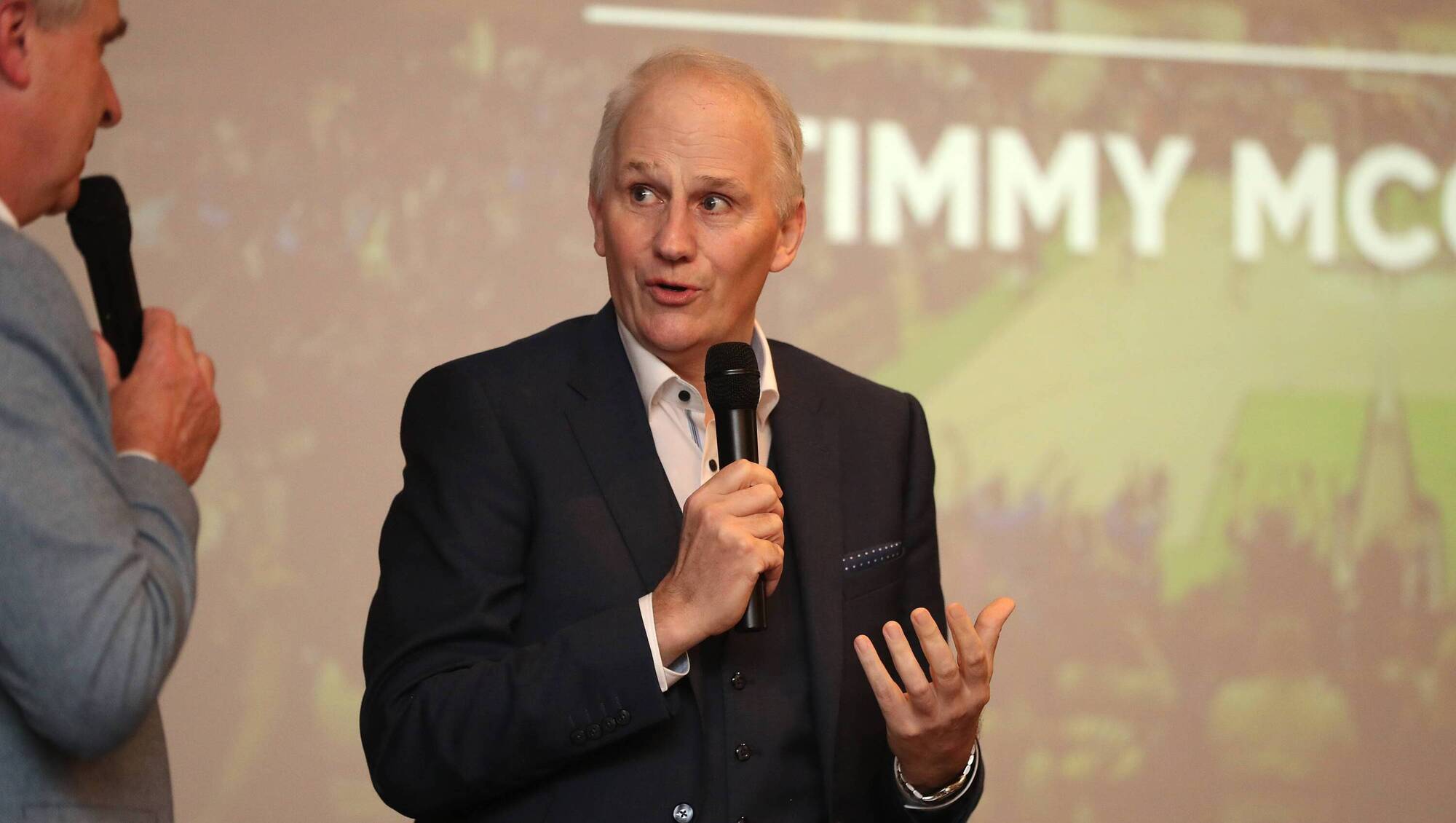
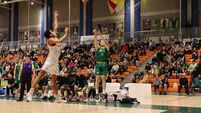
The day Timmy McCarthy was inducted into the Basketball Hall of Fame in May 2023 began in hospital. Prostate cancer had returned and to compound matters, he had a new illness, a radiation cystitis of the bladder. Pic: ©INPHO/Bryan Keane
Despite its title, it was never going to be a basketball book. But when he first began writing, it was primarily a cancer one.
In 2018, Timmy McCarthy found his world upended by a prostate cancer diagnosis. It was a brutal trial that left him at one point stranded in a state of physical incontinence and emotional despair. Yet, when he lived to write the tale, his family pushed back. Cancer was merely a chapter in his life. Where were all the others?
The result several years on is , an entertaining read and ride through a rich and varied life not incomparable to Forrest Gump’s. McCarthy would be a lot more goal-oriented as well as cerebrally capable than Tom Hanks’ fictional hero, but there is a similar, beautiful accidentalism to some of the roles he has drifted into.
Those graphics and stats that would flash up on your TV screen after the first or second half of any live match on The Sunday Game in the 1990s and 2000s? They were designed by one Timmy McCarthy, informed by a lifetime’s involvement in a data-driven sport like basketball.
Why did Ger Canning say Johnny Dooley had been instructed to take his point when the Offaly man ended up going for goal with that free five minutes from time in the 1994 All-Ireland final? Because his stats man McCarthy beside him had spotted Eamon Cregan on the line pointing upwards before Dooley’s own instincts overrode such an instruction.
It was only typical of a man who spent decades successfully straddling different worlds. While spearheading Blue Demons and the Irish national team during the golden era of Irish hoops, he was simultaneously moonlighting as a prolific goalscorer in junior soccer and coaching St Finbarr’s to a Cork senior hurling title. He walked out of school at just 15, starting as a labourer with Munster Furniture before moving on to make yoghurt for CMP. Yet from the factory floor, he somehow engineered a path to the top, serving as CEO for heavyweights like An Post Direct, Ulster Bank, and Hello.ie.
Indeed, the book and McCarthy are probably at their most charming when recalling his upbringing on the northside of Cork in the 1960s and 70s. He was the third of five children to William and Margaret McCarthy, a family dynamic he’d admit left him with a constant craving for attention and approval.
“My older brother and sister were spoiled because they were the first to come along, and then my younger brother and sister were spoiled as well because they were the babies,” he says.
“And then in the middle was me. I got the nickname Second Hand Rose because all my clothes were hand-me-downs from my older siblings. It definitely had an impact on me all through my life, being the middle child. I’d always be looking for affirmation, trying to please everybody else.”
Another lifetime insecurity stemmed from leaving school so early. It was just the norm in those days; he reckons of his fellow Inter Cert classmates in the North Monastery, a third left the same time as him. When he began applying for jobs, he was advised to leave out the name of his locality, Gurranabraher, he would just leave it at 285 Cathedral Road, Cork, and hope for the best. And yet in his mind his world had no bounds.
“I always had a dream of wanting to do better and bigger. Now, I didn’t know what better and bigger was but I just knew it was there somewhere. From our front door we could see Cork harbour below and I’d see the ship Innisfallen when it docked upon its return from England and wonder, God, if I sailed on that, where might it take me? It always seemed so big and better than what we had.”
And yet, he’d come to love and understand, they had so much. All that he needed, really. The love of two parents who he still desperately misses to this day. Sport, including a relatively obscure one which Gurranabraher’s own Parochial Hall would become the national epicentre of. A community that took care of their own, especially Maggie Kelly’s young fella when he started out as a raw sales rep for New Ireland Assurance in the autumn of 1980, around the time his Blue Demons teammates Dave Beckom and Wayne Williams became the first black men - let alone pro ball players - to ever step foot in Cork. And, of course, Ann, the star of some of the book’s sweetest passages in the recounting of the beginning of their courtship.
By the autumn of 1982 they were married, and McCarthy had already played with a string of legendary American ball players – Lennie McMillian, Bob Stephens, and that season, Mike Hancock, who only months earlier had been on the floor for Georgetown when Michael Jordan famously made the shot to win North Carolina the NCAA championship game.
Ask anybody to pick 10 years to play in the Irish league and they’ll hardly pick a better 10 than McCarthy’s, which began with a taste and appreciation of what the sport was like before the advent of the Americans, the golden era itself, before his final year: the first season that it went back down to one American and him winning the league and Irish player of the year. He retired that summer at 29, at the height of his game. The way he saw it though, whatever about the chances of him getting any better, the scene itself couldn’t. It was time to prioritise other things. Career. Family. And be open to whatever way the wind might blow his feather.
A couple of years later he found himself as a co-commentator on live television for the 1992 National Cup weekend, beside Canning and in front of a commentary table. “A sound person explained to me how the set-up operated,” he writes in the opening chapter of Boomshakalaka. “I placed the oil-filled headphones over my ears as he explained in detail how the sound dials and microphone and setup worked. He also pointed out the ‘lazy button’ with which I could speak to the director off-air and in private when needed. But I was like a little child in a candy shop, not really listening.”
A few minutes later McCarthy was dizzy from being bombarded by a cacophony of voices – Canning’s, the coaches’, the crowd’s, the refs’ and the broadcast’s director, Michael O’Carroll. In midsentence to a query from Canning, he suddenly stopped, the cue for O’Carroll to ask what the hell was he doing, only for McCarthy to answer him over the national airwaves, not having paid attention to the facility of the lazy button. “Not a good start for me,” he writes self-deprecatingly.
If there’s one skill McCarthy has though it is the ability to improve and champion himself. At the first break he asked the sound person to explain the box to him, this time listening intently. And the imposter syndrome lurching on his shoulder was brushed off by an inner angel telling him he still had this. That whatever about being the best, he was, in the words of his Olympic hero Shane Gould, just trying to be the best that he could be.
McCarthy’s credibility as a broadcaster was reinforced by his competency as a coach, most notably in leading Tralee Tigers to an unlikely league title in 1995-96. And yet that season nearly finished before it even began with what McCarthy describes as his Saipan moment. In this instance Ric Leonard was his Roy Keane.
“For eight weeks I’d put the Irish players through a very intense preseason, physically and mentally breaking them down to impress upon them ideas like it was all about the team and discipline was the cornerstone of all we do – that season we would shoot 300 free-throws more than our opponents. And if we made a mistake, it wasn’t an individual mistake, it was a collective mistake: it hurt all of us.
“So Ric’s first night back training, one of our younger lads, Kieran Fitzgerald, got hit by Vinnie Murphy fighting for the ball, and Kieran kicked the ball away in anger. In a game that would be a technical foul against us, so I said, ‘Okay, everyone, baseline. Suicide [shuttle run].’ Ric asked me why. I explained why. He said, ‘I ain’t running.’ I said, ‘That’ll be two suicides.’ He said, ‘Coach, I told you, I ain’t running.’ I said, ‘That’ll be four suicides.’
“At this point the committee have walked into the hall, all the players are obviously waiting and wondering what’s going to happen and I’m thinking to myself, 'We’re at a stalemate now. It’s on me as the leader to fix this.’ So I called Ric aside and we walked up the court. ‘Ric, when we walk back down the floor, you will run. If you refuse, I will fine you a week’s wages, a second refusal, a month’s wages, and if you refuse a third time, I’ll send you home.’ Ric said, ‘Coach, you know that won’t happen. I’m the star here. The committee ain’t gonna send me home!’
“Now I knew Ric was the star, and I wanted him to be the star, but this was about the team. So I said, ‘Ric, you had your shot last year and you didn’t win anything. And I’m telling you, we will win the league this year. With or without you. It’d be better and easier with you but either way we will win and it will be on my terms.’
“I stopped at the halfway line then, turned away from the players to give Ric time to get back to them, and blew the whistle. At that point I had no idea what was going to happen. Because if Ric doesn’t run past me, the club have a big decision to make: him or me. To be honest, I was pleading inside. ‘Please, Ric. Do us both a favour and just run.’ Players started to run past me. Still no Ric. But then he passed me. And then when I offered them the chance to take and make a free-throw for every remaining suicide, Ric stepped up and said, ‘Guys, we’re finished here’ and nailed all three free throws. The lads ended up carrying him into the locker room. He was still the star. I was still the coach.”
And by the end of the season they were all champions. A few years later, McCarthy was even a guest at Leonard’s wedding.
There would be hairier moments than that standoff with Leonard though in recent years. As it happens, the book features a second cancer chapter. The day McCarthy was inducted into the Basketball Hall of Fame in May 2023 began in hospital. The prostate cancer was back and to compound matters, he had a new illness, a radiation cystitis of the bladder. That March he suffered a massive bleed that required intensive care treatment.
“That was the most broken I ever was in my life,” says McCarthy. “I thought 2018 was bad but this was worse.” So was the chemo, 26 weeks this time instead of just 18. But again he persevered and followed the advice of the experts, just like he had back in the mid-80s when along with Colm O’Rourke and Pat Spillane he was one of the few Irish sportspeople to successfully come back from a cruciate injury.
That May afternoon he made it to the Hall of Fame ceremony, though few there expected to see him ever again. By the following summer he was commentating on the Paris Olympics and being profiled in the New York Times, once again bringing basketball into the national consciousness as Stephen “Oh My God!” Curry drained shot after shot from DOWNTOWN!
Thankfully the cancer remains in remission. He still golfs a few times a week, playing off a handicap of eight, and continues to work for his own consultancy firm, advising CEOs from the knowledge of once having sat in that hotseat himself, while making sure to have time to enjoy his 10 grandkids.
The middle child from 285 Cathedral Road, ‘Gurran’, did okay. Without ever setting foot on it, he has still sailed his Innisfallen.

CONNECT WITH US TODAY



Be the first to know the latest news and updates