Lowry's latest near miss reminds us why we love to watch top golfers' mind games
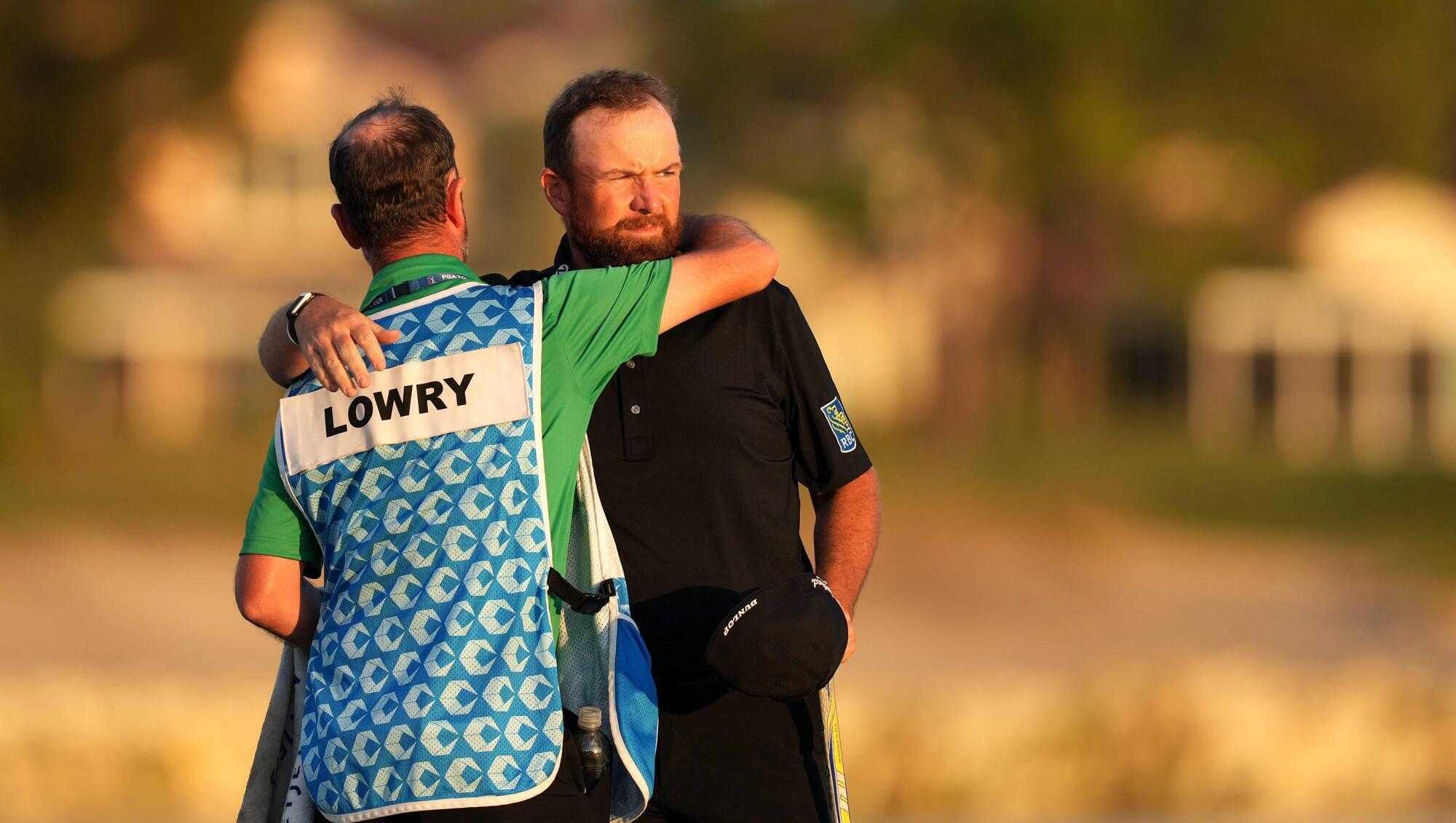
Shane Lowry and his caddie embrace on the 18th green during the final round of the Cognizant Classic. Pic: Raj Mehta/Getty Images
One player, two tournaments, five months and an ocean of emotions between them.
It was late September when Shane Lowry walked down the 18th fairway at Bethpage Black on the last day of the Ryder Cup and pondered aloud to his caddie Darren Reynolds about how this was his chance to “do the coolest thing” in his life.
Europe’s dominance, built up over the first two days, was disintegrating amid a gathering US storm and against a boorish soundtrack. Of the four matches left on the course, the visitors led in none of them. Devon Loch was in the stalls.
Trailing on that last hole, Lowry knew that a half-point would retain the cup. When Russell Henley cracked his approach from a bunker to within 10 feet but missed the birdie putt he left the door open for the Irishman who nailed the most pressurised seven-footer of his life.
Cue the tears.
Lowry was three shots up in the last round of the Cognizant Classic in Florida on Sunday night just gone when he found the water twice, carded two double bogeys and lost the title by two strokes to Colombia’s Nico Echavarria.
The great Bobby Jones once put it that golf is a game played on a five-inch course – the distance between your ears. Lowry’s interview afterwards, when he shared the thoughts running through his mind this last week, told us that again.
“The hardest thing about today is I've never won in front of my four-year-old, and she was there waiting for me. Yeah, I only wanted it for her today. I don't care about anything else. I wanted it so bad.
“Just to see her little ginger hair running down the 18th green would have been the most special thing in the world. I thought I had it. I thought I was going to win.”
Listen to the sports psychologists and they will tell you that Lowry committed a cardinal sin both times. Athletes now are trained in the art of parking thoughts of the end result, and the rewards that come with it, and concentrating on the minutiae in the moment.
Breathe. Visualise your swing, not the trophy at the back of the 18th green.
For the sports psychologist, Lowry’s two wildly different outcomes in circumstances of such enormous import would only stand as proof of the fact that his thought process leaves too much scope for something to spin out of control.
Yes, it can all play out as it does in your dreams, but it’s not an approach you would recommend in Q-School. Put it in technical golf terms and it’s a mental approach that veers towards blades rather than your more controlled cavity back irons.
That’s twice now this year that Lowry has let commanding positions slip through his fingers on the last day of a tournament. “I'm getting good at it,” he joked in an interview commendable for its frankness and the fact that he actually fronted up to the mics.
He isn’t the first golfer to find the last step to be the toughest. Look at Tommy Fleetwood, who hit the crossbar more times than he would care to remember before winning his first PGA Tour title at the 164th attempt last autumn.
Or Colin Montgomerie, who holds the record for the most runner-up spots at majors without winning one. And Padraig Harrington’s early career was a litany of too many near misses before the worm started to turn and the nearly man became The Man.
It was Harrington who kickstarted this remarkable modern period of success for Irish golf when he claimed his first Open at Carnoustie in 2007. Another trend was set that day when he flirted with disaster by finding the water on the last of the regular 72 holes.
In the years since we have seen Rory McIlroy implode at the 2011 Masters and then finally exorcise all sorts of demons by claiming his first green jacket on the back of the wildest 18 holes imaginable last April. Golf’s gamut in one simple sentence.
Lowry has delivered his own panoply of drama at the biggest of tournaments in letting slip the US Open at Oakmont ten years ago and then crushing all resistance by claiming the Claret Jug with six shots to spare three years later.
Harrington, McIlroy and Lowry have been those most to the fore as this island claimed 11 majors inside 20 years, but it is this thin line between triumph and disaster as much as the silverware itself that has made them all such compulsive viewing.
All three have shared their inner journeys week after week for years on years. The remarkable thing is that it makes these multi-millionaire sportsmen feel normal, relatable, as they jetset around the world living with those five inches inside their heads.
CONNECT WITH US TODAY



Be the first to know the latest news and updates