When the wheel turns, Irish cycling looks set to do some heavy medal lifting
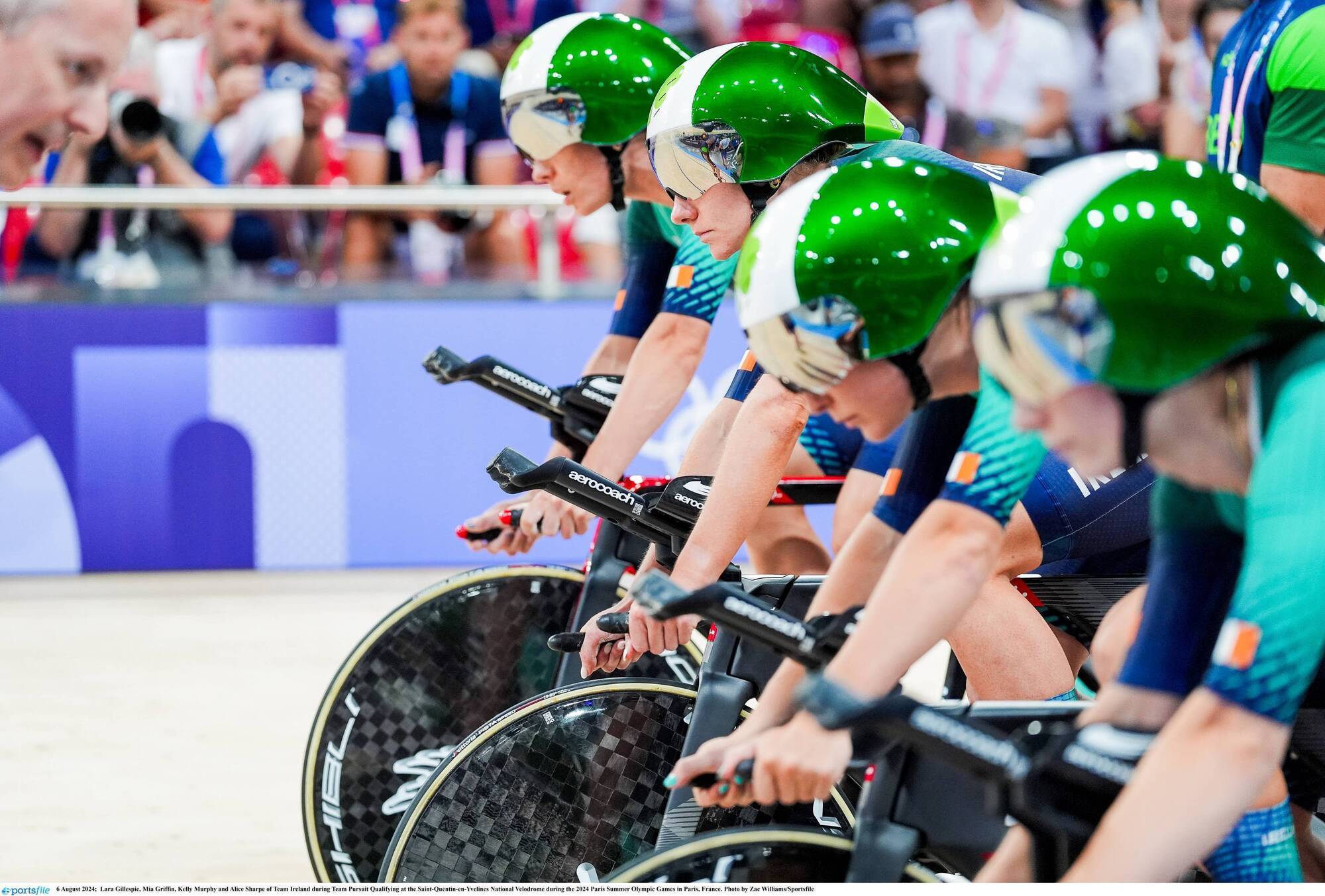
PRIMED: Ireland's Lara Gillespie, Mia Griffin, Kelly Murphy and Alice Sharpe in Team Pursuit Qualifying at the Saint-Quentin-en-Yvelines National Velodrome during the 2024 Paris Summer Olympics. Pic: Zac Williams/Sportsfile
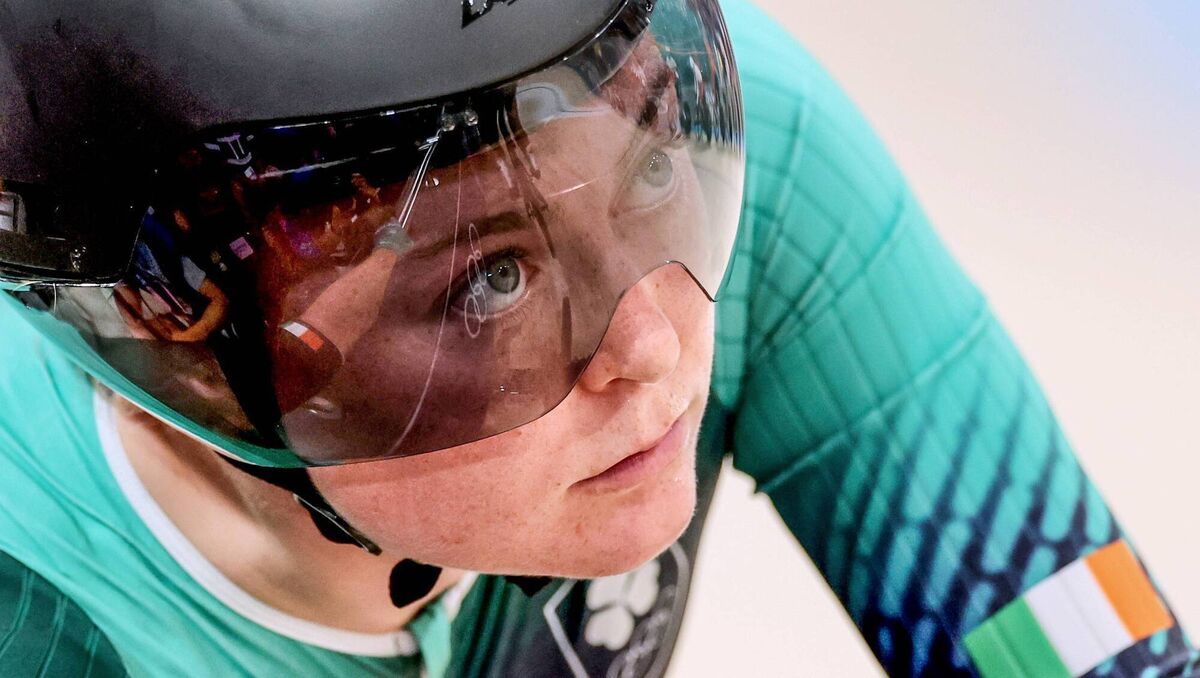
Most of the moments that made 2025 such a standout year for Irish sport on the global stage had come and gone by the time Lara Gillespie added the title of world champion to an expanding body of achievement.
A list that includes her own European title claimed last February in Belgium.
The Enniskerry woman won her second gold medal in the Elimination track race in Santiago, Chile at the back end of October. A month later and she was in Abbotstown where the first sod was turned on what will soon be this country’s first ever velodrome.
Think on that for a bit. World champion: no velodrome.
Cycling Ireland’s high-performance director lauded the ability of four female riders to overcome the absence of such critical infrastructure when qualifying for last year’s Olympic Games. So what might be possible when the track is laid at the Sport Ireland Campus?
“The word that we use, and it's such a cliché, is to say that it will be truly transformative,” says Iain Dyer.
He should know.
Dyer spent 21 years in the Team GB system in a variety of key elite coaching and management roles. He saw first-hand how the opening of the UK’s first velodrome in 1994 tore up the script for cycling across the Irish Sea. In all of its forms.
There was no history of success in British cycling in the 20th century. People were still referring back to Reg Harris and other riders from the ‘40s, ‘50s and ‘60s decades later when it was still unusual to see a British rider on the elite European circuit.
He totally gets how a mountain biker will look at a velodrome and ask what’s in it for them, but he has seen first-hand how one rising tide can lift all boats. Team GB, for instance, medalled in road, track, mountain biking and BMX in Paris in 2024.
“Everyone was rattling around the velodrome in 2002 thinking, ‘how are we going to fill this building’.
Ten years later, the staff team was in excess of 250 people and the velodrome was growing to be an indoor BMX track with an Olympic side start hill and a huge resource.
“It's now got a wind tunnel next door in the institute. So if we can open our eyes to the benefits that the velodrome will bring, and really invest hard in making that a success, the potential growth of the program will be massive.”
Dyer foresees athletes breaking through at all levels and in all disciplines. He predicts that the fruits of the new facility in West Dublin will really start to bear fruit by the Brisbane Games in 2032. And that will fuel the need for more coaches and support staff.
And more money.
He gave a presentation to Sport Ireland recently where he explained that the time is coming when he will be asking to have 30-40 athletes on the State-sponsored carding scheme. To put that in context, there were only 129 athletes carded in 2025 across all sports.
The potential for cycling is obvious.
Swimming, running and cycling are the three most popular participation sports according to the 2024 Irish Sports Monitor, and they offer boatloads of opportunities for Olympic medals for any high-programme system looking for maximum bang for its buck.
Boxing offered 52 medals at the Paris Olympics, rowing 42. These have been Ireland’s two core podium potentials, the former since the year dot and the latter since Paul O’Donovan and Gary O’Donovan first medalled in Rio de Janeiro in 2016.
Athletics? 124 medals. Swimming? 111. Cycling doled out 66. That was the fourth most of any sport on the schedule, and there is growing agreement within the industry here now that these three should be taking much more of the burden off rowing and boxing.
Irish athletics has claimed a record 25 major medals in 2025. The swimming team came home from the European Short Course Championships in Lublin earlier this month with seven medals to hold up for the cameras at Dublin Airport.
Cycling’s output is a diverse one, spread across multiple disciplines and in all directions, many of them far away from the general public’s eye. As with Ronan Dunne, who finished third in the UCI Downhill World Championship in Champéry, France in September.
Others have garnered more publicity.
Ben Healy won stage six of the Tour De France, wore the yellow jersey for two days and finished ninth overall. He also won bronze at the World Championships in Kigali while claiming podiums at Liege-Bastogne-Liege, Strade Bianche and Itzulia Basque Country.
And then there is Gillespie who, as well as the historic successes on the track that bookended her year, posted a string of big podium results on the road, including a third-place finish on stage four of the Tour de France Feminine.
Cycling Ireland has undergone its own transformation in recent years: from troubled national governing body to one whose high-performance (HP) system has become world-class and named HP programme of the year at the recent Olympic Sports Awards.
Under Dyer the full-time staff has jumped from two to nine in three years, produced medals via pathway athletes, and made a name for themselves as a system with a laser-like attention to detail and an ability to identify the best routes to success for their athletes.
High-performance sport is an unforgiving environment. Success comes at a cost, it takes sacrifices, and there is a balance to be struck between extracting the most and the best from the athlete while maintaining a duty of care to the person.
Recent reports have cast an unflattering light on Jon Rudd, the former HP director with Swim Ireland, and Antonio Maurogiovanni, who held the equivalent role with Rowing Ireland, for aspects of their roles in HP structures in the past.
British Cycling, for all its success, has been heavily criticised in recent years.
When Dyer and his staff sat down to plan the year ahead 12 months ago they did it by getting their riders around a virtual table, asking what it was they wanted to target and then working a plan of many parts around that.
The HP management group is even now putting an athlete welfare policy together based on a culture of respect that works both ways, between coaches and riders. The reality, he says, is that everyone is geared towards the same goals.
“So there's a real, symbiotic exchange that's going on here. It's not an us and them scenario. As soon as you switch to an us and them scenario you're doomed, basically. We're in it together. We're here because of them, and they're here because of us.”
These are all crucial building blocks but it’s impossible to overstate the impact of a Lara Gillespie. As one Irish sporting administrator puts it, there wouldn’t have been a Gary Keegan if there hadn’t been an Andy Lee. Gillespie is cycling’s Andy Lee.
“Undeniably,” says Dyer. “Really important on so many levels … Now others can think, ‘Well, maybe I can do that’. And it will be people much closer to Lara, that have maybe raced against Lara when they were younger, and when they see somebody achieving might think to themselves, ‘well, maybe I can do that’.
“I remember Chris Hoy talking about this, about Jason Queally when Jason won the’ kilo’ in the 2000 Sydney Olympics. Chris's first thought was, ‘well, I train with this guy every day, some days I'm actually better than he is, and he's just done that’. The effect in his confidence and his mindset…
“This was at a time when no British athletes were winning Olympic golds, let alone in track cycling. To think that, ‘I could actually do that, this is achievable for me, I'm still young and I can apply myself and achieve those things’, he went on to his own greatness as well. Lara is one of those athletes.”
Read More
Track World Championships, Elimination - Gold
Track European Championships, Elimination - Gold
World Championships Road Race - Bronze
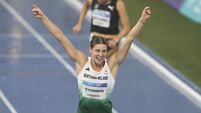
Para Road World Championships, Road Race – Gold
Para Road World Championships, Time Trial - Gold
MTB World Championships, Downhill - Bronze
European Road Championships, Junior Time Trial - Silver
European Road Championships, U23 Time Trial - Bronze
Road Championships, Junior Road Race - Bronze
European Track Championships, Junior Scratch – Silver
: 5 World and 5 European medals.


CONNECT WITH US TODAY



Be the first to know the latest news and updates