'Sometimes you do have to piss people off to grab their attention'
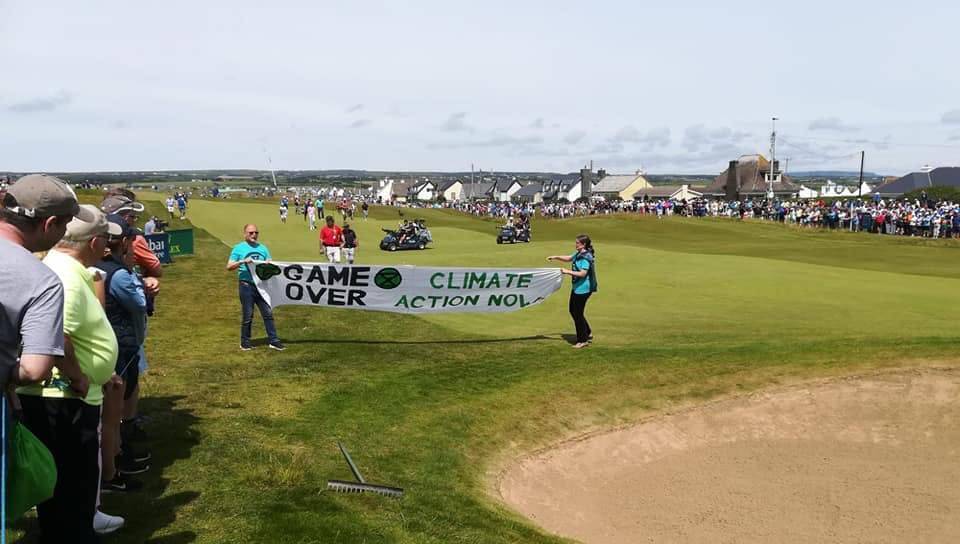
CLIMATE CHANGE: The climate action protest at the Irish Open in Lahinch in 2019. Pic: Extinction Rebellion Clare’s Facebook page.
High summer of 2001 and the eyes of the world were trained on Genoa. Politicians from the most powerful of nations were in town for the G8 summit to talk policy and economics and global poverty. Bono and Bob Geldof were engineering face time with everyone from Tony Blair to Vladimir Putin as part of a drop-the-debt campaign.
It was also a powder keg, the streets already in chaos as the two Irish celebrities shook hands and clapped backs in the neoclassical opulence of the Palazzo Ducale. Bono was among those to criticise the ‘rioters’ among a gathering of 200,000 anti-globalism protesters, but Aisling Wheeler was seeing a different story unfold on the ground.
Living in Italy at the time, and carrying a burgeoning interest in environmentalism, Wheeler found herself part of a larger group of peaceful activists corralled into a dead-end street by the local police. They were penned in just out of reach of one of the water points ubiquitous to the country’s cities, and that was no coincidence.
It was a broiling hot day.
“They were letting people out in twos and threes but not back in. One guy got out, filled water up and tried to lob them back in. The carabinieri fell on him, they just beat the crap out of him. I remember being really, really scared by that. I had never seen that before. It was the first time that I had seen police violence.”
Amnesty International describes peaceful protests as “an invaluable way to speak truth to power”. Sport has long been used as a platform. Consider how apartheid in South Africa was undermined by voices of opposition in rugby and the Olympics. Think Colin Kaepernick kneeling in his 49ers uniform and the wider Black Lives Matter movement.
According to the Statewatch organisation, Genoa in 2001 marked a new peak “in the violent management of protest in a so-called democratic country”. A map on Amnesty’s website shows countries where governments are violating the human rights of protestors right now. Seven western European nations and the USA among them.

Close to two decades had passed by the time Wheeler stood beside the 18th green at Lahinch Golf Course. Shane Lowry, Tommy Fleetwood and reigning champion Russell Knox were walking up the final fairway on day one of the Irish Open when she stepped out from the gallery with two colleagues from Extinction Rebellion (XR) Clare to unfurl a banner.
The banner read: “Game over, climate action now.”
The whole protest was done inside 30 seconds, by which time they had chanted a message designed to resonate with their suddenly captive audience. “Climate emergency, the time is near, golf links courses will disappear.” Whistles and boos rang out as two security guards led them back through the crowd. And then play continued.
As protests go, this was the far end of the scale from Genoa, or the time Wheeler had taken part in a protest blocking roads on the Swiss-Italian border. It still took guts to step out from the massed ranks and make a stand that you could be sure would invite annoyance, some anger and even condescension.
“Very nerve-racking,” Wheeler says six years later.
A local, from down the road in Ennistymon, she met neighbours in the weeks that followed, some of whom applauded the action, others who felt she had simply ‘drawn attention to herself’. That latter opinion drills to the heart of sport as a platform for protest: how to keep the spotlight on the message, not its mode of delivery, or the messenger.
A dozen people were involved in the planning stages for the Lahinch protest in 2019. There were discussions beforehand of going further, of spraying something on the greens maybe, before the idea was eventually dropped. They weren’t looking to ruin anyone’s day, just to sow a few seeds.
A report a year before by Climate Coalition had found that every links course in the UK was at risk of disappearing inside 100 years. Ireland would be no different. Shouldn’t people, shouldn’t golf people, be worked up about that? Targeting the Lowry group was designed to amplify their voice and their message at a tournament being beamed across the world.
For people like Wheeler, climate change is an alarm that never stops blaring. A call to action. For so many others it is a reason for resignation. The ‘what can I do?’ line of thought. More again deny the very science that stares us in the face. This was the sort of indifference and pushback the protesters met with in 2019.
“A lot of people just don’t think about it. This is an issue I have been concerned about for 24 years and I think about it all the time. I don’t stop thinking about it, but most people don’t seem to think about it very often. Some people just don’t really have a global view.
“I felt like people were thinking that you shouldn’t be interrupting play, that Shane is out there doing his best for his country, he has a lot of responsibility or whatever, and we were messing up… I kind of understand that people feel that, but I don’t think he felt that.”
*****
The “elephant in the room”, according to XR Clare six years ago, was a sporting event sponsored by Dubai Duty Free when the airline industry as a whole is, according to a study published in the journal Atmospheric Environment, responsible for 3.5% of all human activities that act as drivers of climate change.
A similar link served as the prompt for Extinction Rebellion Ireland’s (XRI) protest last July at a race organised by Crusaders Athletic Club in Dublin for 2,000 runners and sponsored by JP Morgan. According to a 2023 report by a group of environmental bodies, JP Morgan is the number one fossil fuel financier on the planet.
The bank committed $40.8bn to companies involved in that sector in that one calendar year alone. Fossil fuels are, by a distance, the largest man-made contributor to climate change. Over three-quarters of global greenhouse gas emissions and close to 90% of all carbon dioxide emissions stem from the industry.
And here’s the thing.
Crusaders AC is based in Irishtown, a short jog away from a point where the Liffey meets Dublin Bay. Like Lahinch, it is one of those sporting hubs most at risk from rising sea levels. This is what XRI’s Angela Deegan means when she refers to the “disconnect” in sport and among the general public.
“It’s just the irony of it,” Deegan explains. “This was an athletics club giving JP Morgan a huge platform to whitewash or sportswash their image. It’s kind of absurd, really. JP Morgan are investing in companies which are still actively expanding fossil fuel exploration.
“This is what’s going to bring about terrible consequences for everybody. You would think people interested in outdoor pursuits, like running and things like that, would be particularly concerned at that, particularly when you have athletic grounds in a low-lying area of Dublin.”
Read More
Just Stop Oil started targeting Premier League games three years ago when protestors attached themselves to goalposts at several grounds. A similar intervention was held by Derniere Renovation along the route of the Tour de France. A table at World Snooker Championships at Sheffield’s Crucible Theatre was covered in orange dye in 2023.
For a while there, such sights were common.
The spate of green protests at sporting events has clearly slowed. It’s only in the last month that four Just Stop Oil activists were jailed in the UK for an environmental protest at Manchester Airport when they sought to glue themselves to the runaway. Their offence? Conspiracy to intentionally cause a “public nuisance”.
The Liberties Rule of Law Report 2024 detailed a worrying picture when it came to freedom of assembly and peaceful protest around Europe. New restrictions are being introduced and existing ones tightened, it said, especially when it comes to protests at pro-Palestinian and climate changes demonstrations.
The UK has this year moved towards the introduction through Parliament of a fourth anti-protest bill in as many years. The latest will ban face coverings. This legislative trend has been described by Amnesty International as “draconian” and ”authoritarian”. As an attack on peaceful protest, which is protected under international law.
The Irish government is attracting criticism from the Irish Council for Civil Liberties over proposed laws here that would also govern face coverings in public places. Amnesty has expressed concern over “the escalating crackdowns on freedom of expression and peaceful assembly” in the US ahead of next year’s World Cup.
And these are in the western democracies, not authoritarian regimes.
Wheeler had no illusions about the level of impact their brief intervention in Lahinch made at the time. American tennis player Taylor Fritz said that an interruption during his game at last year’s US Open actually made him want to take more flights but, agree or disagree, which says plenty in itself for the difficulties in getting through to some.
So, what is the future for sport as a platform for protest?
“Gosh, I wish I had all the answers. I’m not a sage!” Deegan says. “We probably need a combination of things. Different things reach different people. There are different ways of taking in information so I think there is a place for different things, personally.
“Sometimes you do have to piss people off to grab their attention. I wouldn’t be one to advocate stopping traffic or anything, but a lot of people are kind of getting on with their day and need to be shaken at times.”


CONNECT WITH US TODAY



Be the first to know the latest news and updates