From the vault: Niland's journeyman life on tennis tour a net loss but a brilliant book
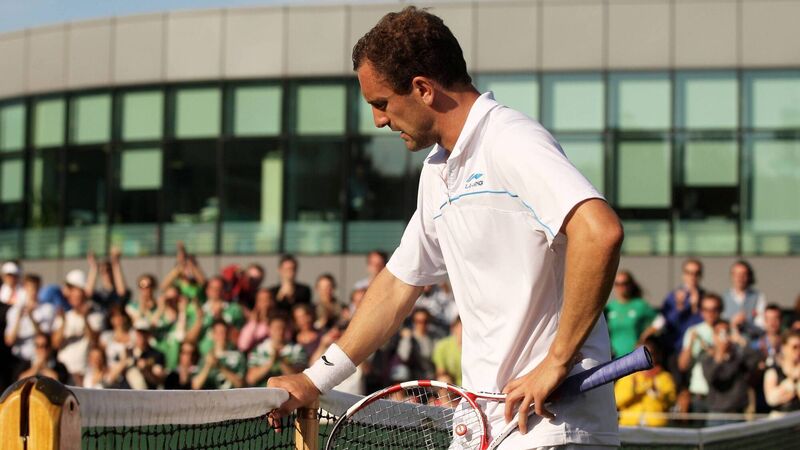
NETBUSTER: Conor Niland of Ireland reacts after losing his first round match against Adrian Mannarino of France on Day Two of Wimbledon 2011. (Photo by Oli Scarff/Getty Images)
Conor Niland,
Conor Niland has written one of the best Irish sports books of the last decade – not least because it’s much more and bigger than an Irish book.
His sport is about as international as it gets, yet seldom if ever has it served up a – a gritty, sometimes witty, insight into what it’s professional game is really like from the perspective of one of its silent majority: the journeyman.
“Obviously there was a blueprint in the Andre Agassi book that we’ve all read and loved,” he says, “but there’d never really been anything done by someone on that crazy life between 100 and 600 in the world.
“So it was important this wasn’t the autobiography of Conor Niland. Only a few people would be interested in that. But people would want to know what does Federer look like in the locker room before he goes out? [Answer: ‘He made it feel like he was its boss.’] What does the tour really look like? So though my career is the narrative arc, it’s really me saying, ‘Look at this world’ rather than ‘This is my story.’”
He’s over a decade retired now. He was approached shortly after he finished up by a publisher but his and Síne’s first daughter had just been born and he was doing a masters related to his new profession, commercial property. Covid though allowed him to pause and reflect – and write. With a degree in English from Berkeley, Niland had long had a flair and passion for the craft. Before he knew a page or two had become 60.
Later Gavin Cooney was enlisted to extract and polish even more nuggets. Together they’ve delivered pure gold, full of killer, memorable lines.
There’s a passage in the book where you recount this straight-talking American referee on the Futures circuit [the sport’s third-tier tour] and what he’d rhetorically ask a string of 28-year-olds to help them transition from delusion to reality. Simon Carr in recent months obviously asked himself the same at 24 and decided to retire, saying how lonely the life of a touring pro is. Why at 28, 29 were you still on the Challenger [second-tier] tour?
Well at that age I had consistently been ranked in the top 250 in the world and getting close to the Grand Slams. I remember saying to someone around then, I’m not going to stop digging for gold when the gold is nearby and I’ve spent this much time digging for it.
As you’d say at one point in your career, ‘I’m doing all this for one afternoon in the sun.’
And that was when I was in college, at 22, 23. And it would take seven years later before I’d get it. So I was always very aware of what I was playing for. I wasn’t going to make huge money [his career earnings would end up being a mere $247,000 – before tax] but after getting a good [US] college career, it was probably going to translate into me becoming a top 200 player and being in Grand Slam qualifying rounds.
Tennis can be very lonely. In a football or hurling team you train with the lads and while it’s tough getting pushed physically and mentally, there’s that camaraderie and sense of having a shared mission over the course of a season; there’s a finite, definite thing.
But this [tennis] was ongoing, never-ending, and the only way I was going to get a payoff was to play at the very top of the sport internationally. Even if I won an event on the Challenger tour, which is a very difficult thing, it wouldn’t register in Ireland. But Wimbledon would.
I got that payoff. Simon didn’t. The way it worked out, he didn’t even get to the Challenger tour, though I’m sure he’s still glad he tried instead of dying wondering. But that’s what drove me. And I’m glad I went for it. I was going to be mostly on the fringes but I’m able to say, ‘Well, I played Wimbledon.’
The opening line of your first chapter is a striking one. As is the second: ‘I was 10 when I first told my folks that I wanted to give it all up.’ Your neighbour Eoin Reddan at the same age could tell his dad to go away and stop turning everything into rugby.
I almost asked for permission from my parents that I was going to stop playing. Even in the Djokovic match [in the 2011 US Open when Niland was suffering from food poisoning]….
You spot your mum in the box, pushing her hands away from her body. ‘Enough.’
I get why that might seem weird; that a 29, 30-year-old man still looking to them like that. But the parents in tennis are almost like the manager.
There’s a lot of academic literature that finds that the best athletes had parents that were supportive but not pushy. Is tennis an exception?
Well, if you look at the likes of Nadal and Federer, they seemed to have parents that were balanced; interested without being overbearing. Nadal’s uncle though trained him 90 minutes a day from when he was seven.
You’ve mentioned how it’s your own children that ask you to bring them to the tennis court. It was the other way around when you were their age. But it seemed to be out of a love: Look, this will be for your own good, trust us.
That was it. My [late] dad [Ray] was obviously a high-level sportsman himself, winning a national league medal and playing in an All-Ireland semi-final with Mayo. And he knew about regrets in sport. He came off after half an hour in that All-Ireland semi-final with a pulled hamstring. He lost a minor final before that. That stays with you.
His own parents barely came to watch him play football. And it was as if he felt, ‘If ever I have kids, I’m going to give them more support [than I got].’ And he was unbelievably helpful. He was an amazing man. I think if he was still around my kids would be a bit better [smiles]. If you spent half an hour with him on the tennis court, you would be better by the end of it.
He comes across as an amazing man. A consultant ophthalmic [eye] surgeon. The image of him coming back from work at 9pm, reading the paper upright in his seat, still in his full suit and tie. And he got amazing results. Gina [Niland’s sister] is our best-ever female player. You’re the highest-ranked Irish-born player ever [129th in the world]. You’ve dedicated the book to him.
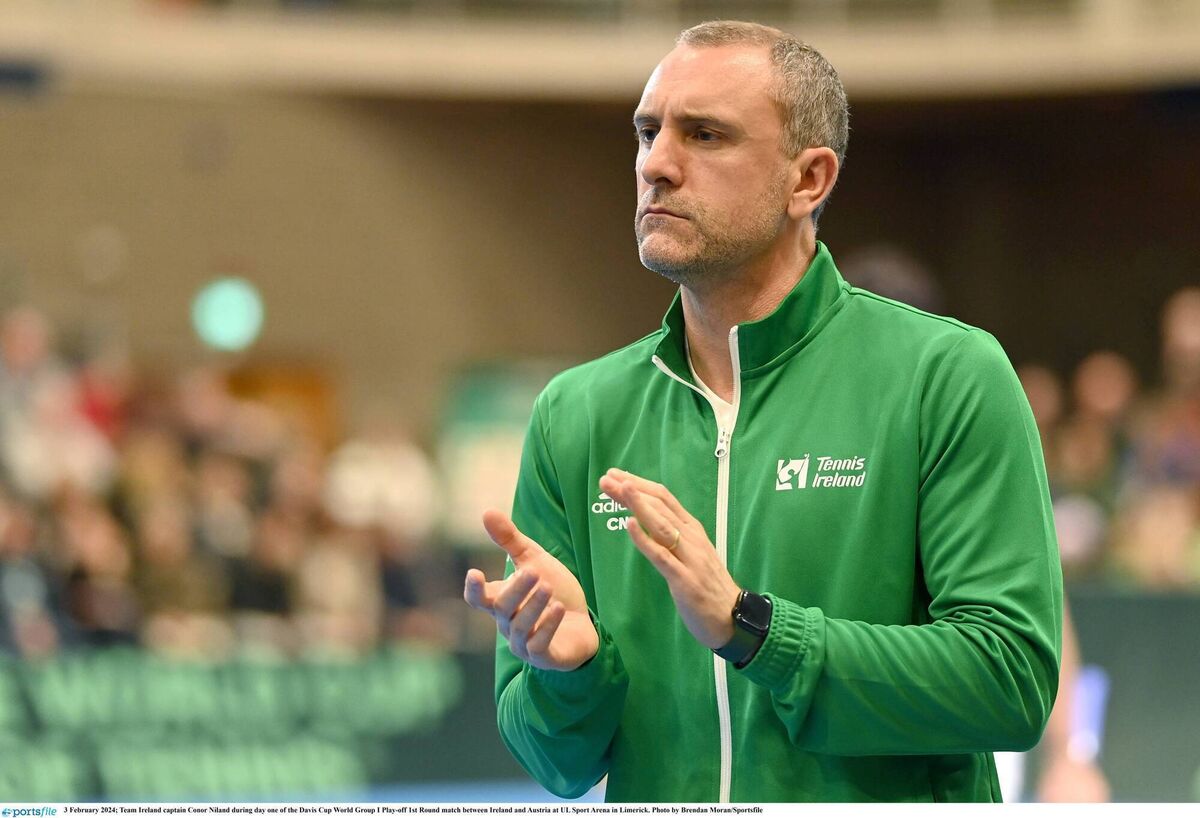
When I think of the amount of time I had with my dad through tennis, playing in the back garden, even travelling in Japan with him [shortly before Niland retired and Ray died], that’s so precious. My friend Stephen Nugent [a former pro himself] called the other day to say that I captured Dad just right in the book: while there was some tension, he was always just trying to help.
He wasn’t this fanatic. He helped produce four well-rounded kids. But when we were doing tennis we were going to go hard at it.
That court he carved out in the back garden. Is it still there?
We sold that house a while back. I don’t know if the court is still there.
When you recall it, how do you look at it? As your playground? Your prison?
It definitely wasn’t a prison, though I do sometimes feel that tennis was sort of this trap: I’m caught, I’m an international class player and this is what I do now. I could never have that conversation that I was going to stop it or get out of it. At 10 I tried but it was basically, ‘No!’ So I look back on that court with my parents and siblings as largely positive. Even though there were times I didn’t want to play, it was a bit like doing your homework. You mightn’t feel like doing it but it’s ultimately for your own good.
Probably the best chapter is ‘Levels of the Game’ in which you describe the unspoken norms and codes of the tour. Who and whether to salute and all the energy and ego that involved. Probably the standout example is the passage about the Bulgarian.
[Grigor] Dimitrov. He’s still top 10 in the world.
And you knew him when he was starting out as an 18-year-old. He latched onto you, confided to you that Sharapova liked him, before they’d go out together for a while. So he’d have known you as Conor?
Sure we’d have dinner together. Practised together all that week.
You talk then though as his ranking rose the less effusive he was. And then the devastating outro line: ‘By the time he had cracked the top 20, he was ignoring me completely.’ Even though he knew you?
Tennis players always know other tennis players. It’s how their brains are wired; they have to remember other players because you could come across them again across the net and you’ve to figure them out.
And did you think, ‘God, what an asshole’ or ‘God, so even you’ve succumbed to the bullshit, buddy’?
Probably more the latter. Maybe he didn’t have the social skills I thought he had but there was definitely that [hierarchy] thing.
And there was – and still is – that whole difficulty of finding someone to hit with before a game as people were quite coy about who they would help.
Yeah. I would have anxiety going to bed at night, ‘God, I don’t have a warmup lined for tomorrow. What am I going to do?’ I started to travel with a coach so I’d always have that backup.
Another rule of the road: Never tell a taxi driver you are a tennis player – just say you play for fun. Why?!
I remember doing a tough week’s training in DCU, then getting on a Saturday flight to France, feeling prepped and primed. So I’m going to the airport and your man sees the rackets. ‘Oh, do you play tennis?!’ So you quickly calculate: Okay, do I really want to spend 45 minutes with this anti-sport-psychologist?!’ Because he’s obviously interested. Before you know it, he’s lecturing you, ‘Jesus man, that’s tough!’ And by the end of the 45 minutes, you’re getting out of the taxi, drained. Deflated!
It’s constantly about conserving your energy. You talk about deliberately lying in so it would reduce the conscious amount of hours hanging around. How if someone asked you what Morocco was like you’d just say ‘Fine’ because you couldn’t tell them anything else about it. You travelled the world without seeing the world.
Yeah. And maybe I did it wrong. I probably overdid it.
I see players now on Instagram posting photos of them having taken off their tennis clothes, put on something normal and take a half-day to do something. That’s probably more pervasive now on the tour; that, you know what, if you want to do this for 15 to 20 years, mate, you better go to the odd feckin’ museum and relax.
That line Richard Williams said to you when you hit with Venus and Serena. First of all, how did you find him and them?
He seemed like a man that had seen quite a few things. He looked an old man, or at least older than he was. But their setup seemed a lot less intense than, say, the Sharapova one. The two girls looked like they were having a good time. ‘Hey, we’re in Bollettieri’s, palm trees, sun shining, we’re going to be the best in the world, it’s all good.’
Well, many years later it’s your turn against Djokovic. US Open, 2011, Arthur Ashe Stadium. Only you’re suffering from food poisoning. It was you out there but it wasn’t the real you. How do you think the real you would have done?
I was playing really well that week; only lost one set in that qualifying round. But the better you play against those guys, they tend to just match it and go beyond. Djokovic’s opponent in the second round was this Argentinian, [Carlos] Berlocq, a really good, proper player, and he just got absolutely destroyed [6-0, 6-1, 6-1].
I don’t know if I could have got to 6-1, 6-1, 6-1 or something like that – and that would have been me playing well. But I practised with Andy Murray in London and one of those practise sets was 7-5. It was just practice but he was playing particularly well at that time.
They often say a lot of guys lost to Pete Sampras 6-4, 6-3, 6-4; he’d tune in for the service games and then up it once or twice [against serve]. But Djokovic is a total destroyer. On every point he just wants to kill you.
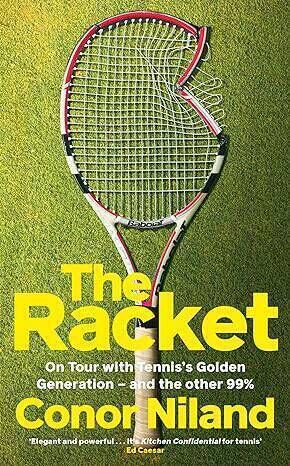
The cover of the book and the broken racket. Is that to symbolise a certain frustration you had with the sport?
Well, I smashed it! Penguin had a sample cover with an old racket so I said, ‘Lads, you need a proper racket’, so I got one and duly broke it! I suppose it does hint that we’re these international-class athletes doing this professional thing but it’s a broken system. There’s certainly a lot of broken dreams.
You say that the tour seems to see its business more as just to oversee competitions than the welfare of its participants. It doesn’t seem to have a duty of care.
There was a weekend [workshop] in London when you made the top 200. But other than that you were completely on your own. There’s no mental health services or anything like that. Working in property now I have to have a licence and reapply every year. In tennis I wasn’t part of a body that I needed to sign out of. I just stopped turning up. And no one asked me where I had gone.
You seem to have come out of it fairly well though.
Yeah, I’m good. I think a lot of tennis players do well because life on tour is so challenging.
You look at a lot of footballers, the life is unbelievable but a lot of them then struggle post-retirement. They miss the rush of the crowd, the camaraderie in the dressing room, the social life.
The fact you have none of that in tennis nearly sets you up quite well! As I say, my social life improved once I finished playing!
CONNECT WITH US TODAY



Be the first to know the latest news and updates