Irish swimmer Conor Ferguson on 8 years chasing fractions of a second
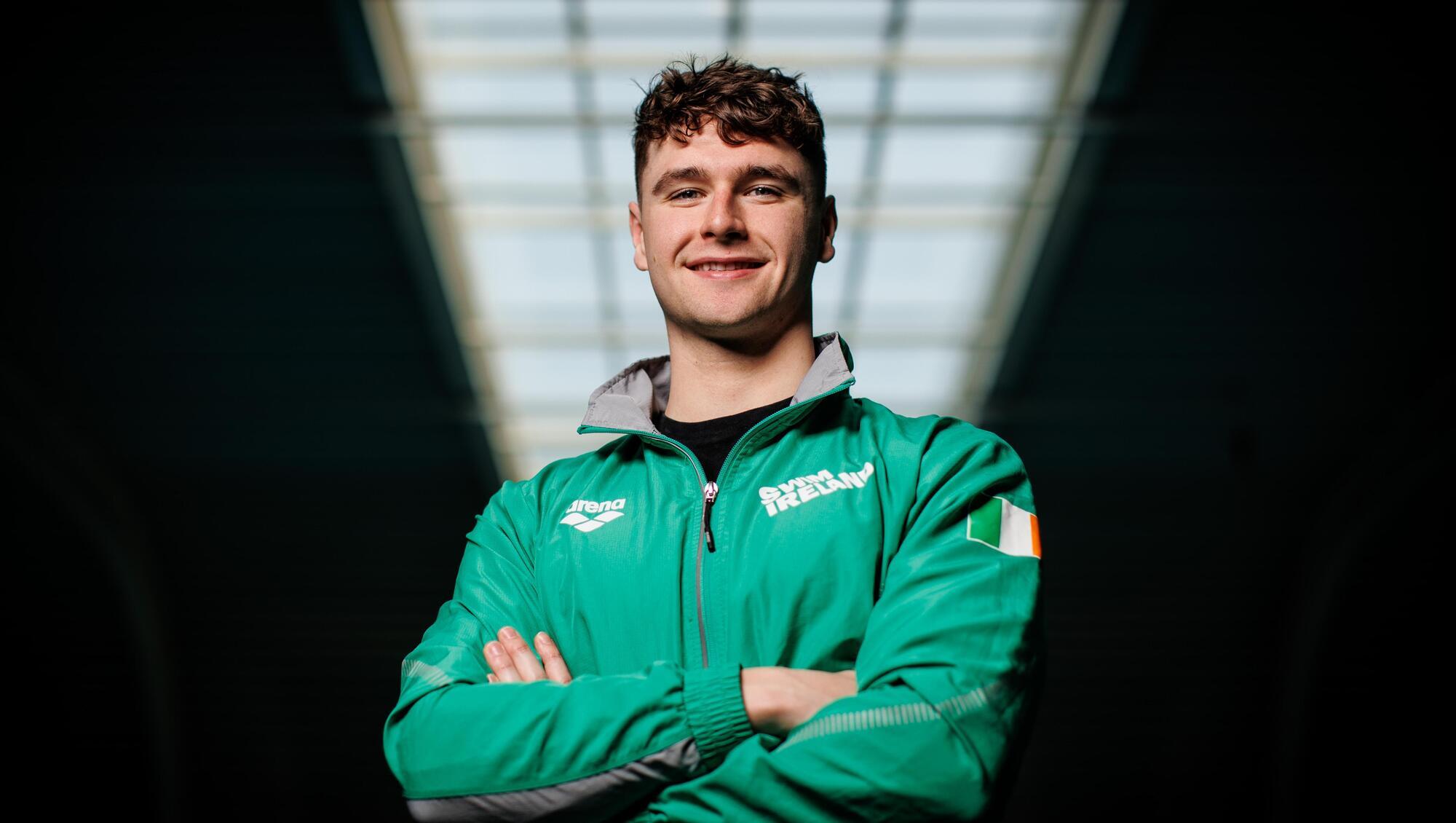
Conor Ferguson pictured ahead of the Swim Ireland Irish Open Championships and Olympic Trials. Pic: INPHO/Ben Brady
Conor Ferguson has spent eight years chasing tenths of a second. These are the infinitesimal margins determining who goes to an Olympic Games and who does not and it’s a search made all the more elusive by the fact that the bar keeps inching higher.
He was still only in his mid-teens, and in a phase of his career when pieces of time were being broken off his PBs like chunks of rustic bread, when he came up painfully shy of booking a place at the Rio Games.
“Yeah, I missed it by .05 of a second, when I was 16. It’s crazy thinking about it now. At the time I was just a kid going, ‘I want to make an Olympic Games’, with an outside chance. It was something like a breakthrough swim.”
Disappointing as it was, it made Tokyo feel doable. Almost inevitable. In the end, the Belfast man was half-a-second adrift as the mark required for the 100m backstroke contracted from 54.36 for 2016 to 53.85. It’s tighter again now having been pinched to 53.74.
So close, now that bit further away.
So on Ferguson goes, struggling to push his own boulder up the hill like a waterborne Sisyphus. He broke the magical 54-second barrier at the World Champs in Doha in February and then lowered it again, to 53.90, in the semi-finals.
He’s graphing in the right direction and, on Wednesday at the National Aquatic Centre in Abbottstown, he will hope to shave off that last 0.16 seconds at an Irish Open meet that is doubling up as a last-chance Olympic qualifying saloon for up to a dozen hopefuls.
“This year especially I know I am capable of doing this time, if not going faster. I believe that because of what I am seeing every day in training and that once I get this final prep done I will be in top form. It is just doing it on the day. That’s what it comes down to.”
It may be that he makes it to France as part of the men’s 4 x 100m medley relay team but their invitation is conditional on at least two of the quartet qualifying as individuals. None have done so thus far, which brings up back to where we started.
Parsing a millisecond here or there is a forensic business.
Like Ireland’s world champion Daniel Wiffen, Ferguson is based at Loughborough University and he utilises the state-of-the-art Kistler camera system and all sorts of other metrics to identify the marginal gains needed to get over the line.
It’s not necessarily a case of being faster on top of the water. The focus for him is to maintain speed on the first 50m without using as much energy because he showed in Doha that he was up there with the fastest swimmers for the second 50.
The turn is another area ripe for improvement.
“We’re talking one-tenth of a second here,” he explained.
It all comes down to this. To now. Ferguson comes from a family with a decent rugby pedigree, the two previous generations having played at a decent level, but the Belfast man gravitated towards the water.
Andrew Bree, an Olympian in Beijing in 2008, hailed from just down the road. Ferguson’s own burning ambition was fortified four years later when he got his picture taken with the Olympic flame as it passed through his home town before the London Games.
Success came early and often but missing out on Tokyo rocked him to his core. He went from hardly missing a day in the pool since the age of 10 or 11 to a complete three-month break and another three months humming and hawing over his future.
“'Am I good enough? Am I cut out for this sport? Am I cut out for the hard mornings in winter? These are the sort of questions that run through your head when you’re at a low point in your career.” He worked for a bit in hospital administration, helping to run the vaccine programmes, and it was January of 2022 before he dealt with all the flotsam and jetsam in his mind and recommitted to a third shot at the big ambition.
He scoured around for the right environment and finally settled on Loughborough where the educational opportunities mirrored the standard of sporting facilities and support and moved over with his partner to plot a course for Paris.
“It always happens at some stage in your career and I am really thankful that I did come through that period, because it has brought me on so much. It has changed me, not only in swimming, but outside of the pool as well in my personality and character.” Now for those last few milliseconds.


CONNECT WITH US TODAY



Be the first to know the latest news and updates