Crucible touching distance away for Irish hopefuls but the bar gets higher

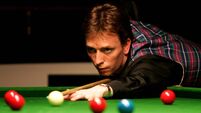
Aaron Hill of Ireland during the 2023 Cazoo World Championship 2023 Qualifiers at English Institute of Sport. Photo by VCG/VCG via Getty Images
Ten minutes in a car, down streets flanked most of the way by the River Don on one side and the Sheffield & Tinsley Canal on the other, is all it takes to get from the World Snooker Academy at the English Institute of Sport in the city’s traditional east end to the iconic Crucible Theatre.
This is the distance 128 players, including 16 invited amateurs, look to cover when the World Championship qualifiers get underway at the ‘EIS’ on Monday. The ‘Home of Snooker’ is a lot closer for these hopefuls than in the days when the qualifiers were held in Prestatyn in north Wales but it can still feel like light years away.
“You feel the butterflies a few days before the Crucible,” says Fergal O’Brien. “These are different nerves, not so good nerves. There’s almost a Dead Man Walking feel to it. It is so important to qualify it feels like you’ve won a tournament. Being beaten [in the qualifiers] is the biggest disappointment you can have.”
Nobody knows these twin truths better.
O’Brien has made the Crucible ten times. He reached the quarter-final in 2000, a feat sandwiched by his win at the 1999 British Open and his loss in the decider of the Masters in the last frame to Paul Hunter in 2001. This next stab at making the Worlds will be the last chapter in his 32-year career having given notice of retirement earlier this season.

The Dubliner has come up short in the last qualifying round at least half a dozen times. He has lost 10-9 on the pink, 10-9 on the black and 10-9 on a respotted black. In 2017 he beat England’s David Gilbert 10-9 after a deciding frame that, at two hours, three minutes and 41 seconds, was the longest in snooker history.
They agonised for half an hour on the yellow alone.
Mark Selby hammered him 10-2 in the opening round of the tournament proper just days later but that was very much the lesser of two evils for a man who knows what it is to stumble back to the hotel after defeat in the qualifiers and wake up the next morning unable to remember anything after the last crushing frame.
“If someone offered you the option of qualifying and losing in the first round you would still take it. At least you’re there. Part of Christmas Day is the build-up to Christmas Day, so even if you don’t get the presents you want you’ve had the weeks and months of excitement and the night before.”
***
The men’s Open golf championship has 156 slots, the two Wimbledon singles events stretch to 128 places apiece, and the last PDC World Championships had 96 different players standing at the oche. Only 32 people get to play in the World Snooker Championships and 16 of them come through a ridiculously treacherous qualifying route.
This year’s qualifying field boats four ex-world champions in Ken Doherty, Graeme Dott, Neil Robertson and Stuart Bingham. Stephen Maguire and Matthew Stevens, two former runners-up, will join them. So will guys like Jimmy White and Marco Fu. Jack Lisowski, Ryan Day, Si Jiahui and Hossein Vafaei are among the younger names of note.
Snooker is more of a global game now than before. The reigning men’s world champion, Luca Brecel, is Belgian, his female counterpart is China’s Bai Yulu. Hong Kong’s Ka Wei Cheung and Qatar’s Ali Alobaidli hold different amateur crowns. Hungary’s Bulcsu Revesz, who will be in Sheffield next week, is the World Amateur U21 holder.
“A Hungarian lad in the World Snooker Championship? Ten years ago you’d be laughed at.”
That’s PJ Nolan, national coach for Snooker & Billiards Ireland who spent ten years in the same role in Qatar and has tutored the likes of Ireland’s Aaron Hill, Alobaidli, Revesz and any number of others.
There were 23 countries represented at the Institute 12 months ago. The ‘home nations’ aside, there were players from China, Jamaica, Pakistan, India, Austria, Hungary, Estonia, Cyprus, Belgium, Brazil, Switzerland, Germany and Iran. The Republic of Ireland had four in the pot, a presence that has been diluted to three this time.
O’Brien is the first of that trio in action on Tuesday, Doherty enters the mix in round two and so does Hill whose performances and results this season have excused him duties from the first of the four rounds. The Cork man reached the third hurdle in 2023 but has gone one-and-done in the past as well. His take on this week, and its import, is succinct.
“It’s a different atmosphere than the Welsh Open qualifier.”
***
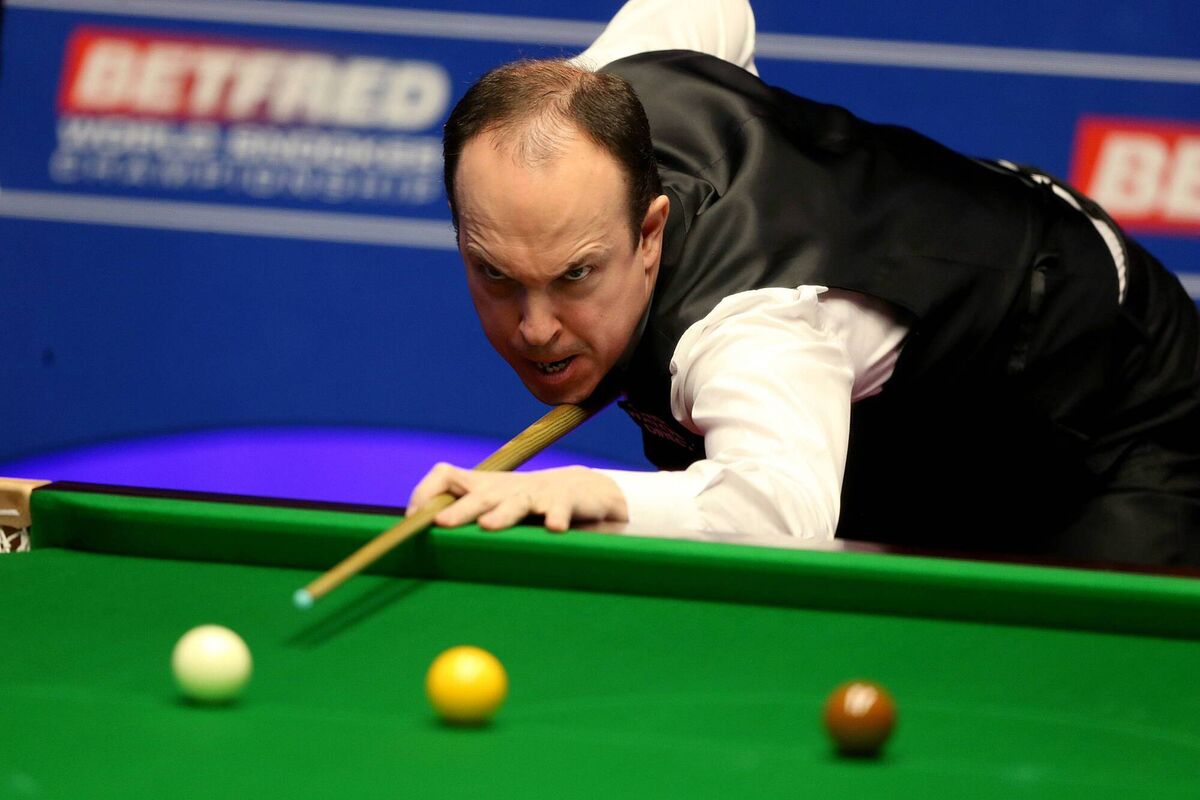
The World Championships aren’t some outlier in the context of the sport at large. The snooker landscape at the elite end is a shallow pool. Everyone’s dream is to make the top 16, or the top eight, but the first priority is a spot on one of the first 64 rungs of the ladder. Fall below that and you slip down the snake to square one.
Points accrued and tour cards only last for two years. Performances prior to that are basically meaningless with everyone from the number 65 in the world on down has to apply again. It’s very much a case of ‘what have you done for me lately’. The same applies to that inner circle of 16 and places for the top tournaments.
This is why the likes of Neil Robertson, who won three ranking tournaments as recently as the 2021/22 season, is having to sweat it out at the Institute this time. It’s why Michael Holt, a player with 25 years’ experience as a pro and with a first ranking title not long in the bag, found himself relegated to the status of amateur and competing on the Q Tour.
Alan McManus, a one-time world number six, has labelled the game at the lower end of the rankings as a “brutal fight for survival”. There are only a handful of tour places available through Q School, Q Tour and amateur championships and the fact that so many old sharks are swimming in the waters make it incredibly difficult for the next wave to break through.
Ronnie O’Sullivan has slaughtered the standard of that younger generation more than once. He made his latest dig at the Masters in January when claiming that they were too slow for him even though he was ‘going blind, has a dodgy arm and bad knees’. Nolan says that was just the Rocket’s way of lighting some fires.
“There’s 200 players who have made a 147. Ronnie O’Sullivan has 15 of them. If you had told me 15 years ago that there would be 200 I would have said ‘no way, it’s too hard’. Aaron Hill has made back-to-back 147s [in practice], Mark Allen’s best is three in a row. David Morris from Kilkenny had back-to-back 147s.”
O’Brien echoes this.
He looks back now at Stephen Hendry’s peak and he doesn’t see much, if any, snooker being played now that is better. The difference is the improvement further down the depth chart where the critical mass of talent is so much greater. The player ranked 40 now is basically streets ahead of the guy who held that spot 20 years ago.
It makes for a mad scramble upwards.
Q School costs £800, Q Tour is an eight-leg affair around various countries while qualifying events for regular tournaments involve long days in nondescript venues filled with cubicles. It’s expensive, a grind and a world where an up-and-comer can beat a player dozens of places above him one minute and lose to someone dozens of places below the next.
“Before maybe you could ‘old man’ guys in the opening rounds, use your experience. Now if you’re not on them from the first shot you could lose a qualifier 4-0 in less than an hour. You mightn’t have known anything about the guy other than his name, and he might not go on and do anything in his career, but he’s well capable of beating you in round one.
“It’s certainly harder to get to the Crucible now than it was,” says O’Brien. “The days of good draws are gone or very rare. There’s plenty of good young players and everything comes down to hunger: what do you want and what are you prepared to do? You need the attitude that you will get a spot regardless of the system.”
***
O’Brien left nothing to chance. He would arrange to meet up with friends for local discos as a teenager then make sure to arrive a half-hour too late so that he could miss the night out and be fresh for another seven or eight hours practice the next morning. That tunnel vision left him with an average Leaving Cert and a burning desire to make it pro.
He moved over to London as soon as he could where Ilford was a magnet for Irish snooker exiles. Eugene Hughes and Ken Doherty both gravitated there. So did Stephen O’Connor, the 1990 world amateur champion, and Eamon Dunphy’s son Tim. O’Brien shared a house up the road in Chadwell Heath for some of it and lived on his own too.
He left a family and a girlfriend behind and could hardly make toast. There were nights when he went to bed fearful in that big, strange, foreign city but it exposed him to the environment he needed on the table, and it gave him the space to play the same shot 100 times in a row if he had to. It never felt like a sacrifice.
“If you had offered me a job at 19 with a hundred grand a year I would have turned it down because snooker was what I wanted.”
So much has changed since. The old snooker halls have faded from view and this country’s imprint on the world game isn’t what it once was. O’Brien is 54 and turning to coaching and commentating, Doherty is three years younger. Northern Ireland’s Mark Allen, at 38, is the leading light on the island, but Hill has what it takes to carry the torch on.
The 22-year reached his first ranking quarter-final at the Wuhan Open earlier this year and he looks well set to finish inside that top 64 and renew his card having lost it at the first time of asking a few years back. The talent is there. So is a work ethic that involves long days spent practising in Antrim with Allen, Jordan Brown and Robbie McGuigan.
“Aaron has big shoulders but he has a lot of stuff on them,” says Nolan. “He is the face of Irish snooker. Fergal is retiring, Ken doesn’t have so many years left and he’s going into the media, but he is still the biggest thing we have. I don’t think anyone is ever going to be bigger than Ken Doherty but if Aaron broke through it would be huge.”
O’Brien’s last appearance at the Crucible was that first round exit to Selby seven years ago. No other player from the Republic has graced its tables this past ten years. Take away Allen’s annual visits going back to 2007 and the roll call of players from this island at the game’s showpiece looks increasingly bare.
The bar in Sheffield in April is arguably higher than it ever was.
A collection of the latest sports news, reports and analysis from Cork.
CONNECT WITH US TODAY



Be the first to know the latest news and updates