John Coghlan: Irish athletics still has cart before the horse
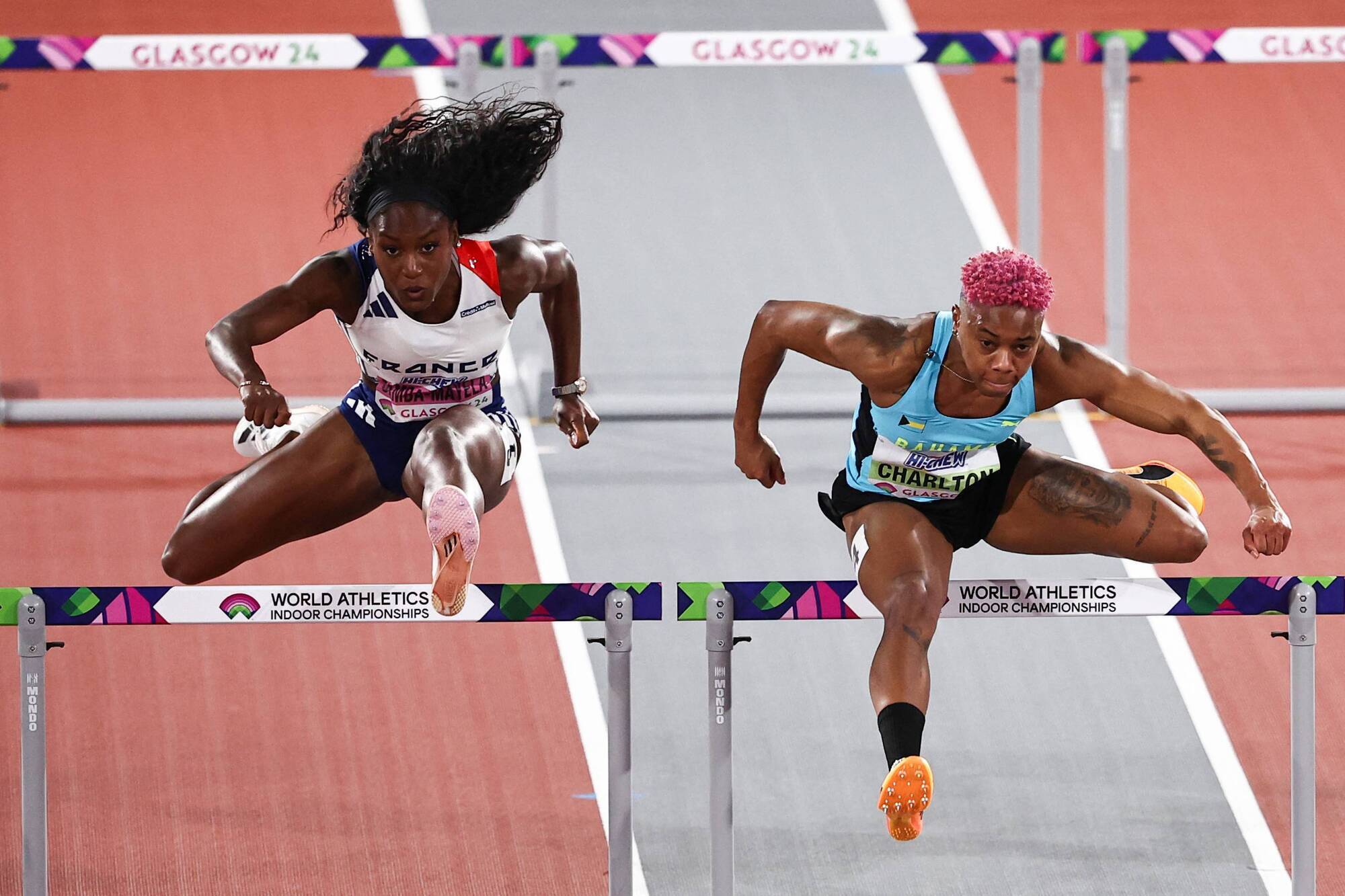
France's Cyrena Samba-Mayela (L) and Bahamas' Devynne Charlton compete in the Women's 60m hurdles final during the Indoor World Athletics Championships in Glasgow. Pic: Anne-Christine POUJOULAT, AP
Four months until the Olympics, and one of Ireland’s most successful coaches picks up the phone 4,000 miles from home. John Coghlan knows this isn’t how it should be but, well, it’s how it is.
Ever since 2020, the Dubliner has plied his trade in Orlando, Florida, helping athletes from Puerto Rico, France and China to major championship medals. It won’t be changing anytime soon.
Coghlan’s expertise spans far and wide and, over the last two decades, it’s been applied to make many Irish sportspeople stronger and faster, from soccer to Gaelic football to hurling. But his heart always beats strongest for athletics.
The thing is: in Ireland that sport has long relied on volunteerism, the coaches guiding athletes to Olympic finals traditionally remunerated the same way as those helping beginners finish a Parkrun – which is to say, not at all.
Between 2007 and 2014, Coghlan worked with many of Ireland’s best athletes before hitting an economic dead end. Back then, training GAA teams a few nights a week provided the bulk of his income but as an athletics coach, it was “impossible to be able to live, to get basic things.”
“I could have had a full-time job and (coach athletics) a few nights a week and I’ve huge respect for people who do that,” he says. “But I just know, having been a professional coach, how much that is falling short. It’s pissing against the wind. I was always trying to do things to a world-class level, not just getting to championships, and I think there is a difference.”
Things have improved, slightly, in recent years, with the top tranche of Irish coaches now given modest funding, though it’s not so much an income as a donation to help cover expenses. Would Coghlan consider coming back?
“If there was the right situation, I’d always be open,” he says. “Nobody from any authority has ever spoken to me about (it).”
Before moving to Florida in 2020, Coghlan spent three years as head of physical development for Meath GAA. His return to athletics came via Paul Doyle, an American who’s one of the sport’s top agents. Doyle had coached Coghlan’s brother, Peter, during his career as a world-class sprint hurdler, and he told Coghlan that Jasmine Camacho-Quinn, a former NCAA star who represented Puerto Rico, was looking for a new coach. Coghlan visited her in March 2020 and moved to Florida later that year, coaching her to Olympic gold in Tokyo.
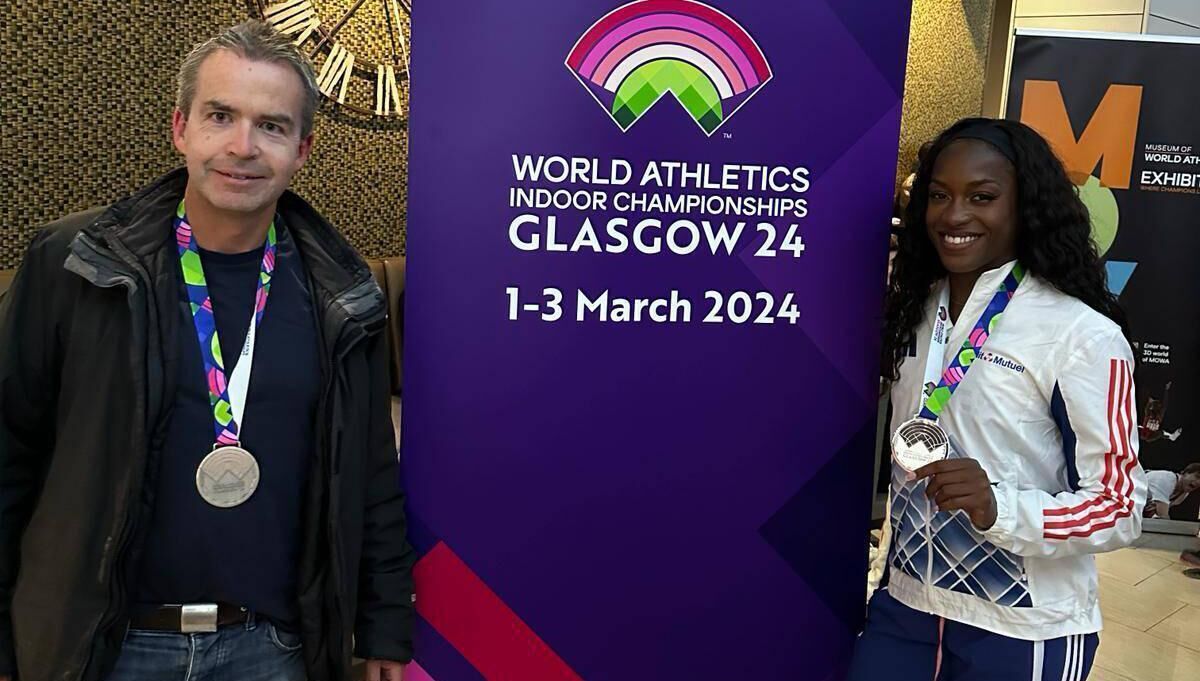
Camacho-Quinn remains the star of his group, though its latest addition is Cyrena Samba-Mayela, who moved from France to Florida last October to train with Coghlan ahead of the Paris Olympics. The 23-year-old was already one of the world’s top hurdlers but after misfiring at last year’s World Championships, she knew a change was needed.
To build her up, Coghlan first had to break her down, picking apart her technique in the autumn, getting her to reconceptualise what she knew. “It’s much more technical than this, but her concept of hurdling was jumping across the hurdle and you’ve got to run through the hurdle,” he says. “It’s modified sprinting, not hurdling as such. We’re breaking things down way more into specific movement patterns and doing a lot of drills, trying to breach coordination barriers. She’s been very open to it and that’s the key to progress – her openness to change.”
Samba-Mayela says Coghlan is “really efficient in his work, someone practical, logical” and that she’s “discovering a new way of training.” Coghlan says Samba-Mayela is “like a sponge – she wants more and more information, which is great for a coach.”
They didn’t set a high bar for the indoor season given the ongoing work to rebuild her mechanics. Samba-Mayela did a couple of low-key races to see how things were progressing and ran better than expected, clocking 7.90 in Arkansas and winning the French indoor title in 7.87. “We said, ‘we might as well just do the world indoors at that stage,’” says Coghlan. “Things were starting to click.”
In Glasgow, she ran 7.81 to win her heat, a French record of 7.73 in the semi-final and 7.74 to win silver in the final, beaten only by the world record of 7.65 by Devynne Charlton. When Coghlan dissected the race video, he realised she was nowhere near her limit.
“I was like, ‘ugh, it’s not even that good,’” he laughs. “I’m not being bad. This is a good thing: you’re running that fast (despite errors).” It left them both excited to get back to work, with Samba-Mayela – a Paris native – having the opportunity of a lifetime as her home Olympics loom into view. “I saw the potential in Glasgow, but I’m preparing the final masterpiece for this outdoor season,” she says.
Of course, there’s an inconvenient truth here from an Irish perspective. In Sarah Lavin, the country has a potential Olympic finalist in the 100m hurdles, yet an Irish coach is applying his expertise with a cluster of athletes who could edge her out of that. For more than 20 years, Lavin has been coached at Emerald AC by Noelle Morrissey, who’s done a magnificent job guiding her to the top level despite holding down a day job as manager of the Eason store in Nenagh.
Coghlan once walked a similar path to Morrissey and knows how hard it can be. “I was putting in 25-30 hours a week (coaching) and it was a watered-down version of what I do now. But I thought, ‘I can’t keep doing this forever.’ I was trying to do it as professionally as possible but didn’t have time to get a job. It was one or the other, and I had to give it up.”
Having worked in China and the US and knowing the ins and outs of various high-performance systems, Coghlan believes the Irish approach lags behind. He recalls a coaching conference at the 2022 World Championships where he shared a panel with Dutch Olympic performance director Charles van Commenee and Sharon Hannan, the Australian coach of 2012 Olympic hurdles champion Sally Pearson. They agreed on the key components of a strong system.
“The athletes don’t need that much money as long as you can provide them with a really good coaching setup and be in a situation where they can train full-time,” he says. “That’s all you need. It’s not that complicated.”
In Ireland, he says it’s still “cart before the horse”. Coghlan says there are “great facilities” but questions having full-time support staff in the absence of full-time coaches. “Would you have an analyst team at Man City or Liverpool without having Pep Guardiola or Jurgen Klopp in place?” We talk of the Dutch system, with top athletes living and training at a centralised location under full-time coaches. It’s reaped huge dividends, the Netherlands winning eight athletics medals at the Tokyo Olympics and five at last year’s World Championships. Ireland hasn’t won a medal at either in over a decade.
“When you see the amount of money spent on things, it wouldn’t take that much (to recreate),” says Coghlan. “We don’t have a huge population; it’d be relatively easy. The coach would be extremely important, but you’d also need a situation where athletes could train full-time, whether you could provide accommodation nearby.”
He may be far from home but as a proud Irishman, one who’s preparing athletes from other countries for the biggest show on earth, Coghlan believes a trick is being missed. “In events like the hurdles, Ireland could be winning medals,” he says. “A hundred percent.”

CONNECT WITH US TODAY



Be the first to know the latest news and updates