Rarely has outlook been so bright for Irish athletics
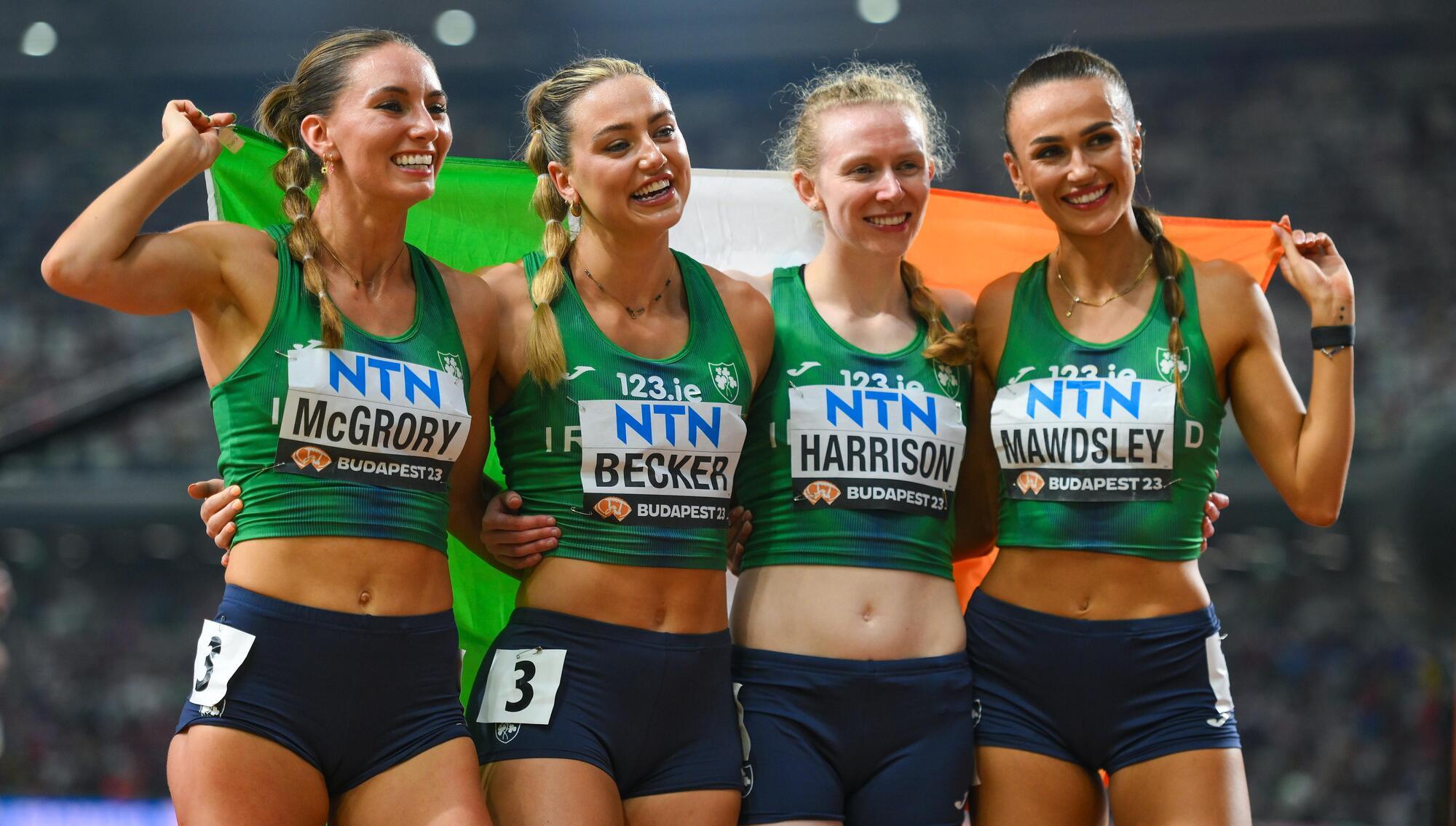
ANOTHER BRIGHT SPOT: The Ireland women's 4x400m relay team, from left, Sophie Becker, Kelly McGrory, Roisin Harrison and Sharlene Mawdsley. Pic: Sam Barnes/Sportsfile
At an event as big as the World Athletics Championships, with over 2,000 athletes, from 200 nations, the conversations you have while standing around, waiting to interview athletes, teach you an awful lot. At this grade, in a global sport, Ireland is a tiny speck of sand in a Sahara-sized landscape, one inhabited by the speediest, strongest humans in existence.
Maybe it’s the hulking, explosive power of Ryan Crouser, the best shot putter in history, who can squat 700lbs yet also run a 4.8-second 40-metre sprint – all needed to throw a metal sphere the weight of a bowling ball the length of a tennis court.
Maybe it’s the gymnastic athleticism of Mondo Duplantis, who sprints at over 10 metres per second while carrying a five-metre pole, then hoists himself more than six metres into the sky, manoeuvring his body like a world-class contortionist. Or maybe it’s the astonishing finishing prowess of Faith Kipyegon, the greatest female middle-distance runner in history, who ran with the world’s best over both 1500m and 5000m before unleashing deadly, destructive, 56-second last laps to take gold.
These are the outliers among outliers, names that will echo for generations in athletics, and rightly so.
The difficulty of joining them on the podium is underlined by the fact just five Irish athletes have ever won medals at this event, with just two on the track in its 40-year history: Eamonn Coghlan and Sonia O’Sullivan. Watching Ciara Mageean and Rhasidat Adeleke come oh-so-close to joining them brought to mind a story about a US coach at a previous edition. One of his athletes was puzzled at his inability to advance through the 1500m rounds, talking about the workouts he’d done, how fast he could kick in the last 300m. “The clue is in the name,” said the coach. “It’s the Championships. Everyone else can do that too.”

As a journalist, this was my sixth World Championships, the first being the 2013 edition in Moscow, where Rob Heffernan won gold in the 50km race walk. In the decade since, Ireland hasn’t really had a sniff, these Monday post-mortems typically examining just how far off it they’d been, or else clinging to top-10s, top-12s, as signs of some green shoots.
But Budapest was different.
It’s a little over a year since Athletics Ireland launched its High Performance Strategy, and one of the most notable targets within that was the ambition to win an athletics medal at the 2024 Olympics. Given the lack of athletes then ranked in the top eight worldwide, it seemed a hugely optimistic goal, but not anymore. Ireland now have two genuine, realistic medal contenders for Paris, 11 months out.
Which brings us back to those conversations. Come to these championships enough and you get to know journalists from all around the world, who are usually far too busy with their work to consciously keep track of how a minnow like Ireland is faring. But what was notable last week was how many of them, when you had those little one-minute exchanges in the mixed zone, remarked on how well Ireland was doing, the green vests up there, present, the athletes fighting the good fight against the world’s best.
It was an impression backed up by numbers, with Ireland netting 12 top-24 finishes, two above the expectation, and four top-eight finishes: Adeleke, Mageean, the mixed 4x400m and women’s 4x400m. Mageean and Sarah Lavin broke national records, Sarah Healy hammered the Irish U23 1500m record, while Sophie O’Sullivan announced herself as a potential senior star with a whopping five-second PB in the 1500m heats.
All of them brought their best to the big stage. You can ask no more. There were many disappointments, of course, Brian Fay and Nick Griggs getting baptisms of fire, while Luke McCann, Andrew Coscoran and Eric Favors were all below their best, as were race walkers David Kenny and Brendan Boyce. Mark English resuscitated what had previously been a lifeless season, igniting hope he can still make the Olympic final that would be just reward for an athlete of his calibre.
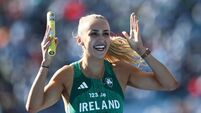
Kate O’Connor looked right at home on the big stage, the multi-eventer taking a giant step forward, while, pound for pound, the Irish star of the week was likely Sharlene Mawdsley, who helped the mixed relay to sixth before smashing her PB to reach the world 400m semi-final, returning to hoist the women’s 4x400m into the final with another blazing anchor leg.
“The days of just about qualifying and being out the back door, they do seem to be gone to some degree,” says Paul McNamara, Athletics Ireland’s High Performance Director. “Whatever benchmark we choose to look at, it is significant progress. We are in a better place than we’ve been in a hell of a long time.”
McNamara knew Ireland was not, on paper, expected to win a medal, which is why deeper metrics of depth are a fairer gauge of success. Still, there are other ways to define it, such as the manner in which athletics re-acquainted itself with the Irish public, drawing in new fans and reigniting a love for it among many who’d fallen away. What might that do for recruiting fresh talent?
“Ah, it’s massive,” says McNamara. “I said that in Munich last year: the number of kids that are really excited about our sport, who spent their evenings on the couch for the last nine days, the opportunities it presents going forward in terms of potential increased Sport Ireland funding, potential commercial revenue streams, all of which can be invested directly back into the sport.
“There’s some things we’re doing quite well. We’re honest and open enough to acknowledge there are other things we’re not doing quite well that we need to improve. A lot of that is resource dependent when one would like to think there’s an imminent upsurge in revenue streams that can better support athlete and coach pairs, and come to these champs even better prepared.”
Rarely has the outlook been this bright. On this stage, the Irish are minnows no more.
CONNECT WITH US TODAY



Be the first to know the latest news and updates