Gillian O'Sullivan's moment in time still endures
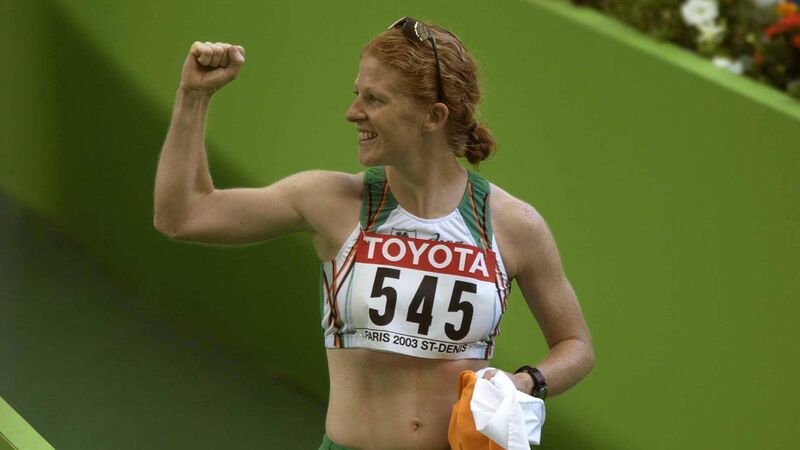
STERLING EFFORT: Gillian O'Sullivan celebrates after winning her silver medal in the Women's 20K Walk final at the 2003 World Championships in Paris, France. Pic: Brendan Moran/Sportsfile
Followers of Cork football will be familiar with the Lissivigeen roundabout. On the pilgrimage to Killarney for Munster final Sundays, the roundabout is one of the last traffic pinch points as you creep towards Fitzgerald Stadium.
It’s where the N22 meets the N72. It’s where, with the finish line in sight, the snaking line of cars crawling from Rathmore and Ballyvourney directions collide to a standstill.
Gillian O’Sullivan was never one for standing still. Didn’t suit her. Especially in forced retirement.
Back in 2011, the Lissivigeen roundabout was named in her honour. It was named after her because of what she achieved in Paris eight years earlier.
Paris and her World silver are 20 years old this week.
Virgin Media, who have been beaming the current edition of the World Athletics Championships into Irish homes, posted a tweet a couple of days ago of footage from the closing stages of the women’s 20km walk from the 2003 championships.
There you can see the red-haired O’Sullivan haring down the home straight of the Stade de France. The black glasses have been lifted off her eyes. Her face, for so long a picture of unbreakable concentration, has melted in the Parisian morning sun. Crossing the line second, she thumps the air three times.
“What a day,” O’Sullivan replied to the tweet.
What a day, indeed. The Minish native, from just beyond the Lissivigeen roundabout on Killarney’s outskirts, was the first Irish racewalker to medal on the global stage.
Twenty years on, she remains part of an exclusive club of only five Irish athletes - Eamonn Coghlan, Sonia, Olive Loughnane, and Rob Heffernan the other four - to podium at a World Championship.
And as the agonising fourth place finishes of Ciara Mageean and Rhasidat Adeleke reaffirmed on recent evenings, world medals are a rare currency.
For the Saturday morning parkrunners out there, imagine a 21.53 clocking. It’s a clocking that is doable for plenty.
But now imagine running a 21.53 5km back-to-back-to-back-to-back. That’s what O’Sullivan did in Paris. Except the then 27-year-old did it walking, not running.
“When I was watching the clip last week, I said to myself, ‘oh my God, how did I do it’.
“It feels like a different universe because it is a completely different life to the normal life I have now,” says the Kerry native long resident in Cork.
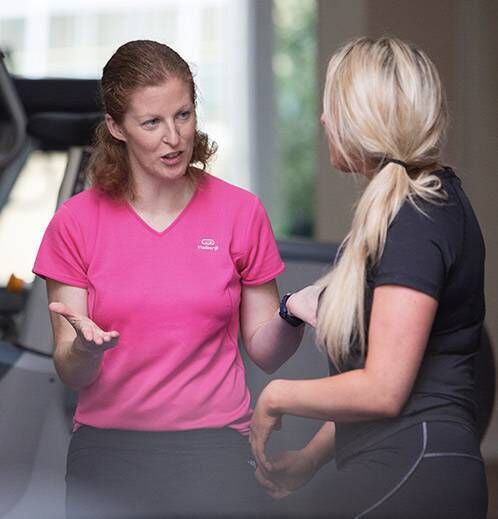
These days, she’s a mom, a wife, and a personal trainer based out of Hayfield Manor in Cork city.
O’Sullivan has been following the action from Budapest all week, regularly remarking to her husband, Anthony, the turn she gets in her stomach when the camera switches to the call room in the bowels of the stadium.
All that nervous waiting. The stalking of opposition. The dread and excitement of what was or was not to come over the next 20km.
“It’s the worst place ever. You want to be there, but you kind of want to run away, as well. It’s funny the feelings it brings back.”
For a time, though, O’Sullivan didn’t want to know about athletics and its major championships.
She didn’t want any reminder of call rooms or the career taken away from her.
From among the best in the world to being parachuted back into daily life before she was ready took years of difficult readjustment.
In April 2007, and less than a year into her 30s, O’Sullivan stopped the watch on her racewalking career. It was not her decision. An injury on the left side of her lower back that had prevented her challenging for a medal at the 2004 Olympics and ruined the seasons that came after refused to ever fully subside.
Her last training session along the old railway line in Blackrock remains perfectly vivid. No more than the Carrigrohane straight road on the far side of Cork city, it was a patch she’d covered many times.
During this particular session, though, O’Sullivan pulled up time and again. The pain screamed all the way from the middle of her back to below her left knee.
She was due to fly out to Malaga for a training camp that same week.
“I knew this was it, like, finished. You just know something bad is happening and you can't stop it. My body had completely broken down.”
And yet she tried to fight. She got on the plane to Malaga, intending to grit and grind through the impending camp and its 80-miles-a-week workload. But even on the flight out, she could hardly sit with the pain.
“I met my coach, Michael Lane, out there and said to him, ‘I don't think I can do it’. I flew home the next day.
“You are on a false high then,” she continues, “because you are doing interviews about retiring, but after that, oh my God like, it is horrendous.
“You have to try and pick yourself up and adapt back into a normal person. And it takes a long time.”
As her injuries worsened from 2004 onward, she became a regular on Gerard Hartmann’s table in his Limerick clinic. The renowned physical therapist told her it would take three years to find peace with her new existence as a former athlete.
He was spot on.
“You have to reinvent yourself. When I retired, I still had the heart rate monitor and all that stuff. I was going out running, and for a brief moment I thought, maybe I'll try the marathon. I was scrambling for another goal.
“Initially, I was doing way more training in retirement than I needed to. I was nearly trying to replicate what I was doing as a professional. There was no need, but I just didn’t have a balance.
“The Beijing Olympics, I didn't even want to know it was on because I should have been there. You don't want to know anybody doing well.”
But, as with so much in life, the passing of time proved the ultimate healer. She set up her own personal training business in 2008, got married the same year, and gave birth to her son, Tom, in 2011.
“You slowly come to terms with the fact that race walking was this part of my life, and you become more grateful of the fantastic career and brilliant experience I had. And you accept more that life does go on after it.
“You get to the stage then where you are delighted if people even remember you,” she says, breaking out in laughter.
On weeks such as this, the magnitude of what she and her four fellow World medallists achieved is amplified.
In such a lonely and demanding discipline, she was, as they say on Leeside, haunted to have Rob Heffernan walking up the world ladder at the same time she was.
After graduating as a secondary school teacher from UCC in 1998, she knew that if she returned home to Minish, the isolation of training alone would make the necessary application and workload even more challenging.
“I was at a crossroads. It was a case of where am I going and what am I doing?
“Remaining in Cork meant the opportunity was there to fall in with Rob. Now, I wouldn't have needed someone to train with every day, and if you needed someone beside you most days then long-distance racing definitely wasn’t for you. But it did help to know there were others working off the same schedule as you.
“I ended up living in a house full of runners at Victoria Cross. That all helped because they understood what you were at. There was no one going out drinking at the end of the working week.”
Her 2003 silver medal, behind the Russian Yelena Nikolayeva, was no stunning surprise. She’d been 10th at the Sydney Olympics and beaten into fourth in the final couple of hundred metres at the 2002 Europeans.
“Twenty years on, you appreciate way more what your body was able to do back then.
“It was years of work to get it done. A life's work in one day. It comes off then and you are very grateful. And proud. It was brilliant, exceptional really.
“The high of that day is a high you will never manage again. You have managed to achieve this, but it is all the people along with you, as well, my coach, my parents, all my family, my friends, everybody. It was this massive celebration. It was incredible.
“It was a moment in time, and such a good one.”
CONNECT WITH US TODAY



Be the first to know the latest news and updates