Even sport's golden cathedrals are nothing without people and dreams
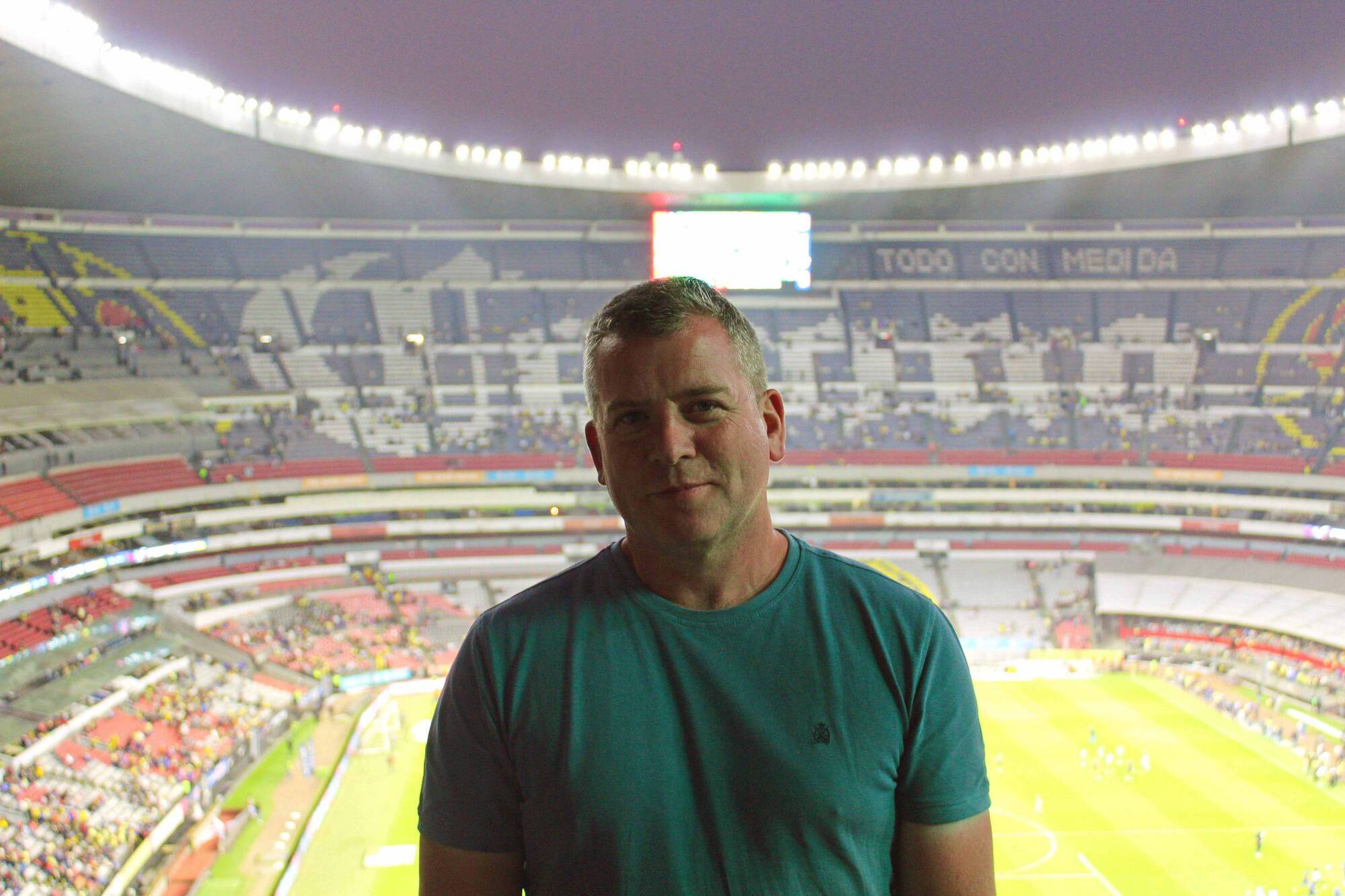
Dara inside the Azteca Stadium Mexico City.jpeg
Have you ever turned into Mountjoy Square in Dublin on your way to a big game and saw Croke Park in the distance?
What did you feel in that moment and why did you feel it?
Yes, there’s all the tension about the game and what will happen. But isn’t there something about the place too? The stadium where so much has happened for so long and where you often felt a sense of connection and community like you had never felt before? Along with all the joys and sorrows you could have never imagined as a child?
A new series Na Goirt Órga (The Fields of Gold) will be first broadcast on TG4 on Thursday night, exploring the landscapes and settings of sport and what they mean to us. And through those places what sport itself means.
The Irish language version of the series is hosted by Dara Ó Cinnéide, the radio and television broadcaster and former an Ghaeltacht and Kerry footballer. It comprises three one-hour long episodes. The series is produced by Loosehorse for TG4 in co-production with Cwmni Da and S4C (Wales), JTV and KCA (Korea) and LIC (China). It features twelve diverse sports venues in Ireland, Mexico, China, Korea, Croatia, Portugal, Wales and England.
The purpose of the series is to explore the meaning, magic and joy of sport through the places where they happen.
Dara told me he really enjoyed his trip to Anfield which was his childhood team in the days of Kenny Dalglish. Seeing the club ‘under the skin’ as they are doing renovations. The highlights were the ‘This is Anfield’ sign, the home dressing room and the storied ‘boot room’. In the first episode he speaks of the place echoing with history. Of course all great sporting arenas are heavy with history, and when it’s your team, the history is personal.
He was delighted to discover another link between Liverpool FC and Ireland. An Irish shipping magnate Robert Samuel Graves, while Lord Mayor of Liverpool, named a new street up to the ground Anfield Lane after a lane beside his home in County Wexford.
In episode one, Dara also visits the Municipal Stadium of Braga, Portugal; the World Cup Stadium in Jeonju, Korea; and The Ryan McBride Brandywell Stadium in Derry, which is so embedded in the city’s culture its people’s identity.
In episode two Dara’s journey is more personal to his own sporting career when he revisits Croke Park (on the days of an All-Ireland hurling final and a football semi-final) – the stadium where he captained Kerry to glory in 2004. He also chats with his friend and teammate Tomás Ó Sé in Fitzgerald Stadium, Killarney, where they both togged out so often for club and county. He is aware that he romanticises the summer evenings training there, but who could blame him?
He told me that the most moving place he visited in the series was in Frongoch in Wales where 1800 Irish prisoners were interned after 1916, including GAA star Dick Fitzgerald (with five All-Ireland medals at the time), after whom Fitzgerald Stadium is named. He organised the famous ‘All-Ireland championship behind barbed wire’ there, where he probably played against Michael Collins.
"To stand in that Welsh field on a cold morning," Dara told me, "where Dick Fitzgerald coached a team over a hundred years ago to play in a mar dhea All-Ireland Final was very special indeed.’ He also told me of the historical significance of St Finian’s Psychiatric Hospital overlooking the pitch in Killarney and its links to the legendary trainer Dr Eamon O’Sullivan who developed occupational therapy so much and was so instrumental in building the stadium.
In episode two Dara also sees the passion of the Racecourse in Wrexham, North Wales, first hand – the oldest national football stadium in the world.
In episode three, Dara goes to one of the most iconic sports arenas, the Azteca stadium in Mexico City and he tells me about the ‘wow factor’ it creates. Venue for the 1968 Olympics where Bob Beamon set a long jump world record and where Pelé and Maradona lit up World Cups in 1970 and 1986. After that, the state-of-the-art new Tottenham Hotspur Stadium where he speaks to the author Simon English about Archibald Leitch, the first architect of football grounds in the UK. He finishes up exploring the ancient sport of horse racing in the wonderful amphitheatre that is the Curragh of Kildare in the company of trainer Willie McCreery, against whom he played football.
But he is quick to point out to me that while the venues are all impressive, speaking with local fans makes them more significant. The places themselves don’t mean anything without the people who throng there week-in-week-out.
He also says that while the ‘bright shining edifices’ of the Premier League like Tottenham’s new ground are impressive, Croke Park matches any of them and how privileged we are to have it.
Like all good ideas in retrospect, we wonder why a series like this has not been made before. But the main thing is it’s here now and will run for the next three weeks on Thursday night, beginning tonight. And we can all walk vicariously beside Dara Ó Cinnéide and experience these places and listen to the people who give them significance as they recount their stories.
At the heart of all these contrasting cathedrals to the religion of sport are the fields of gold where dreams come true or are shattered. But the faith lives on.
Each venue with its own history and identity, all threads in the great woven tapestry that is sport. Meaning, magic and joy indeed.
CONNECT WITH US TODAY



Be the first to know the latest news and updates