'This is first steps' - Irish athletics coaches to get financial support
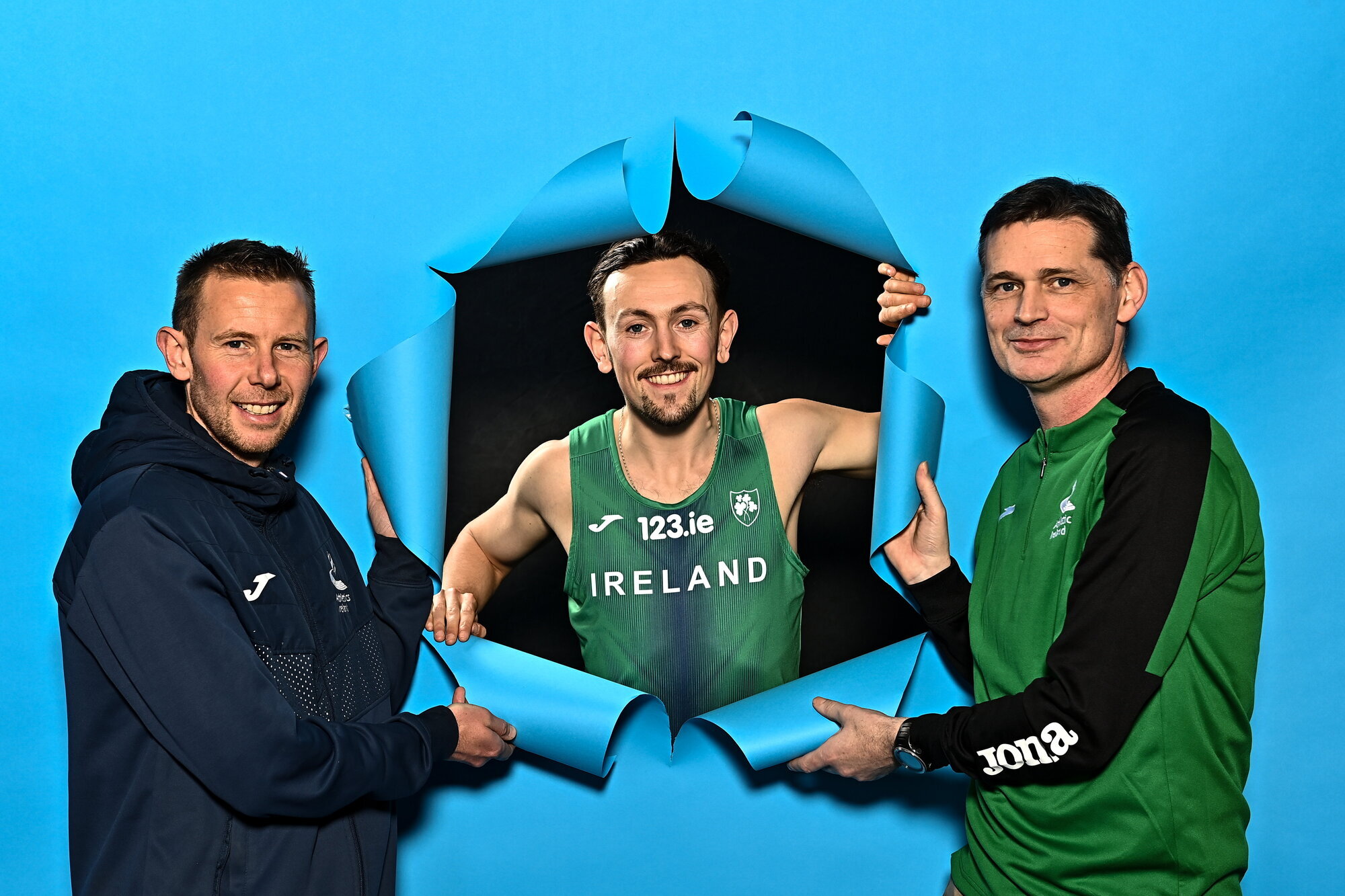
In attendance during a 2023 European Indoor Championships Team Ireland media morning are, from left, Athletics Ireland High Performance Support Coach Emmett Dunleavy, 800m runner John Fitzsimons, and Athletics Ireland Director of High Performance Paul McNamara. Picture: Sam Barnes/Sportsfile
Changing an entire culture doesn’t happen overnight, but as steps forward go, this represents one giant leap for Irish athletics. Through its history the sport has been propped up and powered by the work of volunteer coaches, their work and expertise typically going unrewarded, but now it’s set to be acknowledged in the best way possible: with cold, hard cash.
Athletics Ireland (AI) will offer financial support to 10 contracted Irish coaches this year, with more due to be added in the weeks ahead and a pot of €80,000 split between them. That’s been made possible by an additional €200,000 from Sport Ireland, beyond its core funding, to help Athletics Ireland achieve the aims set out in its High Performance Plan 2022-2028, with the incremental professionalisation of coaching one of its chief objectives.
The coaches selected were those with a track record of producing top performers such as Rob Heffernan, Noelle Morrissey, Feidhlim Kelly and Jeremy Lyons. There will also be a shake-up in the provision of services to such coaches, with more on-site assistance at their training venues and the coaches being prioritised for travelling with the Irish team to major championships.
“By the end of the year the total outlay will be around €150,000,” said Paul McNamara, Athletics Ireland’s High Performance Director. “We’re not talking huge sums, full-time salaries. We’re talking (about valuing) a portion of a coach’s time to support maybe a day or two a week. We do feel this is first steps. These guys are almost all employed in full-time jobs. It’s not that they can’t necessarily afford to be trackside, it’s the justification of that outlay. It’s intended to be money that supports what you are doing.
“Coaching is a profession in most European countries and in the US; it’s not necessarily a profession here. We’re contracting the time of very, very busy people and trying to facilitate that incremental professionalisation of coaching.”
McNamara says “front and centre” of the strategy is to appoint a full-time head coach in 2024 with a track record of international success who will be tasked with mentoring and overseeing the work of Irish coaches.
“We are working towards that and if we have the right candidate and the right money, they can offer real value,” he said. “That’s the key issue: will that individual offer real value to what our coaches are doing on the ground?”
Darragh McElhinney, whose coach Emmett Dunleavy is among those being supported, is fully behind the initiative. “The coaches who are getting it deserve it; they’ve been putting in the hard yards for years,” he said.
“There are a lot of expenses that go into it and you don’t want the fella coaching you to see it as a financial burden.”
Two of McElhinney’s former coaches – Steven Macklin and David McCarthy – accepted coaching positions in Qatar in recent years, and McElhinney believes this funding will “give coaches an incentive to stay in Ireland and keep working with Irish athletes.”
John Fitzsimons, whose coach Joe Ryan is among those supported, was in agreement. “The sport deserves it, the coaches deserve it,” he said. “These are some of the hardest-working people in the sport. They get great recognition, but recognition doesn’t pay the bills. It’s great they are getting paid.”
On a day when Athletics Ireland announced 123.ie as its official kit sponsor, the Irish team was also announced for next week’s European Indoor Championships in Istanbul, with 12 individuals and the women’s 4x400m gaining the nod for selection. Other Irish athletes were hoping to receive a late invite from European Athletics in events where the quota has not been filled – such as 400m national champion Jack Raftery – but McNamara confirmed on Thursday afternoon that European Athletics will not issue any further invites via its qualifying system, which has come in for substantial criticism this year.
“The rankings process doesn’t really work for indoors,” he said. “It’s almost impossible to implement properly for World Athletics, European Athletics and for us.”
McNamara noted the absence of Ciara Mageean (due to a recent injury) and Rhasidat Adeleke (due to NCAA commitments) would hurt the Irish medal chances in Istanbul, with four-time European medallist Mark English representing their best chance.
“In the absence of medals, you’re looking for depth, and the depth will be there,” he said. “You’re looking at four top-eights.”
On the absence of Irish competitors at last weekend’s World Cross Country in Australia, McNamara said it was chiefly due to the lack of availability of Ireland’s top performers.
“Given the way the World Cross has evolved, it just doesn’t play a significant part in most athlete’s performance plans in this part of the world anymore,” he said. “We’re more than happy to meet the cost, but we don’t just go to a championship because it’s there; we go to make an impact. If it cost €30,000 to send two athletes, that money is better spent investing in performance coaches adding value to what athletes are trying to achieve.”


CONNECT WITH US TODAY



Be the first to know the latest news and updates