A night of bullfighting: He explodes into the ring, 500 kgs of looming jeopardy
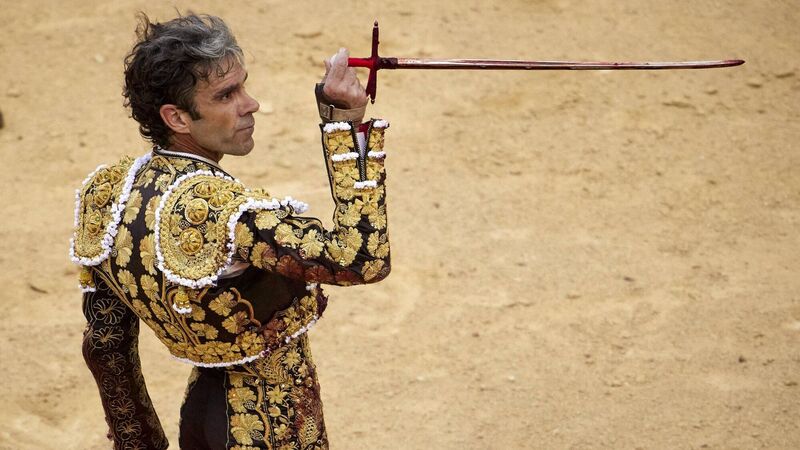
SWORD: Spanish bullfighter Jose Tomas holds the sword as he acknowledges the public after killing a bull during a bullfight at the Coso de La Alameda bullring in Jaen, on June 12, 2022
The bull never, ever, gets a second chance - that would be far too dangerous. Animals can be quick learners and if granted a ‘do-over’ a bull would almost certainly apply his further education to a new fight and that would put the matador needlessly in harms way. Besides, it would make things fair. Bad stuff can happen when things get fair.
In ‘Death in the Afternoon’ his ardent defence of old-fashioned bullfighting, corrida de toros, Ernest Hemingway tells the tale of a bull who became experienced having learnt his trade in the ‘capeas’ or ungoverned fights in cash-starved provincial Spanish towns near Valencia. The sort of towns much too poor to carry the cost of a dead expensive animal so the bulls were recycled and by frequent combat they gained knowledge, grew smarter and developed menace.
Hemingway’s beast had a lengthy career, long enough to kill sixteen people and gore about sixty more before time caught up with him and he ended his days slain in an act of chilling revenge.
The brother and sister of one of his victims, ‘a gypsy boy’, had tracked the bull across the remote provinces of Spain for years hoping for an unguarded moment when they could claim their bloody vengeance. That moment never came so when the bull was finally dispatched for butchery, they paid the slaughterhouse manager for the privilege of the kill. Afterwards, they cooked the bull’s entrails on a street corner, ate them, disappeared, and were never seen again.
That was a hundred years ago. There are no second chances anymore. Not even in the weary-looking castled city of Jaen, nestled close to the dry mountains of Andalusia, just off the road from Madrid and Malaga and where tonight six bulls will die in the fading light of a balmy late autumn evening. They will die angry, confused deaths during the annual festival of San Lucas, the patron saint of the region, the self-styled world capital of olive oil.
Bullfighting is a peculiar activity to stumble across in an EU member state, in the year 2022 and there are few activities that divide public opinion quite as passionately.
The prevailing view outside of Spain, Portugal and the Hispanic countries of Central America, is that this is neither sport nor culture but a spectacle built on a cruel barbarity that ends with the ritualistic slaughter of a tortured animal.
“Not so!” cry the aficionados, evangelical in their conviction that bullfighting is an ancient and essential component of Spanish heritage, just as important as dance, art or poetry. They point to the newspapers where the reporting from the corrida is found not in the sports pages but the culture section.
Their view has been endorsed by a federal law from 2013 which preambles that “Bullfighting is an artistic manifestation detached from ideologies in which deep human values such as intelligence, bravery, aesthetics or solidarity are highlighted.”
Then there are the proponents of bullfighting purely as a sport where strong and skilful athletes compete courageously under circumstances of high personal risk. Matadors, for them, are true sportsmen who must perform with the vision and dexterity of Lionel Messi while being menaced by a tonne of sharp-horned angry beef.
Hemingway said: “The only art in which the artist is in danger of death and in which the degree of brilliance in the performance is left to the fighter’s honour”
Violent interaction between man and bull are not recent. Cave paintings of bullfights over four-thousand years old have been found in Crete. The ancient Romans, predictably, relished any spectacle with a bloody climax and the Moor’s brought a version along when they invaded Andalusia from North Africa at the beginning of the eighth century. It gradually emerged as a pastime of the aristocracy and lancing bulls from horseback became an integral part of court pageantry.
The church was initially ambiguous regarding of the killing of bulls. An enabling early synod had equated the animal with Satan, describing the bull, in words that wouldn’t encourage much mercy, as “a large, black, monstrous apparition with horns on his head, cloven hoofs, hair, ass’s ears, claws, fiery eyes, gnashing teeth, and huge phallus, and sulphurous smell.”
But this perspective softened through the centuries and by 1567 Pope Pius V had had enough. He mandated the ex-communication of nobles who promoted bull fights and refused a Catholic burial to anybody unlucky enough to die in the ring. But not for the first time, nor the last, awkward diktats from Rome were overlooked by the faithful, popularity soared and eventually bullfighting on foot was codified and developed into the spectacle we know today.
There are, however, indications that it is a tradition that might be waning. Local authorities all over the country are legislating against the kill and only 6% of all Spanish citizens are active promotors of bullfighting. Members of that diminishing cohort are mostly older, rural dwellers. There seems to be a growing acceptance in Spain that killing bulls in a public arena in the name of sport, fun or art is an activity destined to someday die on the vine.
But not yet. At least not in Jaen, where friends and family gather to talk, laugh, drink and eat at pavement tables on narrow cobbled streets. And then they head to the local stadium to watch animals die.
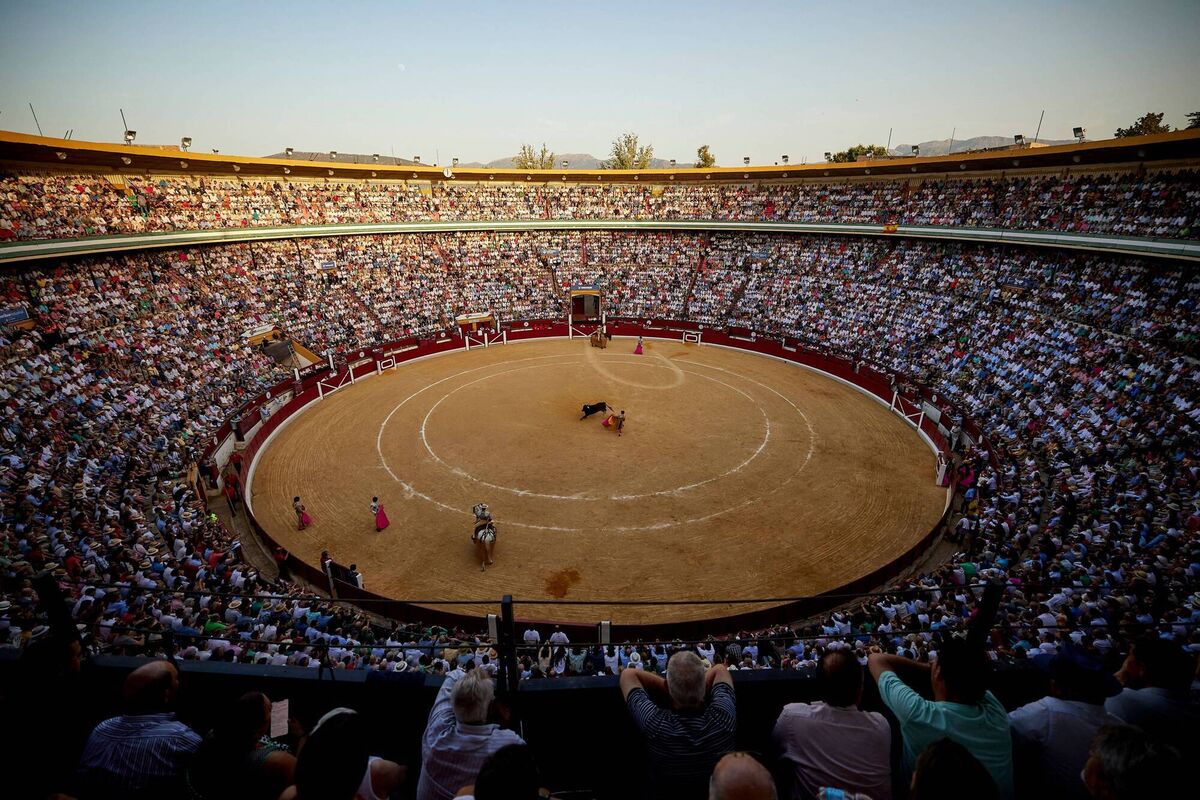
The town on fight night is like the streets surrounding Lansdowne Road before an Ireland game, but instead of cold, sideways rain, there is warm evening sunshine. Chilled white wine in place of creamy pints and fried garlic aubergines instead of greasy hamburgers. What doesn’t change is the late dash to the stands. At 5.15pm the arena is mostly empty, fifteen minutes later, the seats are now substantially full.
Positions are chosen carefully and tickets priced accordingly. Because bullfighting takes place through the hot Spanish summer, tickets in the sun (sol) are the cheapest and those in shadow (sombra) the most expensive. The best view in the house is from the ‘royal box’ where at 5.30pm precisely the presiding dignitary signals permission for the drama to commence. The process is formulaic and the common pageantry is hundreds of years old. It unfolds, everywhere, like this.
A bugle sounds, the brass band strikes up a march and a colourful parade enters the ring. The entourage, cuadrilla, picadors on horseback, banderilleros wearing silver and lastly matadors in gold. Finally, a well-muscled donkey ambles in with a yoke across his shoulders and a harness dangling. Tonight, he is here to work, to drag dead carcasses slowly out of sight. The parade crosses the arena theatrically, then bows exaggeratedly before the dignitaries who return their respect with a paternal wave.
The bull explodes into the ring, bucking, powerful, five-hundred kilos of looming jeopardy. The matadors tempt him with waved capes and then quickly retreat behind protective barriers when he returns their attention. This is the only part of the game that the bull wins and his victory lasts for barely a minute.
A mounted horseman awaits, the picador. The bull, still full of vim and vigour, charges the horse, wildly, furiously, but with deft and skilful avoidance work from the saddle, horse and rider narrowly evade his attacks. The reward for each near miss is the sharp end of a lance to the shoulder.
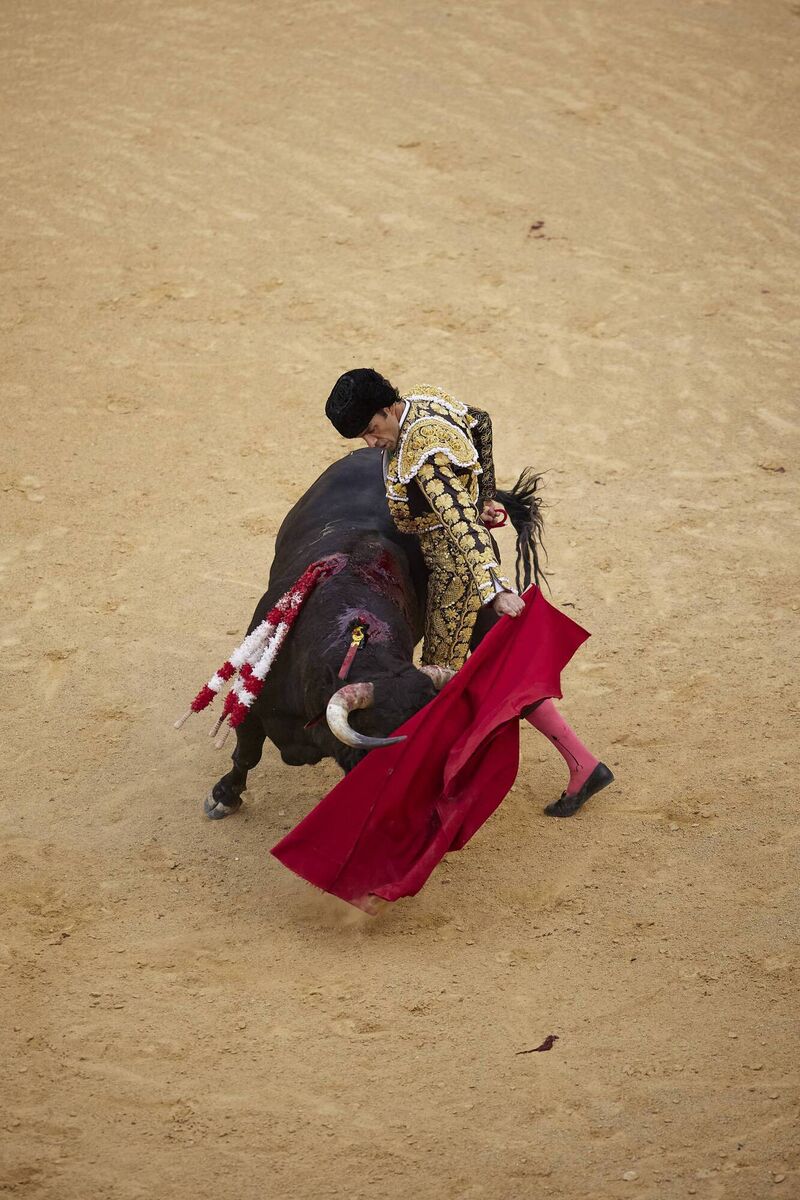
Sharp, barbed harpoons, banderillas, at least four, are driven into the bull’s neck, either by the picador on horseback or the matador on foot. By now he is bleeding heavily, his fading energy dripping scarlet and reddening the packed yellow sand beneath him.
The bull stands still now, in the centre of the ring, tired, focusing only on his one remaining enemy, the matador, who tempts him contemptuously with a crimson cloth, swivelled on a stick, the muleta. He allows the bull to pass close several times but easily dances around him. The spectators thrill noisily, the matador struts, the animal tires, his head a little heavier, a little closer to the ground.
The final sound the bull will hear is a gathering rumble of anticipation from the crowd in Jaen’s old bullring, bums inching forward in seats, expectantly, excitedly. Gazes locked onto the dance unfolding below them, the bright garish colours of the matador capes and costumes made brighter still by the contrast with the bright sand of the floor.
The final moments for the bull will see are thousands of white handkerchiefs waving in appreciation of the bullfighter’s art as mobile phones flash like fireflies, hungrily freezing the images of his ebbing, exhausted resistance. The final emotion (if bulls feel) will be loathing. Loathing for the man before him, strutting dramatically, posing melodramatically, taunting, mocking, as he organises the final scenes in his three-act dance of death.
The matador draws his sword, cold steel this time. Man faces beast, eye to eye. The crowd silences. Man lunges.


CONNECT WITH US TODAY



Be the first to know the latest news and updates