'It’s time to change. Kids should not be relying on cyclists so that they can learn to speak or walk'
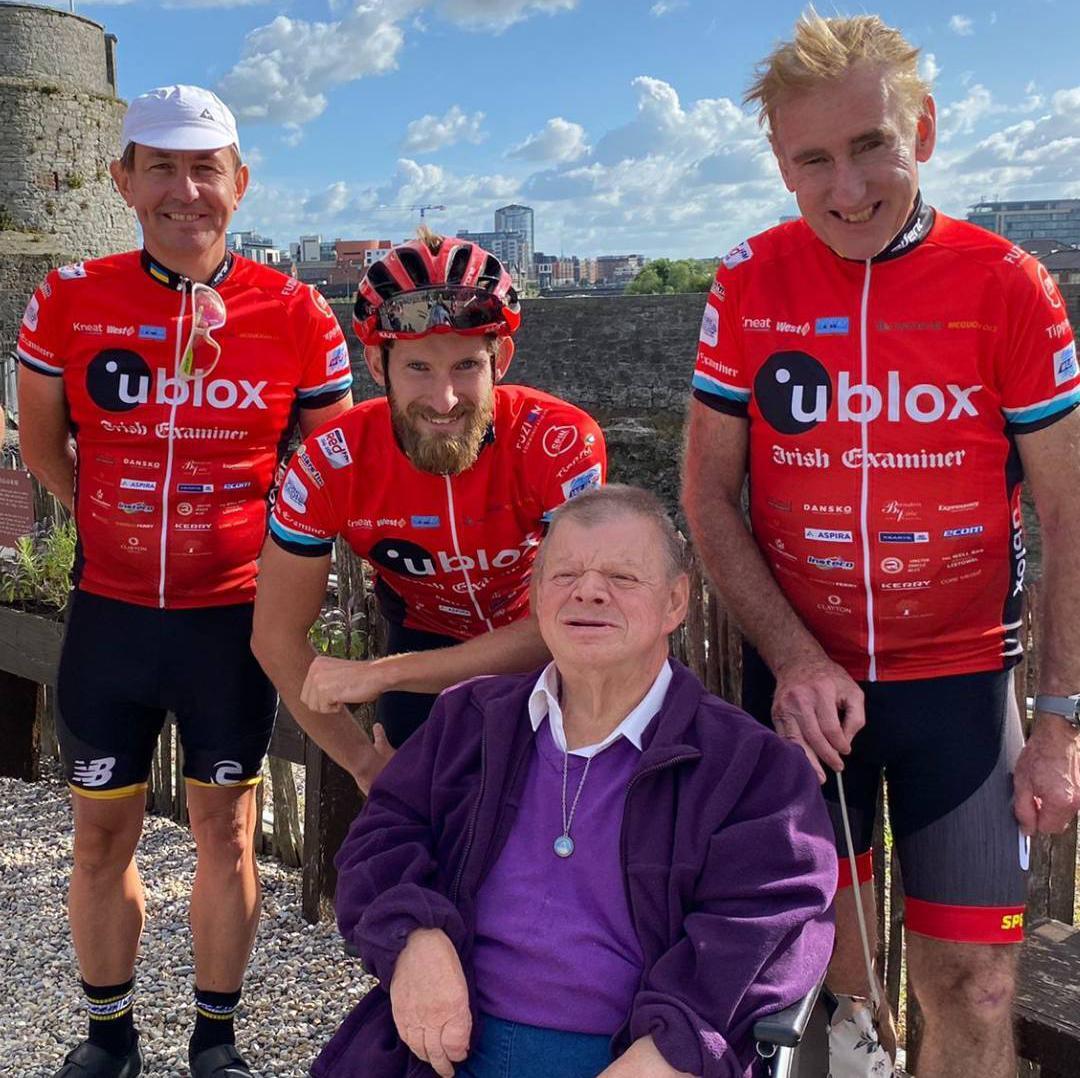
ROYAL VISIT: Emmet Ryan, Gary O'Donovan, Sean Kelly with 'the man himself' Séamus Mooney at King John's Castle Limerick.
Around 30 years ago, I spent long humid summers at my grandaunt’s farm. There were many visitors to her modest house, but one regular I noticed was an older lad named Niall. Niall was different. I knew that. His long face held two large, round eyes that seemed permanently amazed. He spoke softly but his speech was slurred and he often mumbled.
Sometimes I couldn’t understand him but my grandaunt, Anne (affectionately known as Nanny) understood. She spent hours with him in her tiny kitchen, where she’d be forever tossing sods of turf into the range, like they were coins for some Vegas slot machine. This was the heart of the house, the engine room and when the many one o’clock dinners were served, and all the others were away at work, she’d remain. She’d correct Niall’s speech, teach him how to read the clock, give him little jobs, perhaps sweeping and she’d talk about the animals: cattle, a donkey, maybe even a pony. Niall would sit in the corner stroking the cat and soaking it all in, not a bad bone in his body.

The day before this year’s Tour de Munster, I returned home from a trip to that very house. ‘Nanny’ and others are gone now and the house is very quiet. Times change. When I opened my own front door I heard the sweep of paper on the tiled floor, my mail. Bills. Flyers. The usual. But then as I gathered up the pile, I noticed something odd; a letter in a kind of silvery envelope. A letter? Who the hell sends letters? When I had it opened, I learned that this was from ‘The man himself’. Okay, I thought, this person doesn’t lack confidence. And then I saw the photo and it all clicked. This was from Séamus Mooney. Famous Séamus perhaps. I’d recently read about Séamus. He is believed to be Ireland’s oldest man with Down Syndrome. He’s a Clare man, born in 1946. He was ‘one of them’ and the neighbours wanted to take him to Dublin to ‘get him fixed’. He wasn’t expected to see 1956. And here we are. Séamus is now 76 and he was writing (via his niece Michelle) to wish me good luck in the Tour de Munster and to thank me. Me? Why me? I felt privileged. Honoured. There are 150 cyclists on the Tour. Me?

Out of Killaloe on day two and the silk and silver waters of Lough Derg, glistening under a confident sun, led the way to Ogonnello and the first of the day’s hammer drops. These are brief moments in the Tour where the ride turns into a race and ‘hammer droppers’, like Pavlov’s dogs, move out to contend on the sound of a whistle. I was at the back of the caravan of riders, the last group as we were sweeping that morning. Sweeping? That’s when the last group waits for any rider who might have a puncture or who finds themselves in difficulty. The group sweeps up the stricken riders and keeps them within the convoy, safe, looked after, included.
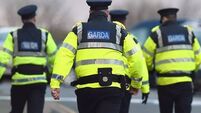
‘What’s wrong?’ asked the Guard who’d spotted that we’d stopped.
‘Puncture,’ said someone.
‘Ah shite, already?’
‘Not a great start.’
And it wasn’t. Some would have to sit out this hammer drop, but that was okay, a small price to pay for knowing that everyone is looked after. When we did reach Ogonnello we were touched by the family of Séamus, who’d waited to cheer us on.
And that’s what it’s all about isn’t it? Being looked after. Perhaps Séamus’s start wasn’t great either, something that so many families who, through a lack of understanding or a lack of services, can relate to. How many, on learning that their child has Down Syndrome, have been told that ‘it’s bad news’? That these babies will have ‘different dreams’? That there is ‘no cure’, no silver lining? But times change. Attitudes change and we all must change. Perhaps our people with learning difficulties will do things at a different pace. Perhaps they won’t become great doctors or scientists or engineers. But that’s okay. It doesn’t stop us from dreaming. I’ll never ride the Tour de France, but nobody will tell me that I cannot dream it.
We rode on.
In Ennis, it was suggested that world champion rower Gary O’Donovan could row the Killimer ferry across the Shannon. Gary was joining us for his first Tour de Munster. Later that night, in the Rose Hotel I asked him if he’d chatted much to Sean, Sean Kelly, Ireland’s cycling king and regular on the Tour.
‘Not yet,’ sang Gary in his west Cork brogue.
‘Do you remember Kelly when he was racing?’ I asked.
‘When did he stop racing?’ asked Gary.
‘Around ’93 maybe.’
‘I was one,’ said Gary, deadpan, to cackles of laughter at the table. I sat down.
Later I imagined a meme, Colm from Father Ted with his long brown trench coat and paddy cap standing in a field the far side of a stone wall. ‘I hear you’re a cyclist now Gary.’ And he is, a handy one, but he’s a rower too, Olympic silver medal owning rower and if there’s one thing the famous rowers of Skibbereen have taught us in recent years, it’s that you can have a slower start than others, but the start is only a part of the journey.
And that’s what it’s all about too isn’t it? The journey. Was it Gandhi who said that a true measure of society is found in how it treats its most vulnerable? Times change. We’re no longer a time-rich/cash-poor society. That was thirty years ago, when thousands of neighbours like my grandaunt Anne did what nobody asked her to do, teach our most vulnerable. Now we’re cash rich but time poor. The helpful neighbours and relatives are busy. But who is sweeping? Who’s picking up the pieces? Who is providing the services and looking after our most vulnerable now? And I mean actual services, not waiting lists, because we can’t just have equality when what we need is equity.
We’ve heard about how vital the services of Down Syndrome Ireland (DSI) are to its users. People would be non-verbal still, if they didn’t get speech and language therapy. Some would use wheelchairs, but now they can walk. This is because of donations given by you.
Next morning in the hotel carpark the sun delivered on its promise. Sounds of tyres releasing air and oiled chains spinning could be heard between the bouts of contemplation. What was to come would be hard. I spoke to Andy Thiel, co-founder of U-blox, ethical wireless tech company and main sponsor of the Tour. I asked him if this kind of event happened much in Germany or Switzerland.
‘No,’ he said. ‘You would never have anything like this. If you want money, you would just go to someone and ask for it. You wouldn’t do this. I guess it’s not the most efficient way of getting money,’ continued Andy.
And he’s right. When you think about it, the idea that 150 cyclists would train for months and then ride bikes around Munster so that you’ll be impressed enough to give us money, money that will pay for a child with Down Syndrome to learn to speak coherently, is as alarming as it is absurd. But here we are.
An hour later the ‘contenders’ group had left the hotel, hurtling towards Camp. For many of us, this is the most intense hour of ‘racing’ in our year. Around 16 cyclists ride through and off at high speed up to the foot of the Conor Pass where the hammer drop really begins and the hurt gets piled on some more. The pressure was on. Near Camp, a rider was off the back, unable to hold the wheel.
‘We can’t wait,’ suggested someone.
‘Ah lads, that’s not what we’re about,’ protested Frank, a stalwart of the Tour, as he selflessly tried to nurse the rider back into the group, this being the only part of the Tour where no sweeper system is used.

When we’d hit the Conor Pass, we had ridden 30 kilometres from Blennerville into an unkind headwind and still clocked over 38kph. Not bad. Who cares about efficiency? This is some craic.
After lunch, sleepy and stuck in a daydream, I watched the waters of Dingle Harbour sparkle and shimmer in the light and I thought about Fungie the dolphin and marvelled at how for forty years he brought good news and friendship to these shores. Alas, Fungie is gone now. Times do change.
‘Everybody grab a bike,’ shouted Paul Sheridan, founder of the Tour and all-round ballbreaker. My daydream was cut short and we still had 100k to ride, but not only that, Paul had been on to me. It wasn’t enough to turn up apparently. I had to do more, more fundraising. My estimated fundraising amount wasn’t exactly going to win medals. But before we left, Paul announced with The Skellig Hotel manager that lunch was on the house, no charge. More money for DSI. Fair play. I wondered if Paul had been on to him too.
And isn’t he right after all? It’s not enough to turn up. Through the Tour, there were sightings of politicians: councillors, Lord Mayors and TDs. While some might be impressed, it’s not enough to turn up. Next time, turn up with cheque books, be the silver bullet, deliver, because for as long as events like the Tour are providing most of the funds for DSI’s Munster branches (who receive virtually nothing from government to deliver these services), we will have failed our most vulnerable in society. ‘Ah lads, that’s not what we’re about.’ It’s time to change. Kids should not be relying on cyclists so that they can learn to speak or walk. And despite inflation, Ireland is full of silver, the magic and the money.
We met some wonderful people like Séamus Mooney right through Munster on the Tour: the dancers at Clogheen, singers in Killaloe, Stephen the speech maker at Christy’s in Listowel, the servers in Limerick and Killarney and the smiling face of little Anna Russell chanting ‘Up Cork’ in Glengarriff. These are just a few but they all have more than one thing in common, they’re all beautiful and they’re all wonderful teachers. They teach us love and empathy and they’re our friends. They’re patient and just like Niall, there isn’t a bad bone in their bodies. They bring only good news.
They’re artists, creatives and in the golden and the silver light, their dreams are as important as any of our dreams. ‘Tread softly because you tread on my dreams.’ When we’d finally reached Cork on Sunday, I pictured Niall again in my grandaunt’s kitchen. Against the odds, Niall did achieve his potential. In 2003 he won a silver medal for Ireland at the Special Olympics. He rode not a bike, but a horse to equestrian glory. And I wondered in the world of equity, if there was any real difference between Gary and Niall’s Olympic medals. In any case, we’ll all go on dreaming. We’ll dream in fields of dreams. And who says, in the words of Yeats, that we cannot ‘pluck ‘til times and times are done, the silver apples of the moon, the golden apples of the sun’?
‘