Phenomenal Bob Beamon waits for society to take a giant leap
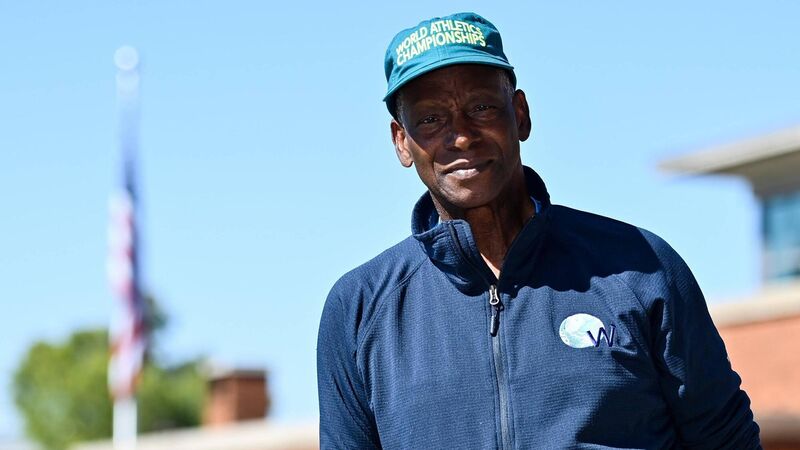
BOB BEAMON: ‘I’ve got a big story I could tell through music.’ He been collecting records since the 1950s and has amassed thousands. Pic: Sam Barnes/Sportsfile
“You ever heard James Brown with Pavarotti?” asks Bob Beamon, sitting in the sun in Eugene, Oregon, passing time between sessions at the World Athletics Championships.
I have not.
“Oh, you’re in for a treat,” he says, opening YouTube and searching for their duet of It’s a Man’s Man’s Man’s World from 2002. For five minutes, Beamon blasts it out from a Bluetooth speaker, bopping his head and tapping his foot, not just listening but each beat.
“It’s the kind of thing that shouldn’t work, but it does,” I say after.
“Yep,” he smiles, pleased at having introduced someone to a performance by two all-time greats.
Beamon, 75, is himself an all-time great – not just in long jump, or athletics, but in sport itself. When it comes to achievements that punctuated the global consciousness, that defied the norms of accepted physical limits, few rival what he accomplished at the 1968 Mexico City Olympics.
See, world records, then and now, aren’t meant to move forward in giant leaps. They inch, edge, creep. To win Olympic gold, they say, you have to beat everyone who shows up on the day. But to set a world record, you have to beat everyone who’s shown up.
At those Games, Beamon accomplished both with a space-age leap that led many to believe it was some kind of mistake – an impossible mark, forged into reality.
Eight metres and 90 centimetres, or 29 feet, 2.5 inches – more than half a metre beyond the longest jump in history to that point, still the second longest wind-legal jump in history.
Beamon has been asked about it ad nauseum ever since, but he’s still content to cover old ground.
“It’s good to talk about it,” he says. “However, you have to be good at the description, how you describe the environment of the people you competed against, and how people look at track and field in 1968 compared to now.”
So, did it feel... different? Not really.
“I thought it was a pretty decent jump. I didn’t expect it to be that long. When I heard the distance, I was extremely happy about this extraordinary experience of jumping not (just) 28 feet, but 29 feet.”
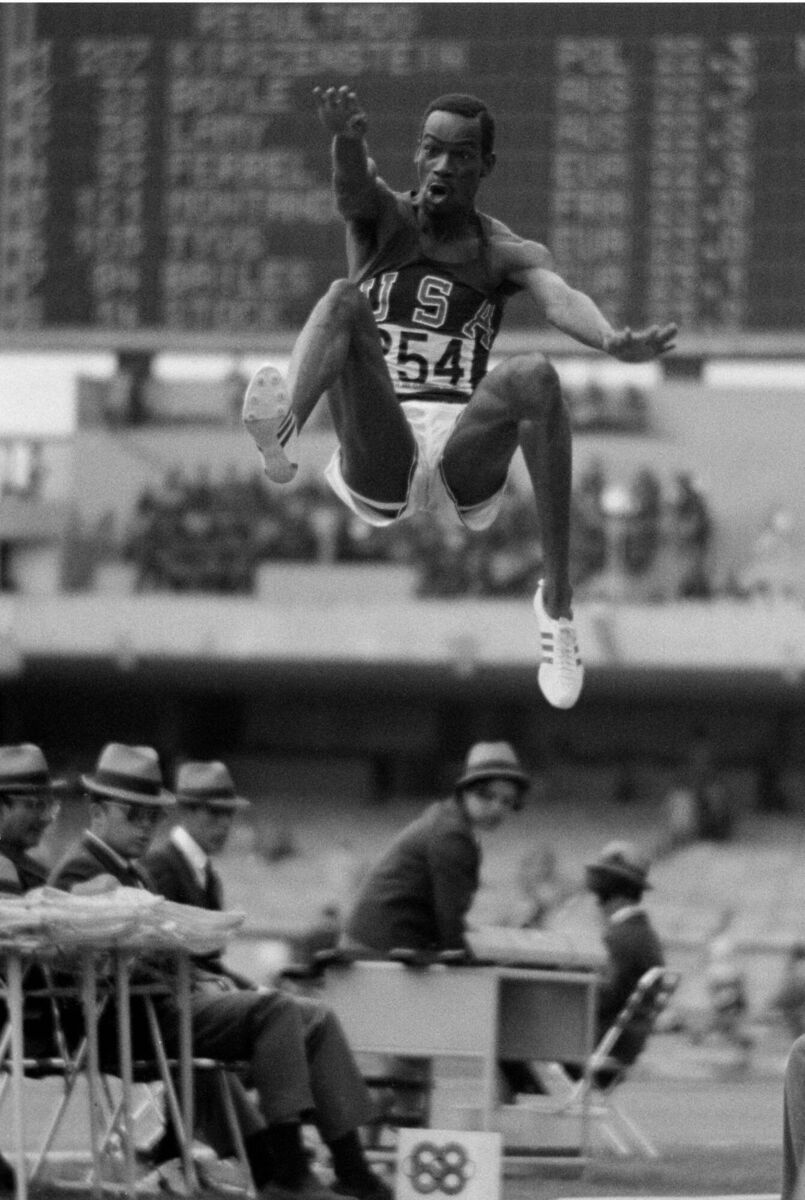
The long jump world record at the time was 8.35m. Beamon added 55cm to it. There was no doubt it had been aided by the conditions, with a lightning-quick runway, 2.0-metres-per-second tailwind (the maximum allowable limit for records) and the thin air of Mexico City.
All the same, everyone had those conditions, and no one that night did anything Beamonesque – a term still used today for a mind-bending breakthrough in sport.
Over the years, Beamon has told many different tales of what he did the night before that final, but suffice to say he wasn’t tucked up in bed early. His mind had been full of stress so he ventured “into town and had a shot of tequila”.
One of the chief reasons for that is a part of Beamon’s story that has, by and large, been forgotten, lingering in the shadows of that dazzling jump.
In April 1968, Beamon and eight of his teammates at the University of Texas at El Paso had boycotted a meeting against Brigham Young University due to the Book of Mormon’s views on black people, which led to them being kicked off the team and losing their scholarships.
Six months before Tommie Smith and John Carlos shook up the world with their Black Power salute on the Mexico City medal stand, and 48 years before NFL star Colin Kaepernick took a knee during the national anthem to protest racial inequality, Beamon risked it all to do likewise.
It’s a story he told in detail a few years ago to journalist Liam Boylan-Pett, one that occurred in the wake of Martin Luther King Jr’s assassination. That track meeting against BYU, a Mormon school, seemed the right place to make a point against the Mormon church, which at the time barred black people from certain rites and did not ordain men of black African descent.
At the 1968 Olympics, two days after Smith and Carlos made their salute, Beamon stepped up to receive his gold medal and made one of his own. He rolled up his pants to his calves, revealing black socks he wore in support of his two teammates, then raised his right arm with a fist after the national anthem.
Given Smith and Carlos had been kicked out of the Olympic village for their protest, and given what Beamon already dealt with earlier that year, I ask him if he was fearful of the repercussions.
“I don’t think it was ever intimidating,” he says. “If it was, I don’t think we’d have continued to fight strong about change. Everybody had a way of making their point and by them doing what they did, (it created) lots of bad feelings here in the United States but also worldwide.
"Change can be very painful but, as of today, people understand more about human rights. I’m very happy to say their thoughts, their consciousness, their awareness, has caught up with them in the right way.”
Two days after I spoke to Beamon, Smith and Carlos sat in a room beneath the stands at Hayward Field in Oregon, taking questions about that protest, with Smith asking the current generation of athletes a pertinent question: “What can you do to create that avenue of equality?
“We have to stand up for what we believe in,” he added. “So the younger generation will understand and have a purpose.”
Later that night, 200m world champion Noah Lyles – a black US sprinter, who at last year’s Olympic Trials had worn a black glove and raised his fist before the 100m final – explained that Carlos had once given him some key advice: “A shy man will never eat, he’ll just starve to death.
“After that I said, ‘I’m going to risk it all,’” said Lyles. “I’ll go out there and speak my truth about Black Lives Matter.”
When Beamon looks at the past few years in the US, he sees history repeating itself. “Everything has come full circle – 360,” he says. “We’re right back where we were 50 years ago.” What does he think of his country today?
“We’re finding our way,” he says. “It can be very painful. We’ve seen some ugly things but we’ve seen some very good things. Every so often our country or the world takes a change in how we think, what we think, how we will end up.
"There’s a whole bunch of stuff going on and we have to acknowledge that change is very important. One of the good things about us here is we are always changing. We’re going to come out of it. We’re going to look good.”
I ask Beamon what he’s most proud of in life.
“That I’m sitting here talking with you, that we can talk about this in a calm and peaceful way,” he says.
“I’m very blessed I can say that I’m healthy, that I’m still alive, that I’m enjoying (life).”
These days, Beamon lives in Myrtle Beach, South Carolina, and he keeps himself busy by sitting on various boards and doing talks that can range from corporate functions to schoolkids.
He grew up in Jamaica, a disadvantaged area in New York, and his mother died from tuberculosis when he was an infant – the void leading him to crave attention in school, where he became known as a class clown. What does he say to students he speaks to these days?
“I be saying, ‘stay in school and be cool,’” he laughs. “I go through some of my experiences, bad, good, whatever, and I try deliver it in a way people take something from it and use it at some time in their lives. The conversations can be motivational or about how important it is to enjoy life.”
How does he enjoy life? Music is his huge passion. Beamon is currently learning to play the saxophone while he’s been collecting vinyl records since the ’50s and has thousands. “I’ve got a big story I could tell through music,” he says.
After the James Brown and Pavarotti duet finishes, Beamon still has some time to kill before he heads to the stadium for the evening session. He loads up a song by Odyssey, a New York band that was popular in the late ’70s, and continues tapping his foot, bopping his head, to the rhythm as we chat, smiling like a man without a care in the world.
Before we part ways, there’s one final question. How would Beamon like to be remembered?
“It’s hard,” he says, thinking for several moments, the silence finally broken when he’s come up with his answer – which has absolutely nothing to do with that immortal jump.
“You know, not part of the problem, but part of the solution,” he says. “That right there – the end result: trying to get to the solution.”


CONNECT WITH US TODAY



Be the first to know the latest news and updates