Rhasidat Adeleke: I want to compete on the global stage
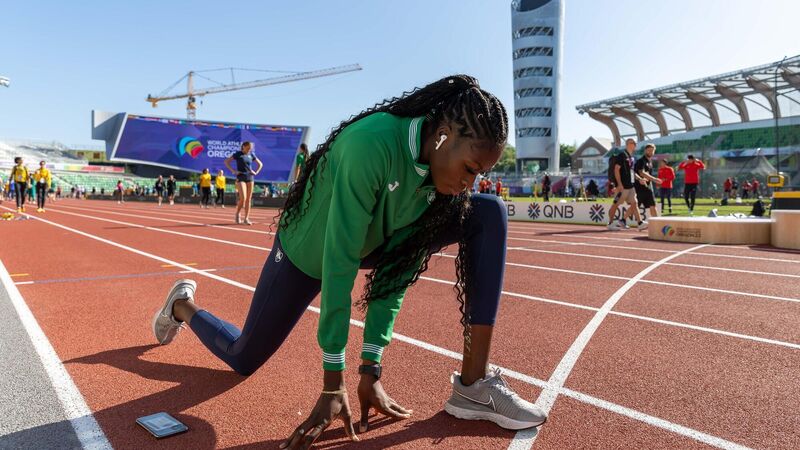
ON YOUR MARKS: Rhasidat Adeleke, member of Irish 4x400m mixed relay team. Pic: ©INPHO/Morgan Treacy
Sitting trackside against a silver railing in Hayward Field, Oregon, gazing out at the world’s most finely tuned athletes fizzing through their final preparations, Rhasidat Adeleke looks a picture of cool, placid calm.
It’s Thursday morning in Eugene, and beneath a burning sun and clear blue sky, one of the brightest talents in Irish sport has finally arrived at the top table of athletics.
“I’m just treating it like any other championships,” she says. “Like NCAAs or U20s – it’s pretty much all the same to me.”
But this, of course, is a little different. This is the Tallaght teenager’s debut at the World Athletics Championships. She may be the fastest Irishwoman in history at 60m, 200, 300m and 400m, but Adeleke is still, somehow, only 19.
She can look at all this in two ways. She could see the size of this stage and feel intimidated by it, what with all these A-list stars buzzing around. Or she could look back at the year she’s had – in which she took a wrecking ball to Irish records – and know she’s already playing with house money.
“I feel like this competition is a bonus,” she says. “I don’t want to put too much pressure on myself, I’m still only 19. I’ll definitely be nervous when I get to the line, but I don’t want to think about it until then.”
A year ago, Adeleke wasn’t selected for the Irish mixed relay squad that made the Olympic final in Tokyo but today, she will anchor a team that includes Chris O’Donnell, Sophie Becker and Jack Raftery – with the heats taking place at 7.56pm Irish time. If they advance, they’ll be back for the final later on (at 3.50am Irish time).
Either way, Adeleke’s work won’t be done.
On Sunday, she’ll line up for the heats of the individual 400m, which will feature Shaunae Miller-Uibo, the two-time Olympic champion who Adeleke idolised in her mid-teens.
“I didn’t watch major competitions until I was 15, 16, but when I became that age I loved her – everyone compared me to her.”
The reason was Adeleke’s rare ability to be equally effective at 200m and 400m. The Dubliner is the reigning European U20 champion at 100m and 200m, but with her height and long stride, her coach Edrick Floreal has long sensed her best potential lies with the one-lap event.
How does it feel to train for the 400m, having previously been a 100m-200m runner?
“Still a 100-200 runner!” laughs Adeleke. “I do dread it sometimes, but relays have allowed me to enjoy it more. I tried to avoid (the 400m) for as long as I could because it just looked so painful, but I can definitely see myself doing it in the future – and also the 200.”
Adeleke had never run a 400m outdoors until May this year, when she produced a stunning performance in Lubbock, Texas, to clock 51.70 in the heats of the Big12 Championships in Texas, followed by an Irish record of 50.70 in the final. She learned something important that weekend: effort is often the enemy of speed.
“When I ran the 51.7 I gave it my all, everything I had, and I put too much pressure on myself. But when it came to the final I was more relaxed – it’s not my event, I don’t train for this, just run. I did that and I ran so much faster.”
She wanted to reach the 200m final at the NCAA Championships in June but after tightening up down the home straight, she fell short, realising again that same truth: the harder you strain, the slower you run.
Floreal, the head coach at the University of Texas, had a hunch after that race what was occurring. In training the following week, he got one of his male sprinters to overtake Adeleke as she sprinted around the turn and he could spot straight away the tension in her stride.
“I’d always be coming off the bend in first but then I’d panic that I’d get caught and I’d immediately tighten up,” she says. “I just need to learn to run more relaxed, but that’s going to be a long process.”
She has trained under Floreal for 18 months now – ever since moving from Dublin to Texas at the start of last year.
“He’s like a father figure,” she says. “We have jokes, we have serious moments, but it’s a light-hearted relationship. We both trust each other. I trust him and he trusts in my talent and ability. There’s definitely some tough love: sometimes as athletes we underestimate ourselves and he has to remind us of what we can do.”
The training, she says, is “hard, harder than what I used to do" at home, and Adeleke laughs as she says she’s “still alive, thankfully” after a year and a half of it.
When she arrived in Eugene on Wednesday, she thought back to those who’d nourished her talent to this point, like previous coaches Johnny Fox and Daniel Kilgallon.
“All the people who helped me get to this stage,” she says. “I definitely do appreciate it.”
At home, she was always an outlier. At Texas, she’s just one of several world-class operators. That led to a psychological shift in her expectations.
“I already knew coming that my perception of what was fast was going to change,” she says. “At the end of the day, I don’t want to just be good as a European. I want to be good globally. It’s helped build my mentality to have a more fierce outlook.”
Her goal in Eugene is to take it “round by round, one step at a time” and see where it leads her. She knows, at the end of a long collegiate season, nothing is expected, though she’ll give it her all regardless.
She knows this is all about learning, so maybe one day she can return to this stage as a true contender. No matter how it plays out, she knows this is the first of many.
CONNECT WITH US TODAY



Be the first to know the latest news and updates