Service game: Can Ireland create pathways to develop the next Nadal or Raducanu?
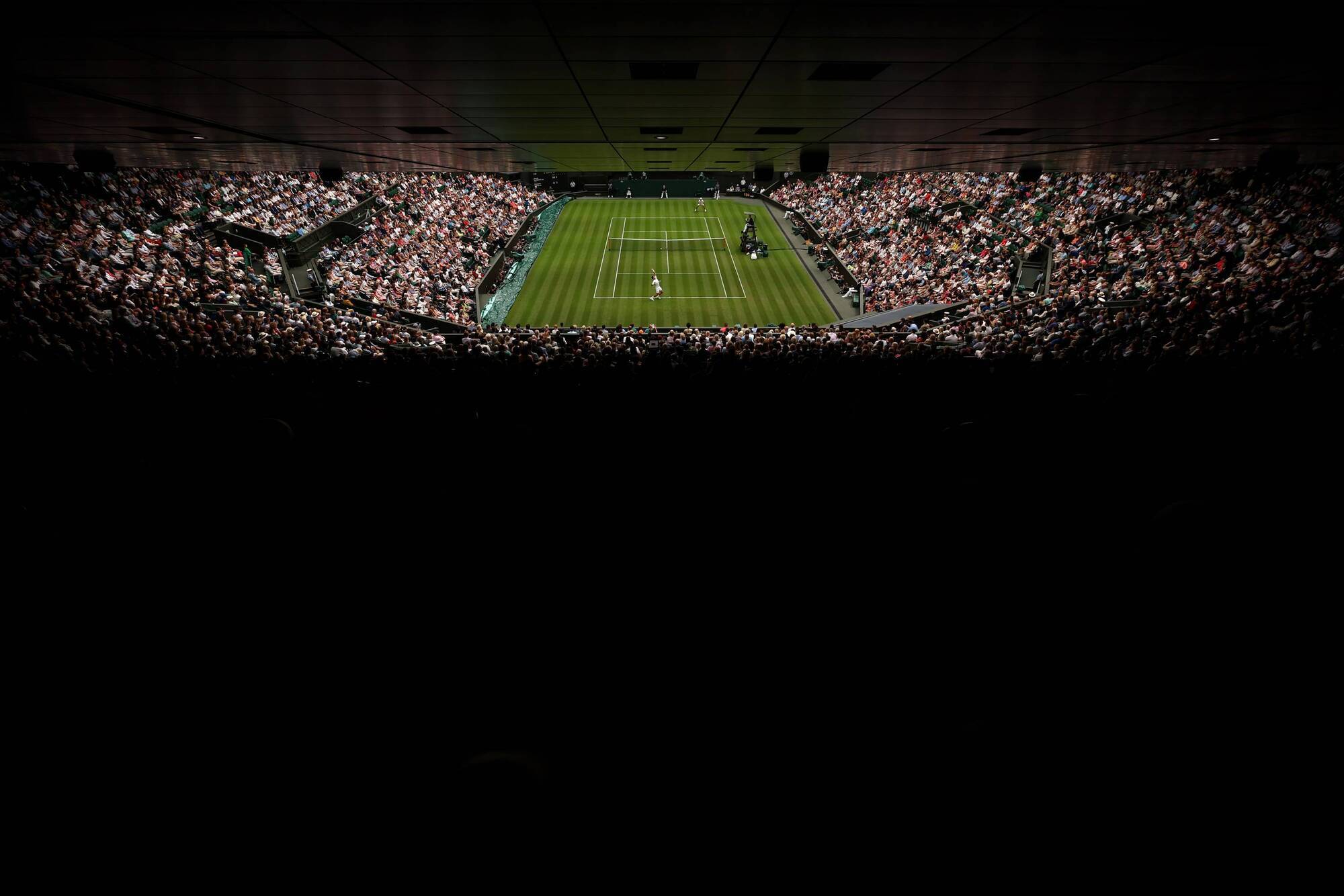
IRISH EXODUS: Action from the opening day at All England Lawn Tennis and Croquet Club.
The drive from Dublin to West Cork can torture the mind. Cross the border into Rebel country and it's hard not to feel that the back of it is broken when the job is only halfway done. That same trap lies in wait on the road from the capital to Castlebar once you hit Roscommon and Garrett Barry knows it all too well having navigated the stretch time and again down the years.
Birr-born but based in the west, Barry is performance director for Tennis Ireland. That journey spanning east and west, replete with pockets where your phone signal can be lost to the wilderness, could serve as a neat analogy for the seemingly endless road that is the sport’s attempt to deliver an Irish player to the summit of the global game.
There is no Irish man or woman featuring in Wimbledon this next two weeks. Again. Recent years have seen Tennis Ireland, as opposed to tennis in Ireland, or Irish tennis players, hit the headlines because of governance issues while the loss this year of Sport Ireland’s high-performance (HP) funding created not a stir.
A nation expects, well … nothing much really.
Barry would appear to have the most unenviable of tasks. Ireland has never had a player ranked among the world’s top 100. Eight people have represented the country in Grand Slams since the game went open in 1968. That works out at one appearance every six-to-seven years. The last two were in 2011.
It’s his job to plot a course to the top of the game for the best players from an island with little in the way of suitable courts, whether clay or indoor, and where the loss of that government funding – flagged years back but implemented in 2022 – leaves them even further adrift of countries from an investment point of view.
In situ since 2019, Barry’s capacity to come to grips with the role has been compromised by a two-year pandemic but a national performance strategy was put together during Covid, with help from Brian McNeice who had previously conducted a similar review for Sport Ireland, and the key is finally being turned on that.
“To be brutally honest, we’re really just starting out as of September last year on our strategic plan for performance. And it’s not high performance. We are performance development. We are not considered high performance and I refuse to call it high performance but that doesn’t mean we don’t have ambition.”
He’s heard accusations of that nature and they clearly rankle. That they have taken two steps back to try and move forward is undeniable but Barry argues it’s the only way they can secure the ground underneath their feet while reaching for the stars. Foundations, which he insists were not in place until now, are required. It is, to all intents, a reboot of what Tennis Ireland had been trying to do. Not everyone is convinced it’s the right way forward.
**********
Barry’s predecessor was Gary Cahill. He spent 13 years in the gig before stepping away and launching his own Prodigy Academy for kids up to the age of 14. A former Davis Cup captain, he was instrumental in getting the National Tennis Centre off the ground around 15 years ago, and the centralised academy that worked out of it.
He looks back now and wishes they could have pushed their best players that bit further up the hill but he stands by the progress they made with the likes of Conor Niland, James McGee, Simon Carr and declares that pretty much all of the top players back then trained for decent spells in the national academy.
Niland made two Grand Slams during his time in the programme, when Cahill was coaching him. Carr and Georgia Drummy made junior Slams, seven in all between them. The theory was that the best players needed to train together constantly, and for sports sciences and other support to be constructed around them.
The thinking was that you then needed to plonk a fair few of your eggs into a select number of baskets early on. Carr and Amar Elamin were prime examples of that with the former having reached a world ranking high of 512 to date and the latter, three years his junior, over 800 rungs below him in the ladder.
“It may seem like it is a numbers game but it is not. It is very much a specialisation sport. You really need, if you are going to develop a top tennis player, to put a programme around one athlete. It doesn’t happen in tennis that you have a tonne of kids and one of them is going to come through.
“It’s not like that,” says Cahill who is also pursuing a doctorate in talent development in DCU. “You really have to specialise. Look at the countries with huge populations. India. China. These countries are not at the forefront of tennis. It is often countries that have smaller populations. Like Serbia, for example. Look at Finland or Norway at the moment.”
Cahill would like to think that there will come a day when Ireland can boast two or three centres of excellence around the country but he doesn’t agree with the policy adopted now by Tennis Ireland which has switched the onus for elite players from a national to a provincial level and with the very best meeting for a central camp periodically.
Barry sees it differently. He points to the success Italy have experienced with this structure as part of their road map. Another core pillar to the new strategy is the absolute necessity to put competition back at the heart of a sport that has leaned way too far in the direction of coaching. Training for the sake of training, as he terms it.
Domestic competition is being stretched further across the calendar to cover the previously dead winter period and the number of international underage tournaments to be held in Ireland has been bumped up from five to eleven. The Finns found that to be a key mover in their success but then Cahill would point out that they run a centralised programme too.
There’s no desire to sow discord here. That two men who have held the same position in the same organisation in recent years hold such different views in how to move forward is hardly surprising given the complex nature of what is being asked, the inherent flaws in the Irish landscape, and the fact that no-one has cracked it in the past.
Barry might describe the previous approach as a “risk” but he also concedes that its one that might have paid off if one player had hit the big time while holding a contrary view on Cahill’s take that the Nilands and Barrys and Carrs were products of what he would term and Irish ‘system’.
He is adamant that broadening the playing base is the key. “The question even of having a top 100 player: we won’t have that until we have ten top 500 players and we won’t have those until we have juniors who are able to go to that level. And we can’t do that until we help players in our country play more international events. You can’t do one thing until you do another.”
**************
Some would say that you can’t do any of it. Not in Ireland. That the only way to produce world-class Irish talent is to stump up for a plane ticket and a lengthy stay at the IMG Academy in Florida or the Rafa Nadal school in Spain and that takes the sort of money that just isn’t available in the game here as things stand. That last point has the potential to make everything else moot.
“A big part of it is matching what you are trying to achieve with investment,” says Cahill. “In tennis, you need to have investment in athletes over a long period of time. If you find a talent at ten years of age, you will have to invest in that talent for the next ten to 12 years. You are hoping that at 22, 23 they become more self-sufficient. You are hoping that they are able to make enough money from the tour to at least live, but you need to have sustained investment, year in and year out. What’s happened a lot in tennis is you might have a few good juniors but the investment is not there for these players to transition from junior to professional tennis.”
There are those who don’t buy into the notion that money is a rock on which dreams here should perish. Cricket Ireland’s transformation from backwater sport to Test-playing nation has been achieved in no small part by attracting major funds from the public and private sectors and shows that a sport’s history doesn’t have to match its future.
“I am very confident in what we are trying to do,” says Barry. “We obviously don’t know if it is going to work but we are taking the view that structures are needed for something sustainable and if I walk away from performance in the future then at least there are building blocks there already for the future."


CONNECT WITH US TODAY



Be the first to know the latest news and updates