Irish Olympian and Kerryman Tom O'Riordan dies aged 84
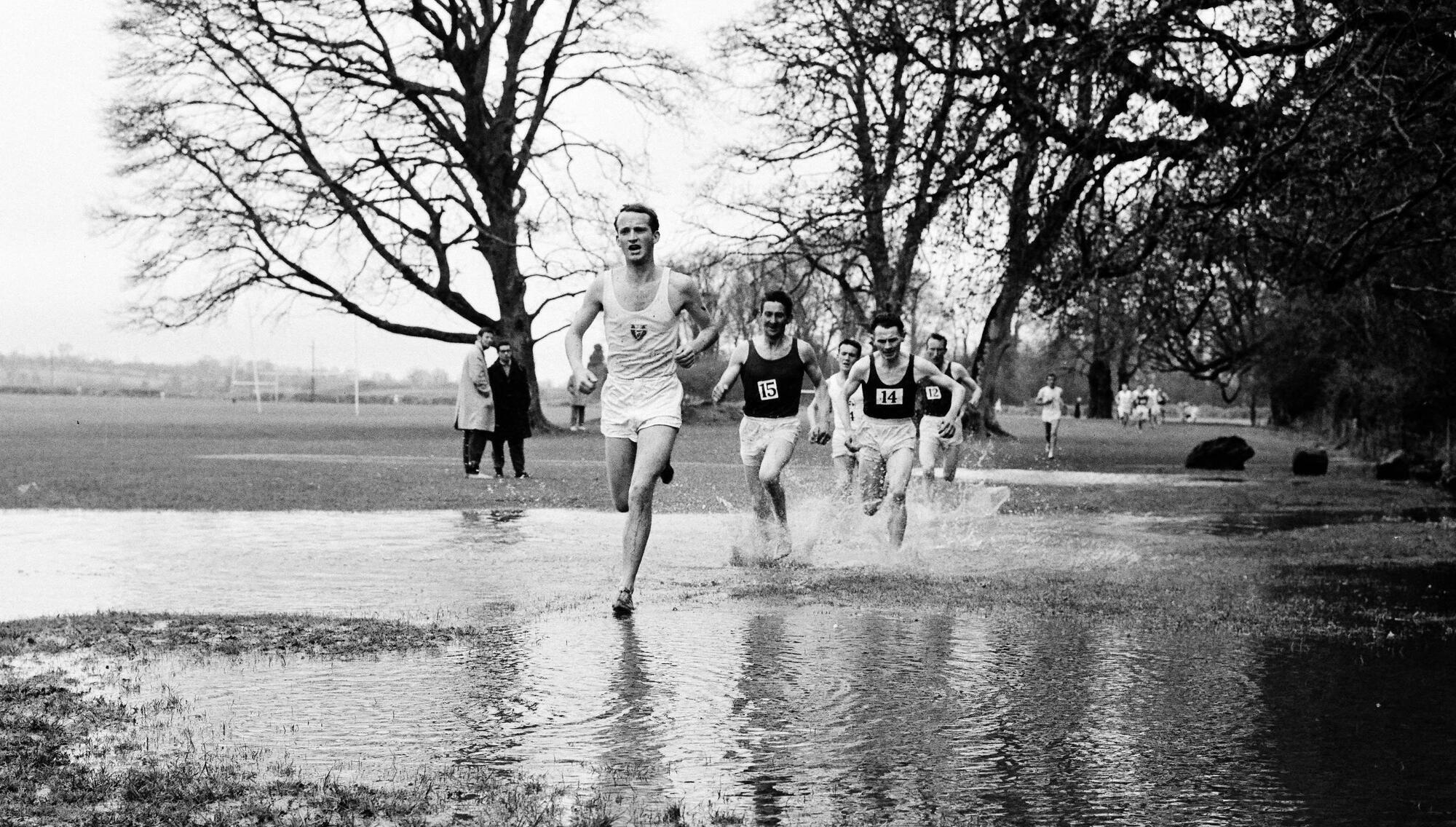
Tom O'Riordan leads the field through water during the 1966 Amateur Athletic Union & NACA Championships, Gormanston, Dublin. Picture credit: Connolly Collection/Sportsfile
He was an athlete, an Olympian, a journalist and – to so many in Irish athletics – an icon. But for all those who knew Tom O’Riordan, and for the sport itself, the news of his passing on Monday at the age of 84 leaves a deeply painful void.
But few will leave behind such a rich legacy, with the Kerryman’s contribution to his beloved sport running just as deep off the track as it did on it – where he entertained, inspired and illuminated across a decorated career.

“Like everyone else, I’ll miss him,” said John Treacy, the 1984 Olympic marathon silver medallist. “I’ve lost a great friend.”
Sonia O’Sullivan was one of those whose career was covered extensively by O’Riordan, and she remembers a tough but fair reporter.
“Once he knew you were good, he always expected you to be at that level and if you weren’t, he was never afraid to ask the tough questions,” she said.
“He was like a dog with a bone. He was very good at his job. He’d be your biggest supporter but also your harshest critic. Because you knew all those things, you had the greatest respect for him.”
Born in Turbid, Co Kerry in 1937, O’Riordan grew up in Ardfert, and his talent was clear through his teenage years. In 1956 he won an All-Ireland Schools title over a mile for Tralee CBS, which earned him a scholarship to Idaho State University.
That was a time when few Irish athletes followed the now-well-trodden path, but off O’Riordan ventured into the unknown – some of the highlights of his four years at Idaho being an NAIA individual title at cross country and a fifth-place finish in the NCAA cross country.
After graduating in 1961, he moved to California and trained under famed coach Mihaly Igloi, where O’Riordan would rise at 5am for workouts before going to work in a local foundry. He returned to Ireland in 1962 and joined Donore Harriers, coming under the guidance of coach Eddie Hogan and maturing into one of Ireland’s best, a distance runner who dominated his rivals on the domestic scene.
O’Riordan broke Irish records 13 times on the track, won seven national cross country titles and racked up 12 national track titles. He represented Ireland multiple times at cross country, while he also competed at the 1966 European Championships and at the 1964 Olympics in Tokyo – where he finished ninth in his 5000m heat.
“‘Twas a bit of a disappointment now that I didn’t make the Olympic final because I was capable of it and I was fit enough, but I just didn’t do it,” he told the Irish Independent in 2017.
“And that lived with me for a good while after. It was a great disappointment to me. Huge.”
But O’Riordan had many other great days to reflect on, his performances up there with the best in the world when he was on song. In 1964 he clocked 13:18.4 for three miles at the national championships, just six seconds outside the world record.
He made his entry into journalism while still competing internationally, juggling racing and reporting for years. After one of his national cross country titles he ran in gear to a public pay phone to call in his copy, while he also filed reports shortly after competing at the World Cross Country Championships.
“I had to find out who the winners were and the times and the team race and all that,” he said. “It was a bit of an effort but I managed it. I was never sued for writing the wrong stuff!”
He was known to his colleagues in journalism as “The Runner” and worked for Independent Newspapers for 38 years, covering every summer Olympics up until Sydney 2000.
“He was a great journalist,” said Treacy, who used to stay with the O’Riordan family when visiting Dublin. “The old thing is athletes and journalists don’t become good friends, but we were. He always had a good nose and he worked extremely hard. Some of the stories I’d hear about him were legendary, in terms of the amount of copy he’d present to the editor after an Irish win.”
O’Sullivan remembers how O’Riordan wrote her a letter after her crushing disappointment at the 1996 Olympics, detailing where he believed she went wrong. “I always appreciated that he took the time to do that,” she said. “He wanted to let me know he wasn’t just there to ask questions. He also cared.”
O’Riordan’s wife, Barbara, and his children were the bedrock of his life, and his son, Ian, followed a very similar path – becoming a high-level distance runner before transitioning to journalism, now carrying Tom’s baton as the athletics correspondent for The Irish Times.
In the latter years of his life, Tom battled Parkinson’s disease, which he described as “a bit of a struggle”, but while dealing with it he refused to feel anything but appreciation for a life well lived. “I’ve had a good life,” he said. “I wouldn’t change it for anything.”