Sarah Keane calls for equality for Winter Olympians
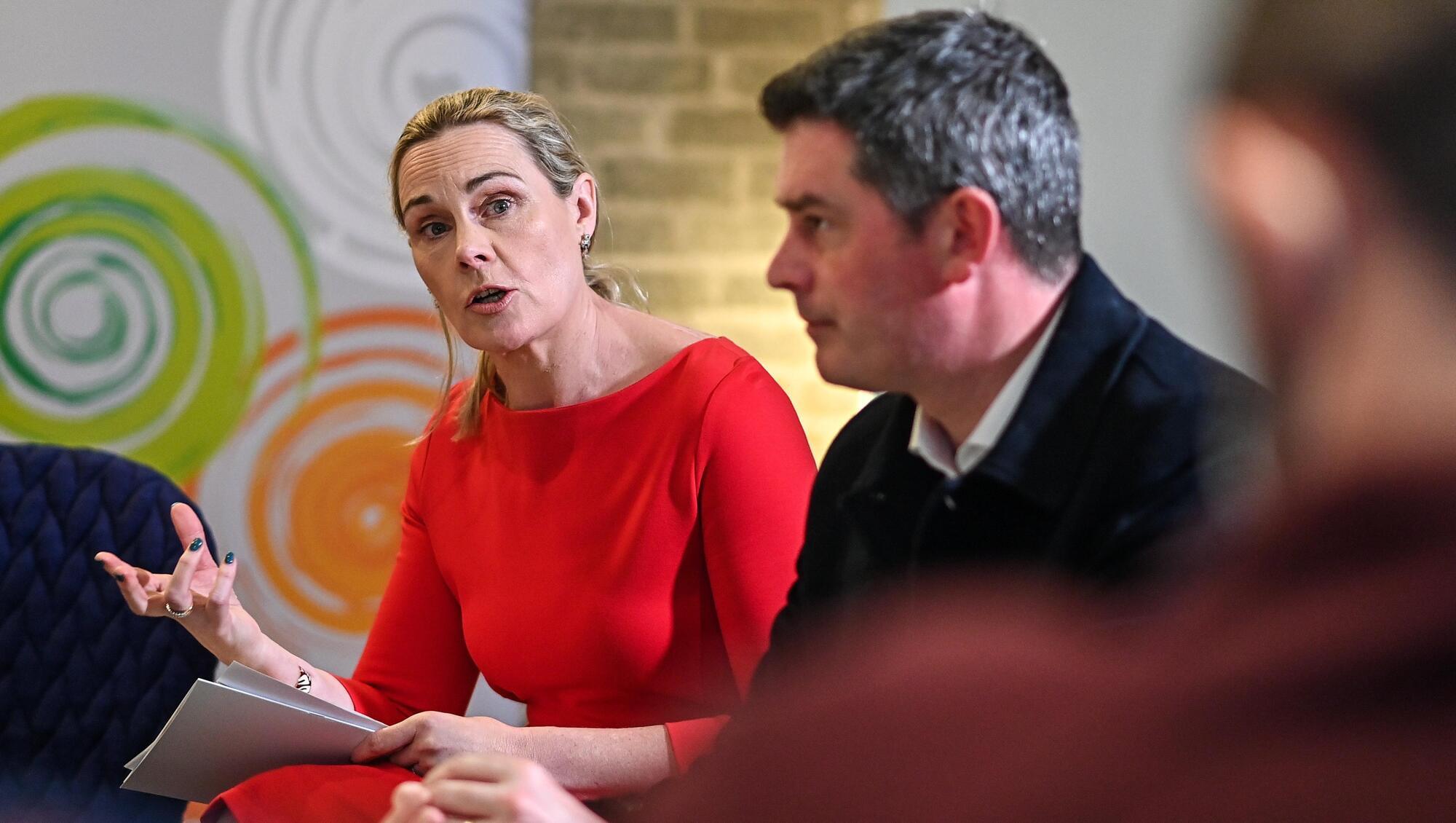
12 April 2022; The Olympic Federation of Ireland today launched the Winter Sports Strategy which is calling for a structured approach to supporting winter sports and athletes in Ireland. Pictured at the launch is Sarah Keane, President, Olympic Federation of Ireland, and Peter Sherrard, Chief Executive Officer, Olympic Federation of Ireland. Photo by Ramsey Cardy/Sportsfile
The President of the Olympic Federation of Ireland (OFI) has called for equality for Irish Winter Olympians, highlighting the huge imbalances that exist in funding, access to facilities and support structures compared to their counterparts in the Summer Games.
Sarah Keane, who’s been OFI President since 2017, said change “needs to happen sooner rather than later” to eliminate inequality for Ireland’s winter Olympians, who don’t have access to state funding through Sport Ireland’s carding scheme.
Keane was speaking after the launch of the Irish Winter Sports Strategy, which outlines key areas the OFI is targeting in the years ahead: facility development, visibility, governance, athlete carding, participation and talent development.
“It’s about equality, transparency, visibility and infrastructure,” said Keane. “Our goal is to open up more discussions about this.” While Ireland has never won a medal at the Winter Games, most of the six Irish athletes who competed at the recent Games in Beijing turned in highly competitive performances, with Jack Gower 12th in the Alpine skiing combined, Thomas Westgard 14th in the men’s 15km cross country skiing, Seamus O’Connor 15th in the snowboard halfpipe and Brendan Newby 20th in the freestyle skiing halfpipe.
While some of those received small grants through the International Olympic Committee’s Olympic solidarity programme, the vast majority of their costs were covered themselves as they travelled the world competing in qualifying events. For Keane, it simply doesn’t make sense that winter Olympians don’t receive the same backing as summer Olympians who perform at a similar level.
“We feel strongly about it because it is an inequality,” she said. “We’re saying as a nation that we’re putting athletes’ welfare first, that it’s morals over medals, but we have athletes, particularly winter Olympic athletes, who are making decisions like driving 23 hours in a car because they can’t afford the flight; athletes who are sleeping in their car so they don’t have to pay for hotel accommodation; athletes who do one (downhill) run instead of two so they can afford an extra meal.
“I can understand that Sport Ireland have concerns (about) opening up the carding system to more people and there’s a finite amount of money – does that affect others if it opens up? But there’s only so many winter Olympians who’ll be at that level and they’re not looking for special treatment. We just want them to be treated the same as everyone else.” All six members of Ireland’s team in Beijing are based abroad, which is no surprise given the lack of facilities for winter sports in Ireland. In 2018, the government released its 10-year National Sports Policy which stated that “increasing participation is the cornerstone” of its objectives.
Keane believes the lack of a year-round ice facility in Ireland is “cutting off this opportunity for anyone who might be interested in ice hockey, ice skating.” “I think we’re the only capital city in Europe that doesn’t have one,” she said. “If you do the comparison with the UK, where they have about 60, and you compare by population, we should have about five.” The strategy outlines how a permanent ice facility would be commercially viable and achievable “through private funding at little or no cost to the taxpayer, provided government and local authorities can assist in securing land.” “A lot of people go abroad to ski,” said Keane. “But there’s also a lot of people here who want to do something different, and you could manufacture luge and skeleton facilities that are participation environments – you can do those things to capture minds.” Minister for Sport Jack Chambers attended the launch and listened to grievances raised by athletes and administrators involved in the national federations of winter sports.
“Access to facilities is a big thing,” said Keane. “One of the big things in Irish sport the last number of years is to offer opportunities for people to stay in Ireland to be the best they can be.” Governance is another area that is targeted, with several winter sports federations not currently recognised by Sport Ireland due to insufficient participation numbers.
“At the moment they’re outside the system and we need to tidy that up so these federations work towards the same governance standards,” said Keane. “They’ve all signed up to this and it’s been a work in progress for a couple of years.” The strategy also outlines ways to improve visibility for winter sports. RTÉ did not broadcast the recent Beijing Games and Keane believes improved visibility will “inspire kids to do something different.” She paid tribute to the athletes continuing to keep Ireland on the global map in winter sports despite the difficulties faced.
“They’re incredibly humble,” she said. “What they do to get themselves by – it’s a very lonely existence. Most of them can’t afford to have coaches with them. They don’t have physios, sports scientists – the stuff a lot of our summer Olympians have and things a lot of athletes in other sports have when on their Olympic journey, even if they don’t make it to the Games.” “All of the federations have come together and they want to make the sports more visible, they want better access, they want their athletes better supported and funded, and really just recognition for the contribution they want to make to Irish society.” Peter Sherrard, CEO of the OFI, said: “The winter sports federations have put in a significant amount of work to establish a clear framework for improvement and success over the next four-year period. The OFI is committed to supporting the journey with €50,000 funding to help the federations fulfil the actions it contains.
“Ahead of us, we have a very exciting project which has the potential to transform participation opportunities, while ensuring that the winter sports federations, by working together, are better recognised and supported, along with their athletes who represent us on the Winter Olympic stage.”


CONNECT WITH US TODAY



Be the first to know the latest news and updates