Sport now has to ask itself some tough questions
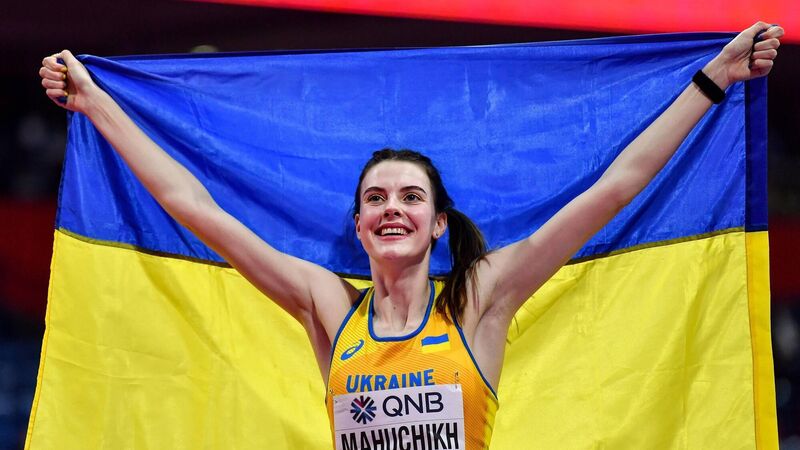
Yaroslava Mahuchikh of Ukraine celebrates winning gold in the women's high jump final at the World Indoor Athletics Championships in Belgrade Photo by Sam Barnes/Sportsfile
Perhaps we should have known last summer, as we saw a simple act of celebration between two athletes get hijacked by the poison of geopolitics, that sport canât always be what we want it to be.
It has long been a force for good, of course, a method to unify rather than divide, but the past month has shown us it canât incubate itself from the wider world, the choices it made in response to Vladimir Putinâs invasion of Ukraine throwing up some fiendishly difficult questions.
Such as: What barbaric acts should sport take a stand against? And when should it turn a blind eye?
What athletes should be punished for the actions of their government? And which nationalities should get a free pass?
If we leave behind the principle that sport is an arena that welcomes all participants, regardless of cultural differences or political beliefs, then where is our cut-off point of whoâs accepted and who's not?
Because Russia, for all its woes, does not have a monopoly on civilian slaughter.
But back to that moment from last summer, which involves two athletes who, in different ways and to very different degrees, have become victims of this conflict.
Shortly after the womenâs Olympic high jump final in Tokyo, gold medallist Mariya Lasitskene from Russia and bronze medallist Yaroslava Mahuchikh from Ukraine embraced and posed for a picture. Lasitskene, 29, has been the queen of her event for many years, while Mahuchikh, 20, is its brightest young talent, an athlete who grew up watching videos of Lasitskene jumping, hoping to emulate her technical brilliance.
Little did they know then, in that euphoric moment of celebration, how many in their home nations would see that picture, their everyday act of basic decency, as some form of betrayal â a conscious choice to fraternise with the enemy. Critical comments rained in on social media, and even from government circles.

What made it harder for Lasitskene and Mahuchikh is that both are members of their respective armed forces, a relic of the Soviet sports system in which high-achieving athletes are given military rank, with salaries enabling them to train, essentially, as full-time athletes.
There is, after all, more than one way to serve your country.
Now fast forward seven months from the Olympics â to last Saturday at the Stark Arena in Belgrade. Draped in a Ukrainian flag, with tears welling up in her eyes, Mahuchikh stood before us after winning gold at the World Indoor Championships and tried to put into words the horror of the past month.
âThey killed our people, they killed our nation and they killed our children, the future of Ukraine," she said. âI want peace for my country, and the way to have peace is for Russians to go home.âÂ
Mahuchikh was at her home in Dnipro on 24 February when she awoke to the sound of explosions. âI cannot describe in words what I felt at that moment,â she said. âI wish nobody in the world will have the same feelings.âÂ
She fled her home city, hiding in a cellar for safety, and endured three days of travel, âhundreds of phone calls, many changes of direction, explosions, fires, and air raid sirensâ before making it to Belgrade.
In the days after the invasion, every sport was thrust into a tough position, looking for ways to make a stand while not abandoning their fundamental ideals.
Athletics, rowing, and badminton were among those to issue an outright ban on participants from Russia and Belarus at major competitions, while football and rugby suspended all Russian teams from international events. Formula 1 terminated its contract with the Russian Grand Prix, while tennis, cycling, gymnastics and swimming allowed individual Russian athletes to keep competing, but only as neutral athletes, its flag outlawed â which had been the case in athletics for several years due to Russiaâs state-sponsored doping scandal.
Lasitskene missed an almost certain gold medal at the 2016 Olympics due to the blanket suspension on Russian athletes in Rio, and since being cleared to compete as a neutral athlete, sheâs been a brave critic of the Russian athletics federation and its glacial progress with anti-doping reforms.
And though she did nothing wrong, then and now, the 29-year-old is now consigned to sit and wait, her career again starting to pass her by due to the actions of higher powers in Russia.Â
Of course, such difficulties seem utterly trivial compared to the millions whoâve been forced to leave Ukraine, and the thousands of families whoâve lost loved ones in recent weeks.
In Belgrade, there were reminders everywhere of the tragedy of all this, with Maryna Bekh-Romanchuk, whose father-in-law is currently fighting with the Ukrainian militia, dedicating her triple jump silver medal to those back home.
âI could prove today that we are a really strong nation,â she said.
As for Mahuchikh, there was deep sadness in her eyes on Saturday as she spoke about what lies ahead. Unable to return home, she will go to Germany, trying to maintain some consistency in training as she targets more global success in the summer.
âI want to show Ukrainian people are strong people,â she said. âThey never give up.âÂ
She stopped for every journalist who wanted to talk, her words carrying such raw emotion that they triggered both sympathy and anger in those listening, a feeling that what sport has done in ostracising Russia is ultimately a principled stand. But what it has also done is set a precedent, and many are asking when that same stand will be taken against other forms of aggression or oppression.
Sport now has to ask itself some tough questions, and it could start by examining what Saudi Arabia is doing in Yemen, and the uncomfortable truth about the western nations enabling it with their supply of weapons.
It could ask itself what Israel is doing to Palestinians, something Amnesty International has labelled as apartheid.
It could ask itself what China is doing to Uyghurs, something Human Rights Watch has said constitutes âcrimes against humanityâ.
On and on it goes â a dark, tangled web of complexity with no clearcut answers.
Sport is a potent force for developing unity in the world, and now that itâs bared its teeth, and taken a stand, it has to follow through. It has to be consistent.