Lavin the shining light on frustrating weekend for Irish
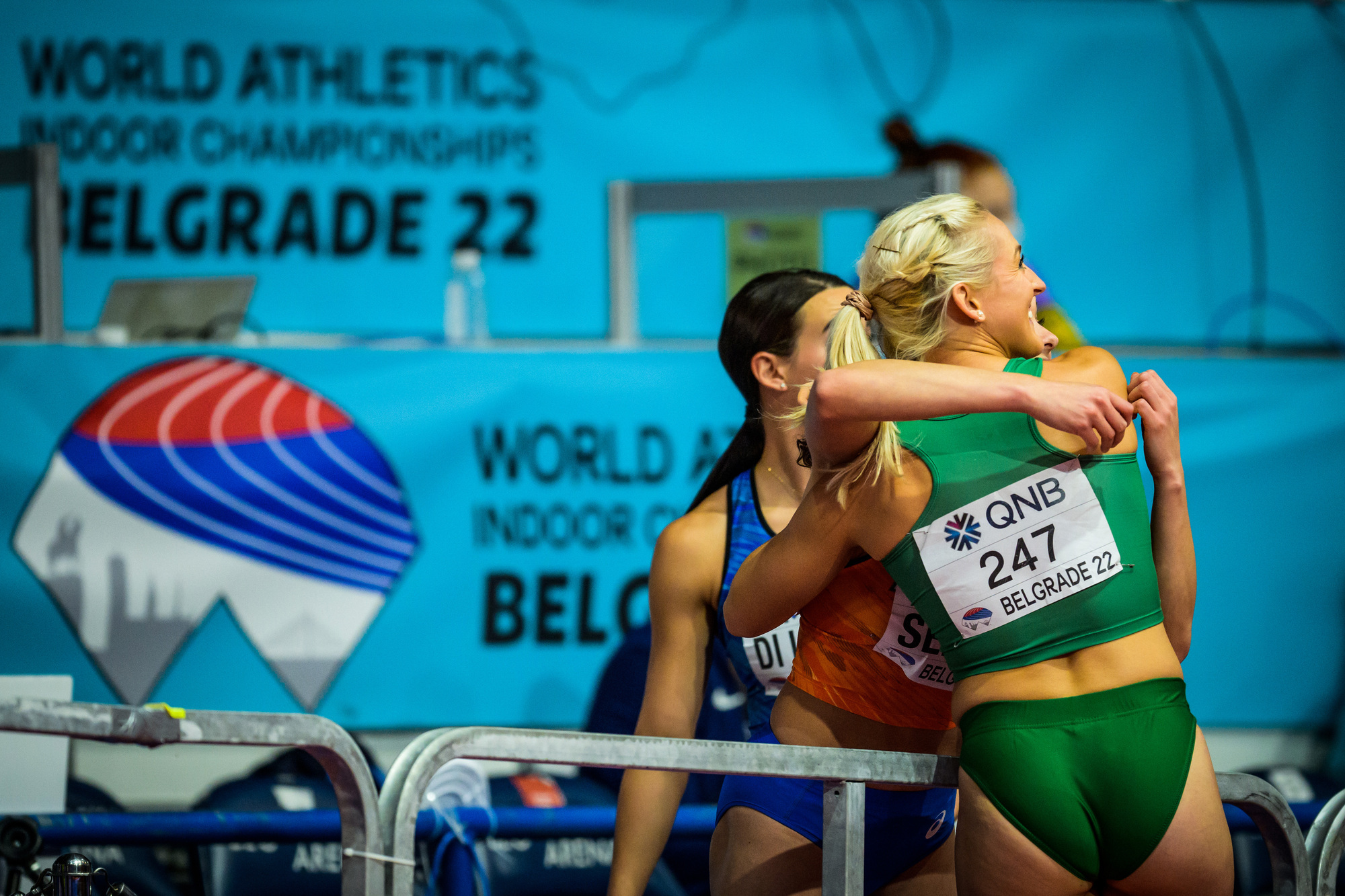
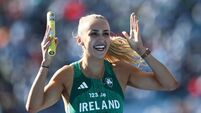
Ireland's Sarah Lavin celebrates qualifying for the final
For Irish athletes, lining up at a major global championships can all too often prove a chastening experience, an eye-opener of just how big a chasm they have to bridge to the world’s best. In Belgrade over the weekend, that was again the case for many.
One by one they walked into the mixed zone, their reactions ranging from frustration to fury. Not all of them, of course, but enough to form a trend that suggested – as the numbers supported – that so many had left their best performances behind them on a much smaller stage.
The one big exception was Sarah Lavin, the Limerick athlete producing the performances of her life on Saturday to power into the world indoor final, clocking a blazing 7.97 seconds to finish second in her 60m hurdles semi-final.
A teenage star, this was Lavin making good on her vast talent after much of her senior career was lost to injury, a way for her to pay back the support of coach Noelle Morrissey, who has steered her career for the past 20 years.
In doing what she did, and reaching a world final, Lavin diverged from what has become an unwanted norm among many of the Irish. Instead of being blinded by the stage, she was emboldened by it. Before Lavin, only one Irish athlete – Derval O’Rourke – had broken eight seconds for the 60m hurdles, and here she replicated O’Rourke’s ability to find an extra gear when it matters most.
“What a moment, just for everyone in my life,” she said after the semi-final. “To be a world indoor finalist, no one can ever take that away from you. It’s a dream come true.”
She had scant time to come back to earth before the final, and maybe that dizzying high was part of the reason she couldn’t replicate her semi-final run, Lavin finishing seventh in 8.09 in a race won by France’s Cyrena Samba-Mayela in 7.78.
A perfectionist by nature, that was never going to leave her content. It’s a good sign that it didn’t, but once that minor disappointment faded she knew she had achieved something significant – the first Irish athlete since David Gillick in 2010 to make a world indoor final.
“I have to be immensely proud,” she said.
There were other positive notes too. Teenage sprint star Israel Olatunde had a strong run in his 60m heat, his time of 6.66 to finish fourth not enough to advance but not far off his best. “I wanted to get out there and compete against the best in the world and I think I did that well,” he said.
Molly Scott backed up her great indoor form by making the 60m semi-final, and swore she’d return in two years and be right up there. Phil Healy put a bout of Covid behind her with a superb performance to win her 400m heat, but the edge the illness took off her fitness no doubt affected her in that evening’s semi-final.
Recent bouts of Covid were also a factor for Mark English, Sophie Becker and Andrew Coscoran, who were all below their best, while others, like Luke McCann, Síofra Cléirigh-Buttner, Sarah Healy and Darragh McElhinney were somewhere between despondent and disgusted by their runs.
“Not only is it not good enough, it’s just not good at all,” said Cléirigh-Buttner, while McCann said it “feels embarrassing”.
The final day of action saw national records for the Irish men’s and women’s 4x400m teams, with Cillin Greene, Cathal Crosbie, Brian Gregan and Chris O’Donnell clocking 3:08.63 to finish third in their heat, seventh overall, and take 0.2 seconds off the previous record. Sophie Becker, Roisin Harrison, Sharlene Mawdsley and Phil Healy clocked 3:30.97 to finish third in their heat, also seventh overall, and just 0.06 shy of the final.
“I’m really proud of the girls, we’ve shown we can mix it with the best,” said Mawdsley. “To be so close to a final is so disheartening, but we left it all out on the track.”
Elsewhere there were stunning world records in the women’s triple jump by Venezuela’s Yulimar Rojas, who soared 15.74 metres, Grant Holloway in the 60m hurdles gold with 7.29, and Sweden’s Mondo Duplantis, who cleared 6.20m in the pole vault.

CONNECT WITH US TODAY



Be the first to know the latest news and updates