'The war and battle analogies devalue sport and what sport is'
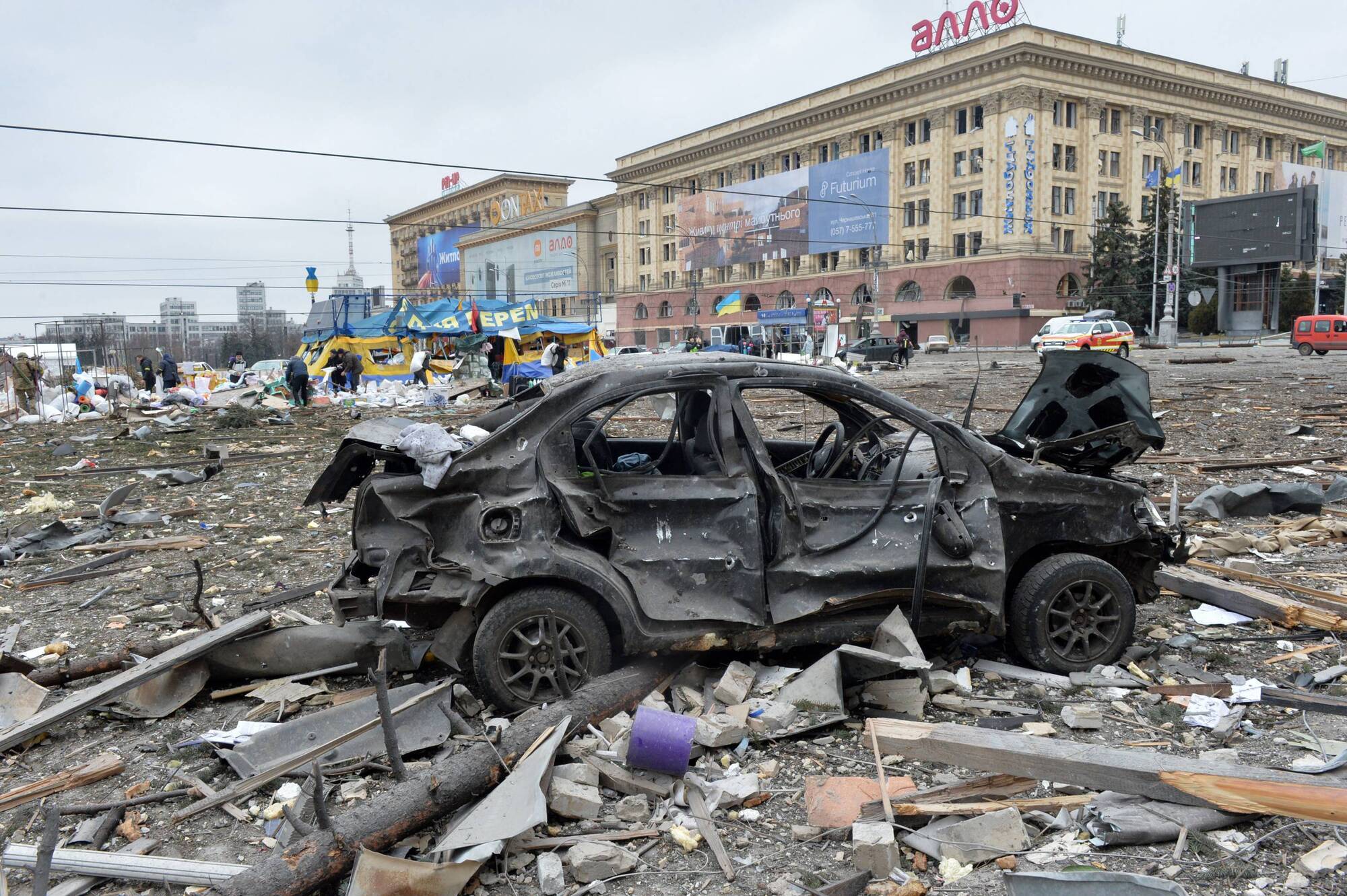
A view of the square outside the damaged local city hall of Kharkiv destroyed as a result of Russian troop shelling
Battles and war zones, dogfights and warriors.
The combat rhetoric in sports coverage can often seem overblown, but with the invasion of Ukraine dominating the airwaves it’s rarely seemed less appropriate.
There’s an ongoing debate in medical coverage about terms such as ‘losing the battle’ with an illness and what such terms connote: should we stop using similar terminology in sports coverage also?
Tom Clonan can offer some perspective. The well-known security and defence analyst joined the Irish Army in 1989 and was involved in armed support to the Gardaí before the ceasefire and the Good Friday Agreement.
He went to Middle East with the Army, was an election supervisor in the former Yugoslavia, and since 2001 he’s been writing about defence, security, and allied matters.
That’s over thirty years’ experience in the area, but Clonan credits his deployment in the Middle East as formative when it came to his thinking about conflict.
“In 1996 the Israelis came into Lebanon in what was called Operation Grapes of Wrath - they absolutely saturated all the little villages and towns of south Lebanon with airstrikes, artillery, helicopter gunships, a punitive operation against the entire population because of what Hezbollah had been doing, firing missiles into Kiryat Shemona.
“The unit history records literally quarter of a million separate attacks in a four-week period in the Irish area of operations. A lot of Irish people have been to Lebanon but very few had an experience like that.”
Clonan was in Irish Army patrols which went out to examine buildings which had been struck by missiles or tank fire.
“That meant we had to take the bodies of entire families, elderly people, children, infants out of those buildings.
“You’re talking about decapitation, limb separation, horrific burns. That’s what war is.
“It’s about the killing of civilians and it’s the most squalid, sordid, appalling thing - the lowest thing as a species we’re capable of.
“We’re the only species on the planet with moral agency, but what is happening now in Ukraine, that is the absolute end of the line. Killing innocent women and children.
“And sport is the very opposite of that. It’s a beautiful thing, a cultural activity where people find expression and find they can self-actualise. People can express themselves in sport.
“You could also say it allows Irish men in particular to express emotions in a way they might not be able to do otherwise because we’re not socialised in that way.
“In many respects, then, sport is the absolute polar opposite of war. Because of that I think the use of that kind of language, the war and battle analogies, devalues sport and what sport is.
“It also sanitises the ugliness and squalor of war to an extent, so there are two things going on when that language is used.” Clonan expands on what war really is - and what it really does to people, which is a far cry from the tired cliches used when describing games and sportspeople.
“Lebanon was an experience that remains with me. It was war, and it was a life-altering experience, and if people don’t have the proper supports and help that can be a life-limiting experience.
“The stress reaction to that kind of experience is a natural and inevitable response, but if you get the proper help you can get past it. If you don’t then you can develop PTSD.
“As a result, I think using those terms devalue sport and sanitise the experience. My kids play rugby and I see how much they enjoy it, the sheer crack they have with their friends. So for me the two things are so far removed it’s not even true.
“On radio I’ll hear sportspeople being asked ‘what you learned on the field playing such and such a sport, did you bring those lessons into business’, and absolutely those lessons can be applied.
“Did I learn anything from the world of conflict? My experience in Lebanon came to a head in a little village called Qana, where 117 men, women and children were killed in one incident. Soldiers from all over Ireland went into that village with no medical training, and went among the dead and injured trying to help those they could, and to give comfort to those they couldn’t.
“I flew home the next day, so twenty-four hours after that experience I was walking down Grafton Street holding hands with my girlfriend. I didn’t have the vocabulary to describe what had happened in Lebanon.”
Clonan says he was finally able to articulate his experience in 2003, when he and his wife had a little girl, Liadain, who passed away: “When we buried her in Glasnevin Cemetery . . . the hardest thing was walking away and leaving her in the ground. That was when I began to come to terms with what had happened in Lebanon.
“And that’s what war is like, if I were to describe it - how negative it is. How final it is.
“When the talking stops, which is what has happened in Ukraine, hundreds and thousands of people will have that experience. The loss of home, the loss of loved ones, and in the most squalid conditions you can imagine.”
Euphemism isn’t confined to sports discourse, either. Clonan points out that discussions of conflict can often be pretty sanitising on their own terms: “A lot of the expressions I’d use talking about conflict - weapons systems, logistics trains, exchange ratios, multiple-launch rocket systems and platforms, aerial platforms - aren’t really describing what they’re about. Really what you’re talking about there are instruments which are used to pull people apart and dismember them. So it goes both ways when it comes to language that sanitises what it’s describing.”
An end to taking no prisoners and being in the crosshairs, then? No more falling on the sword or dying with the boots on?
“The use of that kind of language in a sporting context does normalise and sanitise war, and it really has no place in that context,” says Clonan.
“Because when you go out to play a game or sport, whatever that game or sport is, you celebrate life, it gives full expression to our physicality.
“And that’s beautiful, and it’s inherently what makes us human. Other species don’t play games in that way. So we’re fully human when we play sport, but engaging in war is the very opposite of that.”
Does that kind of discourse grate with Clonan?
“Over the years I’ve often done slots on the radio, generally after some appalling event, and that often means chatting to the host of a show right after the news bulletin.
“And that in turn means right after the news the sports correspondent comes in and reads the script, and it would strike me the odd time that it’s a very innocent space in some ways.
“The language is very dramatic but what it’s describing . . . I represented Ireland internationally but I wasn’t wearing a rugby jersey. I had an Irish flag on my shoulder but it wasn’t a football pitch. There were no rules. There was no referee. It was absolutely barbaric. So when I hear ‘he’s a tough man on the field, a tough man off the field,’ the innocence of that strikes me. That’s not denigrating sportspeople, it’s the use of that kind of language in that kind of context.
“Naive is the best description.”

CONNECT WITH US TODAY



Be the first to know the latest news and updates