Basketball Ireland CEO John Feehan: 'We’re capable of catching the big three sports'
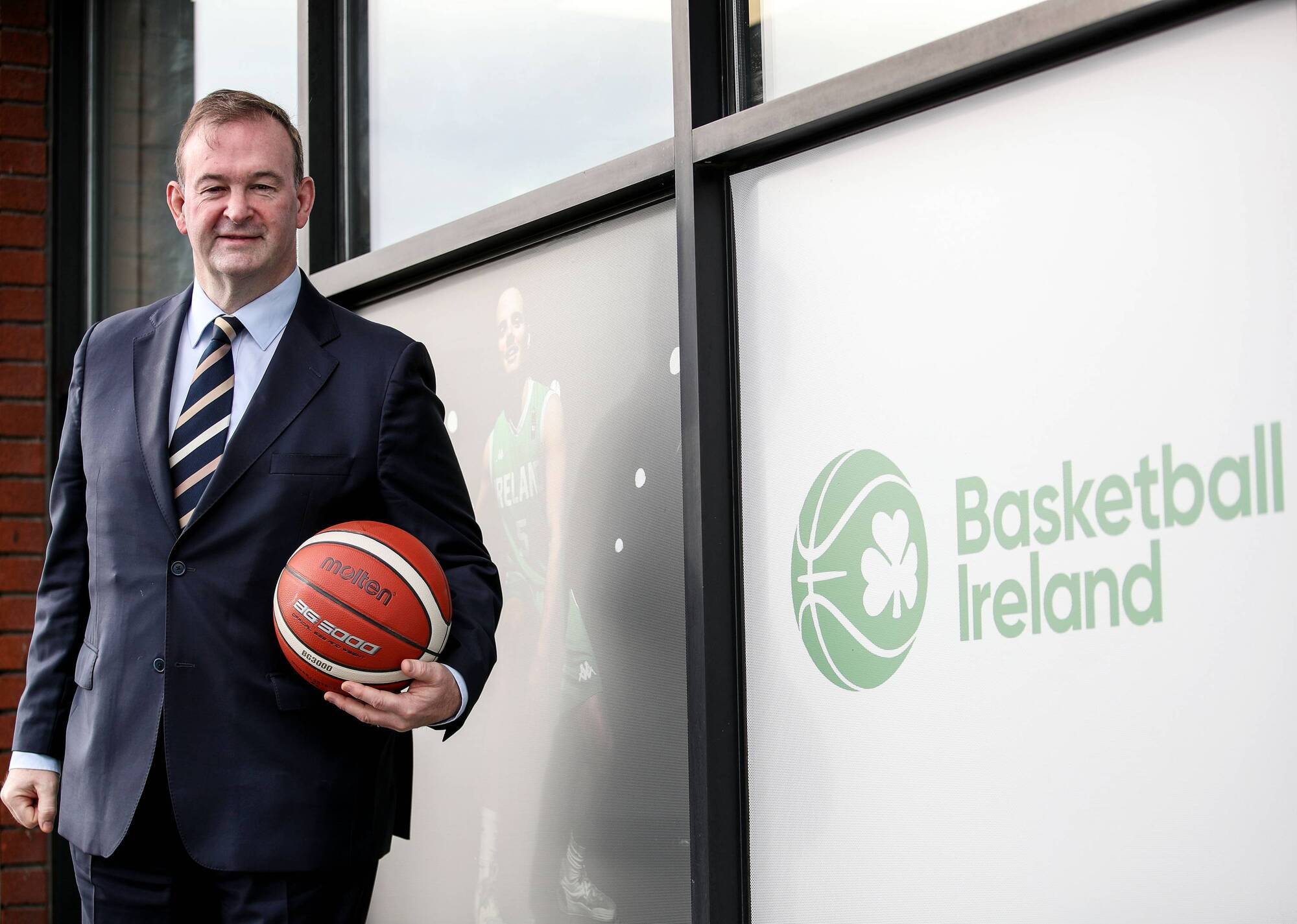
Basketball Ireland CEO, John Feehan. Picture: INPHO/Evan Treacy
A new year, a new man in charge, but for Irish basketball there’s finally a sweet sense of familiarity about the weeks ahead. After a two-year absence, January once again signals the home stretch for the National Cup, with the semi-finals playing out in Cork this weekend.
For John Feehan, who took over as Basketball Ireland CEO in mid-November, the feeling in the sport is now one of cautious optimism.
“It’s just nice to be playing games again as opposed to (looking at) closed indoor courts,” he says. “People are just relieved we’re back playing. There’s a little bit of trepidation with what’s around the corner but that’s okay, we can understand that. We just have to go with the punches here and see what comes along.”
Basketball, along with other indoor sports, absorbed the hardest of hits over the past two years as it repeatedly endured the game-over, ball-burst dictum from government buildings. For those working at its coalface, that meant an increasingly uphill struggle to maintain membership levels. Competition is the oxygen that keeps such numbers alive, and while its absence was understandable there was no denying the collateral damage.
“We’ve been hurt and hurt badly,” says Feehan. “Our revenues have been hit fairly substantially but leaving that aside, we’ve had great support from government and Sport Ireland in particular. We’ve had great support from FIBA (basketball’s world governing body), the Olympic Federation of Ireland, and between everybody we’ve got through. We’d like to think we’re coming out the other end. Time will tell whether that’s the case or not, but we feel we’re robust enough to see ourselves through this, whatever happens.”
Recent weeks brought an unwelcome sense of déjà vu, with 18 of 20 recent National League games postponed as Covid-19 again took a wrecking ball to the fixture list. Where does that leave the league’s current status?
“I’d love to give a solid answer but I don’t have one,” says Feehan. “It’s such a fluid situation. We plan to finish out the League and to obviously finish out the Cup, and we think we can get that done over the next couple of months. Some of it will depend on government guidelines, what regulations apply. Some of it will depend on the levels of infection in various teams and those involved. We just have to adapt and be flexible. As of today, we think we can get everything completed.”
Feehan’s stint as CEO began in mid-November, and though he had no basketball background he has an accomplished record in sport, specifically rugby. As a player, he was capped for Leinster at senior level along with stints with Trinity College, Old Belvedere, Old Wesley and the Irish U21s. From 2002 to 2018, he was CEO of the Six Nations and the British & Irish Lions and he was CEO of the PRO12 from 2011 to 2015.
What did he learn in those positions that he plans to put to use now?
“There’s lots of specific aspects: I dealt with a lot of people in a very advanced setting within the Six Nations and I know a lot about the media markets, how to structure commercial programmes. I learned about the communications process, the dynamics about the various competing stakeholders and how to handle them.
“As chief executive, you learn how to manage people, which is a really important part of any business, but particularly in sport. The professional staff are a very important part of how a sport operates and without them you couldn’t get the growth you need.”
Before working in rugby, Feehan was marketing director for Oakhill Group, a printing company, and in the ’90s he spent eight years as senior marketing manager for Beamish & Crawford brewery.
“The business of sport and other business, there’s large parallels between them,” he says. “Sport is different in that you have a huge volunteer aspect that you wouldn’t have in a business. There are certain distinctions. It’s probably the only business you need to be in where you actually need to protect your competition. If you kill your competition, you kill your sport, where in any other business if you kill your competition, from your point of view, it’s a good thing.”
Feehan was also co-founder of Sport2Sport, a sports business consultancy, and he was “working away with that and very happy” when the Basketball Ireland position became available last year. He was chosen from approximately 70 candidates, but why the move into a sport in which he had no background?
“To be honest, I decided a while back I wanted to stay in Ireland. I could have gone abroad and got any number of different jobs. But this particular one came up and I said, ‘Wow, basketball is a big sport.’ I don’t feel it’s given the prominence and importance it has. I don’t feel it gets as much time in the sunshine as it deserves.”
The sport has more than 250 clubs across the island with about 30,000 registered members and it’s also played in 800 schools, with Feehan estimating it’s now played in a structured fashion by about 40,000 people.
“It’s a pretty substantial number and that puts it up there with the big boys,” he says. “Because it’s not showing up for how important it is within the overall market, I believe the skill set I have can really bring on the sport. I can apply principles, my experience and knowledge to help the sport really drive forward.
“What do I want out of it? A sense of achievement and to feel like I really delivered for the sport. Basketball is the sport that has given me this opportunity. There aren’t many jobs of this calibre in Ireland; I’m really thrilled to be here.”
What would success look like in the role?
“A range of different things,” he says. “It would be a much bigger sport again. We’re capable of growing substantially over the next few years. I think we’re capable of catching the big three: GAA, rugby and soccer. To give it the profile it deserves, (it needs) a significant improvement in the commercial delivery the sport can provide for itself; and to improve the reputation and exposure of the international sides as well as our primary club and league competitions.”
Ireland didn’t field international teams from late 2009 to 2016 due to financial issues, but Feehan is adamant that won’t be the case again during his term.
“Any sport that wants to be a major sport in Ireland has to have a fully-functioning senior women’s and men’s side,” he says. “It’s a focus, a pinnacle of the sport. It’s a really important part of identity with basketball in Ireland. We’re very lucky to have great senior clubs but obviously the international sides are key to giving the sport the profile it needs, and kids need something to look up to and identify with.”
Over the past two months Feehan has spent much time getting to know the various people who keep the sport running, from grassroots up to international level, and while some might see his lack of experience in basketball as a downside, the big benefit is he’s viewing it through a clear, unbiased lens.
“With any business (with) a fresh face coming in, you can see some things that might need to change a little bit then other things are being done extremely well. It’s a learning curve and the curve hasn’t stopped just yet.”
He’ll make the drive from Dublin to Cork this weekend to continue that process at Parochial Hall and Neptune Stadium, meeting more of the players, coaches and officials whose interests he now serves.
“I haven’t met everybody but it’s been fascinating and, as a first step, that’s the most important. I’m also assessing the business of this; any sport is a business and I’m assessing what works and what doesn’t work.” Feehan knows the importance, too, of the volunteers who devote so much of their time to keep the sport ticking and growing.
“Without them, we’d be lost,” he says. “We have to support them whatever way we can. We have to try get more money for the sport and all of that will be pumped into basketball. At the end of the day, the volunteers will be beneficiaries of that too.
“We’ve got to recognise the really good work these people do week in, week out, through the most trying times. Without the volunteers we’d be lost and my hats off to them all for standing up and being counted. We couldn’t do it without them. It’s as simple as that.” Each week brings Feehan a new lesson in this realm, and having surveyed the landscape he’s confident there are brighter days ahead for the sport.
“Clearly, I don’t have any skill in basketball but I’m beginning to understand it pretty damn quickly,” he says. “It’s a wonderfully exciting sport, with a good dynamic to it. It’s got so much going for it. We’re in a very positive place.”
CONNECT WITH US TODAY



Be the first to know the latest news and updates