Dave Malone: How a Paralympic champion has created a winning mentality in the pool
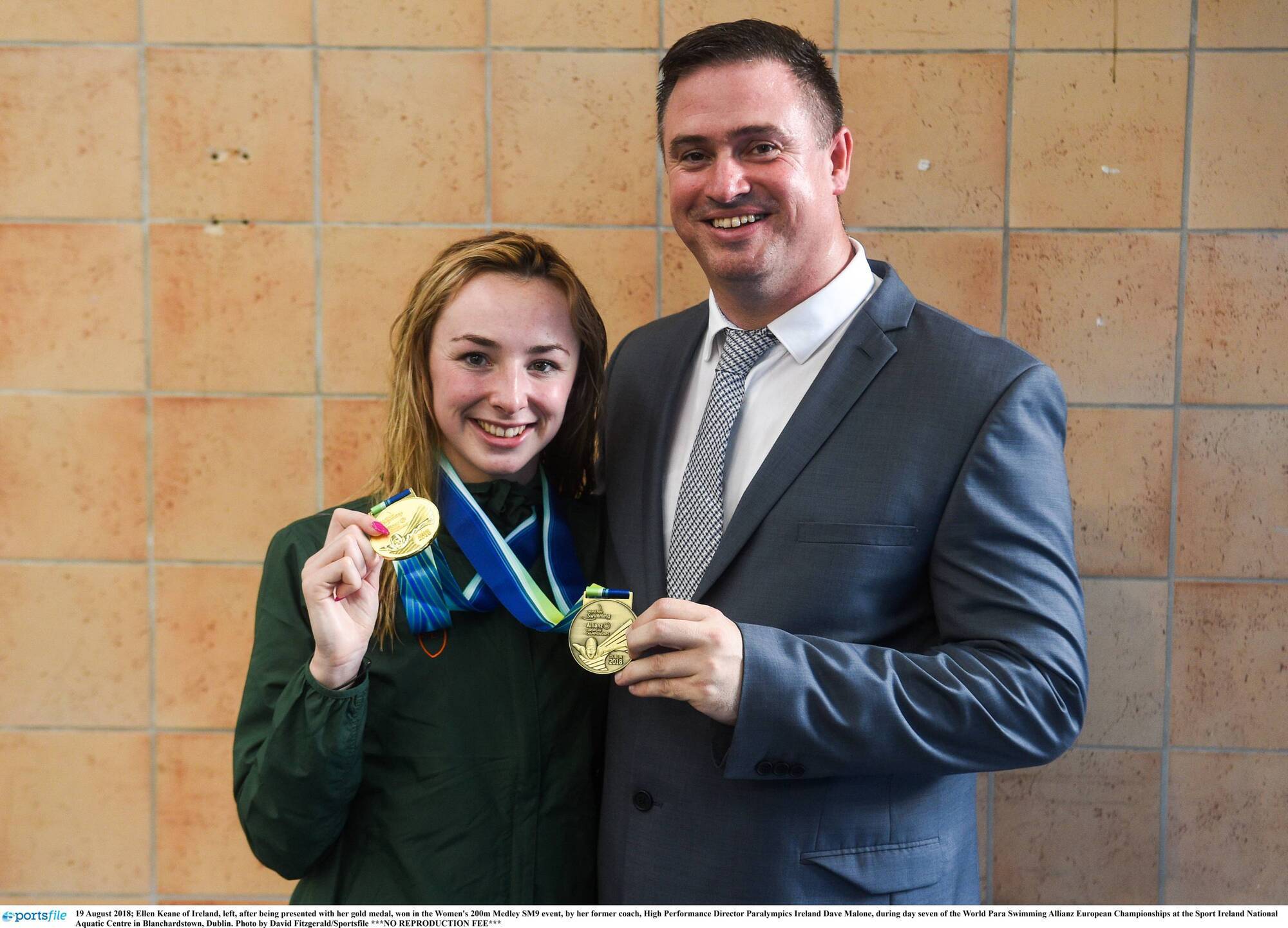
Ellen Keane with coach Dave Malone after winning gold at the 2018 European Championships. Picutre: David Fitzgerald/Sportsfile
Dave Malone was nervous. Once he says goodbye to his athletes, the baton of control solely in their possession, all the Dubliner can do was sit and wait. Or walk. Malone usually chooses to walk.
Back and forth, across the stands at the Tokyo Aquatics Centre, he began to pace as he counted down the minutes to the key swimming finals at the Paralympics. On Monday it was the S6 50m butterfly, where his athlete, Nicole Turner, won silver for Ireland. Four days prior it was the SB8 100m breaststroke, where Ellen Keane, who he’s coached since 2013, struck gold.
The latter was the first athlete he coached to a Paralympic title, Keane’s success emulating what Malone achieved 21 years earlier in Sydney, where he dead-heated for gold in the S8 100m backstroke.
His involvement these days can often feel just as visceral as it did back then.
“I sometimes feel like I’m swimming every stroke,” he says.
“The final 50 (of Keane’s race) I was roaring. Normally I don’t but it’s quite emotional; it’s not every day an athlete you work with is in a position to win a Paralympic gold.”
Before the race the last thing he said to Keane steered clear of motivational mumbo-jumbo, delivering a very specific reminder.
“Whatever you do tonight, stick to the race plan,” he told her. “She did, and she was magnificent.”
Malone is the performance director for the athletics and swimming teams in Tokyo, but his most direct impact is through coaching, managing the day-to-day workload of three of the five Paralympic swimmers: Keane, Turner and Patrick Flanagan. He’s worked full-time in this area since 2009, having closed the door on his competitive career at the 2008 Paralympics in Beijing.
To him, successful coaching is not about barking orders. “It’s not a dictatorship, it’s very much partnerships,” he says.
“We’re in a people performance business and a lot of times we can lose sight of that, but it is about the individual.
“What are the individual needs for each athlete and how do you pull that together in a collective spirit?”
His experience as an athlete is key.
Malone knows what they’re going through. He knows all about the challenges for those with disabilities, the power of sport in defying social or physical limitations some like to impose upon them.
Malone was born with a bone defect condition, arthrogryposis, and at the age of seven his right leg was amputated below the knee, with his left leg amputated above the ankle the following year.
He’d been an active kid despite his condition, and following those surgeries he was soon back out there, riding his bike and kicking ball with artificial legs. He found his way to swimming through a friend, Brian Dunne, overcoming the initial anxiety about having to leave his legs by the side of the pool, soon realising that no one really cared.
By the age of 16 he’d become an established international swimmer, and two years later he won silver at the Paralympics in Atlanta, and upgraded to gold at the World Championships in 1998, setting a world record in the S8 100m backstroke that would stand for 10 years.
He started coaching in the late ’90s, but only after his retirement in 2008 did he think about making it a full-time thing. In 2009 he was chosen out of 21 interviewees as the head of Irish Paralympic swimming, and went about building his idea of a true high-performance culture.
“We have to have a vision, to understand what we’re trying to achieve,” he says.
“You want to create an atmosphere and environment where we provide the right opportunities but also challenges. “Challenge is important but the athlete has to have a voice. Sometimes we don’t listen to the athlete’s voice enough and I try to empower the athletes to take ownership of their development.
“For me, culture is an everyday thing and it’s constantly evolving. You’ve got to work hard at it and have trust. When you have that you have integrity and that’s the key to our programme: integrity. Hard conversations are part of the daily environment but we tried to strip out of a lot of the drama and the team is probably the most relaxed at a major tournament.”
This is Malone’s seventh Games and it’s the small things that show him the culture is where it should be, like how all of Patrick Flanagan’s teammates went to watch and cheer him on during his final race yesterday.
All the same, Malone knows standing still is a surefire way to get left behind. It was a point Jason Smyth made this week: that the rising performances across the board means Ireland has to do more to maintain the current success.
“The standard is growing in Paralympic sport at a rate that far surpasses the performance improvement at Olympic level and that’s due to many factors: coaching, human resources and financial resources,” says Malone. “I think we do need to invest more in para-sport and the new Sport Ireland High-Performance Strategy clearly sets out an increase in funding, and that’s vital.”
Beyond the facilities and sports science back-up, which Malone knows are necessary, he knows so much comes down to something more fundamental: having world-class operators guiding Irish athletes day after day.
“We need to get more people coaching,” he says. “We need to really focus on world-class coaching within our systems and to prepare them for where international standards are going. It’s clear where our competitors are going with major investment.
“We can compete with the very best and we need to reinforce what we have and allow coaches to come in and work in that daily training environment, which we just don’t have. What I’d like to see is having a number of full-time, world-class coaches supporting our para athletes — that’s going to be key to have the success we’re currently enjoying.”
As one Paralympics comes to a close and a three-year clock starts ticking to Paris 2024, you’d hope someone of Malone’s experience, with the track record he has, will have his wishes granted.

BLACK FRIDAY
Already a subscriber? Sign in

CONNECT WITH US TODAY



Be the first to know the latest news and updates