The bigger picture: How sport has become a means of engaging and retaining customers
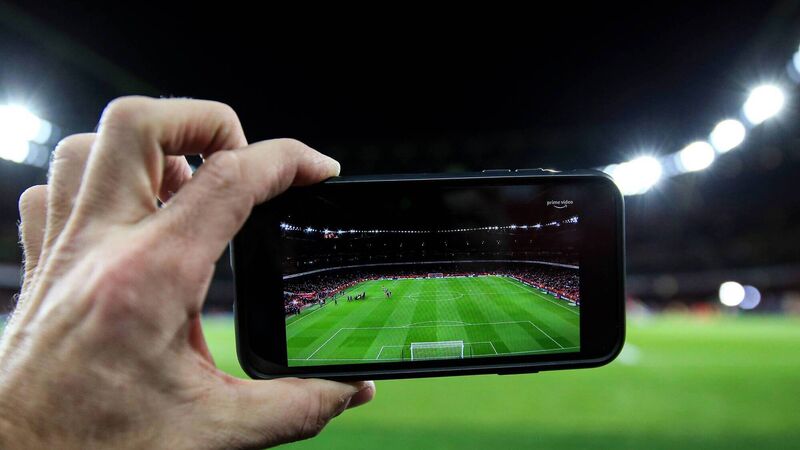
Amazon Prime have inked a deal to show Premier League matches. Picture: Getty Images

Glen Killane, formerly MD of both RTÉ Television and Eir, is explaining what the European Broadcasting Union does, how it represents 500 TV channels (and 700 radio services) across Europe, North Africa and the Middle East.
Now executive director of Eurovision Sport, Killane points to the Eurovision, the European satellite network, and the EBU’s ability to buy sports rights for its members, such as next year’s World Cup (for RTÉ).
“Those are the visible parts. In this day and age operating as an individual market, even if you’re a big player like the BBC in Britain, you’re very small when compared to the buying power of an Amazon or a big entity like that.
“Our members can work together because they’re not in competition with each other.”
Ah, Amazon. Recent noises made by the GAA indicate a willingness to dance with Amazon, but how attractive is the Irish market to an organisation like that?
“It’s a very sophisticated market,” says Killane. “The data you’d gather in a country like Ireland would be very useful to big markets, it’s a very good test market.
“When I was in RTÉ I remember talking to companies about TV formats, and launching new formats like Dancing With The Stars - those companies were interested in Ireland because just as the US companies would use the UK as a test market, the UK would be using Ireland as a test market.
“Being next to the UK, sharing a language - I think that’s why Amazon is officially Amazon UK and Ireland, by the way - is one of the challenges for Irish broadcasters, differentiating themselves from Britain.
People in Ireland want to hear Irish voices, which is true for countries across Europe, by the way. People always want that local voice, even if it’s commenting on international events.
“We’d work with Amazon quite a bit on various things, but it’s not an organisation that’s going to come with a wheelbarrow of cash to solve everybody’s problems unless that makes sense for them.”
Killane points out that for Amazon - just like Sky or Eir in their time - TV content supports their “core proposition”.
“TV and content might not be Amazon’s core business, but it’s helpful to deliver on their core proposition, which is selling goods online.
“If TV and sport can help with that they’ll look at them, but now their strategy seems to be to roll out across different markets in Europe. Amazon is aware of where the opportunities are, but it’s a cautious company, too.
“Don’t forget that. They’re very smart guys and they analyse everything to within an inch of its life.
“They’re in this market and they might well look at GAA content - if it works for them - but they’re also quite conservative about what they do. When they act it’s when they have a good rationale for doing so.”
Incidentally, we see the GAA - a big player in a small market - as unique, but Killane points out that regional sports are the norm across the continent.
“I’m living in Switzerland and there’s a sport here, Schwingen, which is a little like sumo wrestling. It’s unknown outside the country but events are attended by thousands of people.
“In Sweden you have floorball, which is like roller hockey, ski jumping is huge in Poland, while biathlon - a mix of cross-country skiing and shooting - is up there with soccer in Germany in terms of popularity.
Some of those sports are popular in other countries as well, but really outside soccer, basketball and handball, most sports tend to be regional.
However, even regional sports can benefit from partnerships - depending on what the parties want from the deal.
“Outside of GAA it’s difficult to get exclusive content in Ireland because everything else is coming in from the UK, so you have to approach sports rights on the basis that a UK channel will be broadcasting it.
“The PRO14 deal which Eir had, which I was involved in before leaving, was practical precisely because it was a cost-effective way of getting exclusivity.
“Also, what Eir was doing in terms of rolling out fibre into the big cities in Ireland, there was a connection between the content and the business - Munster appeal in Cork, Limerick and Waterford, Connacht in Galway and so on. So that was attractive.
“It’s a little like the situation with Amazon. Eir’s content was only a small part of what the organisation was really about, which was mobile and broadband and so on. Sport was a way of engaging and retaining customers - and winning customers.” That in turn means a sharper focus on what those customers want.
“It’s no longer about having a broad suite of sports to reflect all tastes, particularly when you’re dealing with different organisations, particularly telcos (telecommunications companies).
“Segmentation of the audience, and what’s appealing to the customer we want to attract - that’s how they see it. A broadcaster may see it in terms of, ‘this is the advertising return on the public service quota’, while a telco may see it in terms of ‘what is this contributing to us retaining customers or winning new customers, and what’s the value of that?’
“That different way of looking at sport makes it difficult to compete with those sorts of entities, because the metrics are totally different.”
The side effects? There’s the basic question for sports governing bodies - what do they want from their rights deals?
“Increasingly there are pressures on traditional broadcasters to deliver viewers,” says Killane.
“One effect is sports which were delivering 10 years ago are finding it harder to get a foothold in schedules.
“There’s a trade-off for what sports federations can sell in rights - to the EBU, or to agencies which can sell on to broadcasters - and exposure. It’s a trade-off between money and exposure.
“For me there’s no one solution to the question. Federations now either sell their rights to a pay channel and lose out on exposure, or they sell their rights for a lower fee to a free-to-air channels to get more exposure.
“They can try to build value for their sponsors, but the market is difficult at present for second-tier sports.”
With soccer the only real first-tier sport?
“It’s the only game in town. In general terms you have to differentiate between soccer and other sports because it (soccer) has thrived behind the paywall. By contrast, a sport like cricket is seen as having lost a generation of players because it went behind a paywall on TV. I think that’s a matter of regret for the sport now, which has moved on to a mix of pay- and free-to-air TV coverage.
“For a sport like rugby that’s also a consideration - if you go behind a paywall totally, what effect does that have on the uptake of a sport? Don’t forget that for many sports, sponsorship is linked to visibility, but visibility is also necessary to attract new athletes and new supporters.
That’s very important to sports federations as well, because ultimately that’s their job, to secure the future of their sport.
CONNECT WITH US TODAY
Be the first to know the latest news and updates