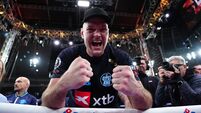
Carl Frampton: 'I’m a UK fighter, I’m an Irish fighter, I’m a Northern Irish fighter. I am all those things'
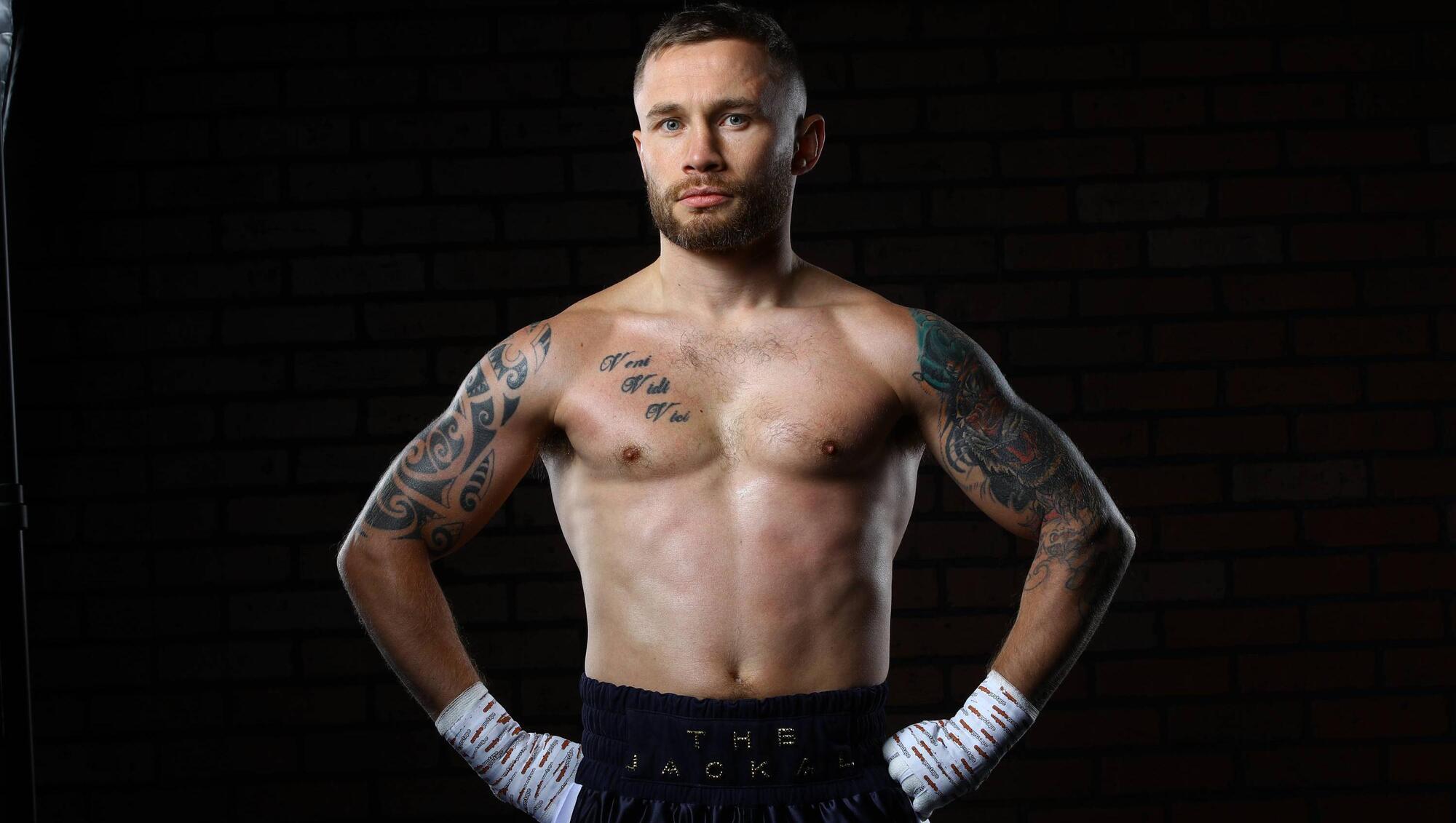
Carl Frampton: 'Everyone wants to be successful. If a genie had granted me a wish at the start of my career that I would be a world champion and lose it in my first defence, I would have taken that.' Picture: Mikey Williams
It had just ticked over to December 23, 2018 and to all intents and purposes Carl Frampton, sat backstage at Manchester Arena, was now an ex-boxer. Some defeats inspire a desire for revenge, but the only thing Frampton was thinking about after his loss to Josh Warrington was a desire to get home for Christmas with his family.
“I was retired in my head after the Warrington fight without announcing anything,” Frampton said. “I thought that was it. But who would have thought sitting in the changing room that night that I’d be on the verge of fighting for a world title in the third division and creating history and Josh Warrington would have lost to an unheard-of Mexican? It’s a strange game is boxing.”
On Saturday night, at Caesars Palace, a resort on a man-made island in the Persian Gulf at Dubai, Frampton, 34, will challenge Jamel Herring for the WBO super-featherweight title, attempting to become the first Irishman to win world titles in three different weight divisions.
Frampton is well aware of his place in Irish boxing history and will happily talk Steve Collins, Katie Taylor, Michael Carruth, Wayne McCullough or Jimmy McLarnin, who left Co Down for North America as a child and won a world title in the 1930s.
“McCullough was my hero when I was growing up,” Frampton said. “He was in his prime when I was a kid, going to Japan to win a world title, his fight with Erik Morales. He doesn’t get enough credit. To be the top of the pile would be amazing.
“Everyone wants to be successful. If a genie had granted me a wish at the start of my career that I would be a world champion and lose it in my first defence, I would have taken that.
But I went on to achieve so much more than expected but there is still more I want to do.
Boxing has long been one sport that was truly cross-community during the Troubles. Despite being a Protestant from the staunch Unionist area of Tigers Bay in North Belfast, Frampton proudly represented Ireland as an amateur at home and abroad. In 2003, he boxed for Ireland at the European Schoolboy Championships and went on a team trip to the Vatican.
“They let me in!” he said. “That was the big joke in the team. There was me and seven others. They were taking the piss and throwing holy water on me. It was just a joke, no one really cared.”
Frampton is not interested in labels. His wife, Christine, is a Catholic, as are many of his closest friends.
“You can call me what you like,” he said. “I’m a UK fighter, I’m an Irish fighter, I’m a Northern Irish fighter. But I am all those things.”
He became a world champion for the first time when he beat Kiko Martinez on a chilly September night in the Titanic Quarter in Belfast in 2014 for the IBF super-bantamweight title, then added the WBA title by beating Scott Quigg in Manchester two years later. He then travelled to New York in 2016 to claim the WBA featherweight title from Leo Santa Cruz, although he lost a rematch in Las Vegas six months later.
He rebuilt after a messy split from Barry McGuigan, his manager, beating another big name in Nonito Donaire and then fulfilled a lifelong ambition by topping the bill at Windsor Park. He had been a strong favourite to beat Warrington back in Manchester for the IBF featherweight title, so defeat had seemed like a natural conclusion to his career.
“After I thought about it rationally, I came to the conclusion that I could win another world title,” Frampton said. “I knew I was better than that, I performed very well in sparring for that fight. I under-estimated his punching power.
“I knew it was going to be a difficult fight but I didn’t think he could hurt me. That thought went out of my head after about 30 seconds. I just got it wrong. It is the high-end of sport, some you win some you lose. It was an under-par performance rather than me being over the hill.”
His career has proved an inspiration to others, though. Anthony Cacace, the British super-featherweight champion from West Belfast, was once on amateur teams with Frampton and has been a sparring partner for this fight.
“The sort of thing Frampton was doing didn’t seem possible for a wee guy from Belfast,” Cacace said.
“To see what he has done has really inspired me and others. To show that is real, that you can change your life through boxing.
He showed us all the key to the door and all we have to do is follow suit and we can be just like him.
Frampton believes he is in a good place now. Hand injuries, which saw him spend the Christmas before last with both his hands in plaster after operations, are now behind him. So too is the High Court case against McGuigan, which had hung over him for a long time.
“It was very, very stressful, especially at the start of the court case when I was being cross-examined,” he said. “It was the most stressful experience of my life. I wasn’t eating properly, sleep wasn’t great. But after I got done with my bit, it was actually enjoyable to go to court every day and watch everyone else go through that.
“Since it has been settled, and settled in a way that I am very happy with, I feel like a weight has been lifted off my shoulders. I am not dwelling on the past now, I don’t think about these people.
"They are not in my head. That is a part of my life that is now over.”
What could be against Frampton, however, is the step up to super-featherweight. It is a rise of just 4lb, but a significant one when you consider that Frampton spent much of his career at super-bantamweight while Herring, 36, boxed as an amateur – including at the London Olympics – as a light-welterweight, four divisions up.
“He is a big lump of a man but I know I will be the fresher guy because I am not struggling or killing myself to make the weight,” Frampton said. “He says he doesn’t struggle but that doesn’t make sense. How can he go from finishing his amateur career ten years ago and now fighting two weight divisions below. It is just not viable to me.
“The size difference doesn’t affect me. I’ve been sparring big guys – Alex Dilmaghani, Jack Catterall, Anto Cacace - all similar heights to Jamel Herring and I have been flying.
“He is a very good fighter, he is a world champion, but if I am on it on the night, I win this fight, no question.”
CONNECT WITH US TODAY
Be the first to know the latest news and updates