A service game with a difference: How an Irish tennis coach is helping refugee kids
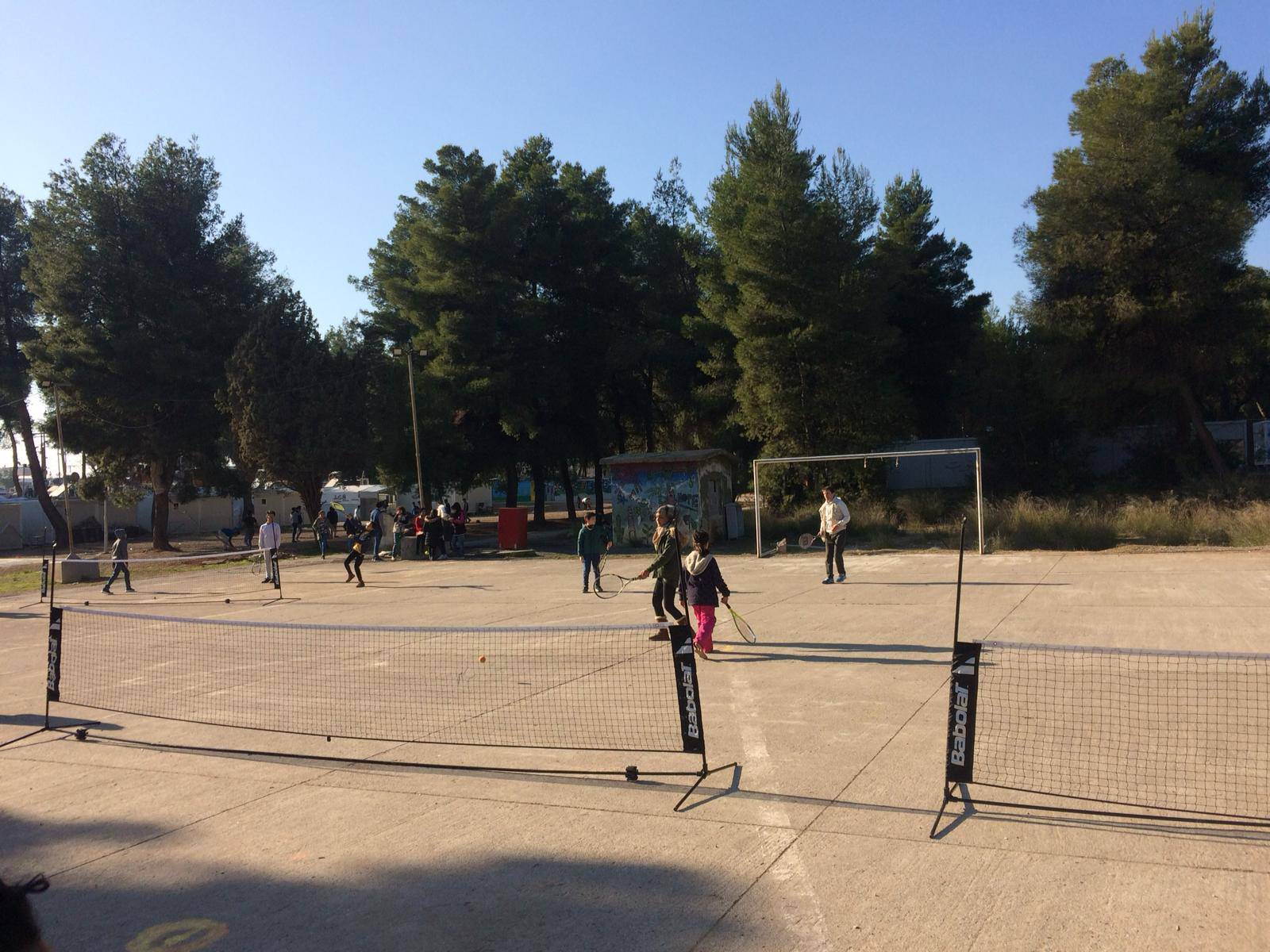
Children playing tennis at the Ritsona refugee camp in Greece.
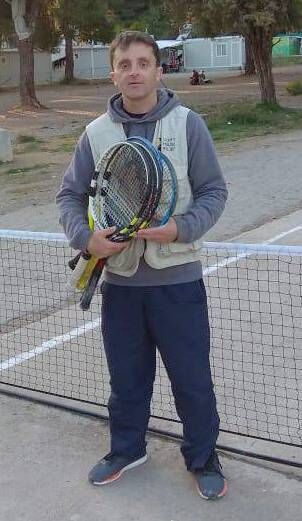
Wes O'Brien can’t wrap a pretty bow around it.
He can offer no neatly-packaged response when asked why a tennis coach from Killaloe felt the urge to direct his time and energy towards the refugee crisis that has landed on European shores via the Mediterranean.
For Bob Geldof, it was the horror of Michael Buerk’s report from a famine-stricken Ethiopia in the mid-80s that prompted action, but humanitarian impulses rarely stem from a lightbulb moment, or prompt such a global ripple.
For most people, this need to help, to do something, anything, is just that: A need. It is unexplainable. You may as well ask why one foot follows another. Or why the sun shines. It just does. He just did.
O’Brien only knew that he wanted to do something and when he reached out to some non-governmental organisations (NGOs) about running tennis camps in one of the refugee camps in Greece it was Lighthouse Relief who
returned his serve.
His first trip to the Ritsona camp in central Greece was in November 2018.
He has been back for stints twice since, the last of them in January of last year and just as Covid-19 was about to fasten the continent and the wider world in its grip.
“There was no defining moment where I saw something on television and thought: ‘I have to do this’. It was just something I always wanted to do and I’m just glad I could do it this way,” he explains. “It was always something I was interested in doing, to volunteer abroad.
“Maybe, if they are lucky enough to go into a new community in France or Germany one day they might see tennis and, because they have played it before, they could get into a club and make some friends.”
Ritsona has expanded from a camp of roughly 400 people prior to his first visit to one that caters for about 4,000. Facilities have improved. Where once there were tents for accommodation there are portable buildings, but it’s no life.
“Families of five can live in one room. Some of the children O’Brien coached on that first visit were still there on his last trip 14 months later.
Lighthouse Relief has been operating child-friendly and youth engagement spaces, a volunteer programme and a list of sports activities that includes football, volleyball, basketball and the tennis which is played on a court eked out of the limited space available.
Knowledge of the game can be rudimentary, he had only 35 rackets with him and the language barrier had to be overcome but, for four or five weeks at a time, O’Brien would spend four hours a day catering for a constant stream of kids eager to play.
Volunteers are not allowed into the residential area — it’s not their space — and asking people where they come from, or about the experiences that brought them there, is another no-no.
If people want to talk about that then it is up to them to broach it. Some did open up to O’Brien but his focus while he was in Ritsona was just the same as it is when coaching children in Killaloe.
The wider picture wasn’t one he could alter so he concentrated on the pixels in his little corner.
“I just went into kid mode. I just did my job and what I would normally do here with the kids. I didn’t think of everything that was around it.
"I trained my mind to say that this is just like a normal summer camp (in Ireland). I ran it as I normally would. I didn’t let myself think about the situations these people found themselves in.”
One moment sticks in his mind: A small boy sticking around to help him gather up nets and the balls, his parents wandering over to capture the scene on their phone and beam at their child’s delight in such simple pleasures.
The only time O’Brien’s focus veered away from tennis was when promising Lighthouse’s Claire Campion, a woman from Kilkenny, that he would organise a defibrilator for the camp. He had done the same for the tennis club back home.
This led him to a web of correspondence with famous sportspeople around the world in search of memorabilia that might be auctioned off to raise funds. The defibrillator has already been bought but the list of items has multiplied.
Rafa Nadal’s foundation sent a signed shirt, so did Usain Bolt. Rory McIlroy has contributed a signed flag from a World Golf Championship tournament. Lewis Hamilton’s signature is on a print, and Felix Jones sourced a signed Springbok jersey.
That’s just a flavour.
The GAA community has contributed handsomely, Dessie Farrell organising Dublin’s contribution and Kerry county chairman Tim Murphy writing a mail outlining that it would be an honour for the Kingdom to do its bit.
He still isn’t sure how to auction all this off. The pandemic has played havoc with those plans but O’Brien is looking into some ways and means of doing so and is open to approaches from charities with any suggestions that might be of mutual benefit.
Any funds secured will fund more trips to Greece where further tennis programmes are being mooted with the Second Tree NGO, which operates in the north of the country, and Sport and Yoga for Refugees, based on Lesvos.
Among the stars he cold-called for an item to add to the burgeoning memorabilia collection was Nick Kyrgios, the Australian tennis player, whose foundation decided that they would go a step further by partnering up and contributing more rackets.
“It’s growing a bit of legs now, alright,” he laughs.


CONNECT WITH US TODAY



Be the first to know the latest news and updates