The big interview: How Shane Sweetnam is raising the bar with style and grace
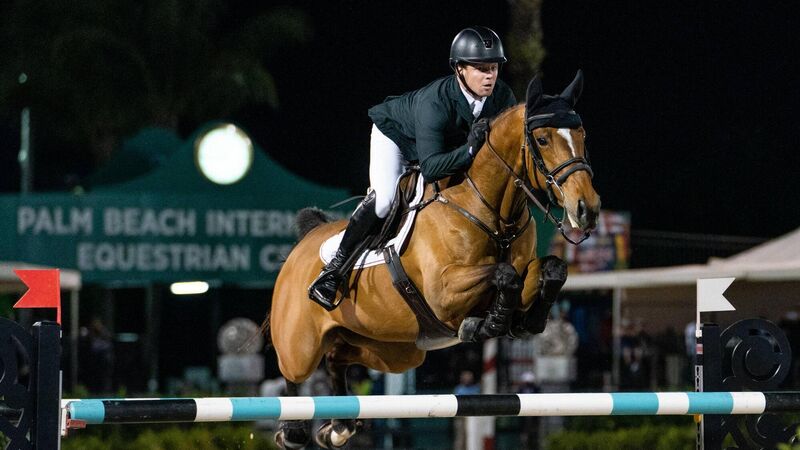
Shane Sweetnam during the Fidelity Investments Grand Prix at the Winter Equestrian Festival on March 13 at The Palm Beach International Equestrian Center in Wellington, Florida. Picture: Aaron Gilbert/Icon SportsWire
It might still be something of a secret but right now in another equestrian game, Florida is proving to be something of a Cheltenham: A place where the Irish are winning big.
And to date if the festival there had a Rachael Blackmore, then that rider most likely would be a 40-year-old from north Cork called Shane Sweetnam.
The name might ring a bell with you, or at least trigger a question he’s been asked multiple times: Would you happen be a relative to your man who plays for Munster?
And for a long time Sweetnam could give the sweetest of answers: Yes, I’ve a cousin that plays for Munster — just not the one you think.
He’s no relation to Darren, the rugby back who also hurled a season with the Cork seniors back in 2013; though Shane himself played quite a bit of GAA himself growing up, it was with a club in the north-west of the county called Castlemagner, over an hour from Shane’s native Dunmanway in the south-west.
Someone who is his cousin though is Donnacha Ryan, the towering lock who soldiered for over a decade with his province before joining European Champions Cup finalists Racing 92; Ryan’s father and Sweetnam’s mother are siblings.
“When we were younger he’d have spent a lot of time with us,” says Sweetnam.
“I was able to beat him up back then but I wouldn’t be able to do it now.”
It possibly says something about showjumping’s standing with the Irish sporting public that one of the best 32 riders in the world at the moment wouldn’t have the same profile as someone who hurled just the one year at inter-county level and has been unable to break into the 30-plus-man national rugby squad in recent years.
But what we might not quite grasp is that while nationally showjumping might not be as box office as it was in the days of Eddie Macken and Paul Darragh, globally it has gone to a whole other stratosphere. And right now the centre of that universe is Florida, where Sweetnam not only lives but is starring.
Just as there’s a phase in the golfing calendar where the PGA and the world’s best gravitate to the sunshine state, it has a similar gravitational pull in showjumping.
For 12 weeks, from the first weekend of January to the first on in April, the majority of the world’s best riders flock to Palm Beach County to take part in what’s known as the Wellington Equestrian Festival, the largest equestrian competition in the world.
Every weekend there’s an event, with some bigger than others.
In mid-February the first five-star grand prix of the year, the $401,000 Douglas Elliman Real Estate, took place at the Palm Beach International Equestrian Centre.
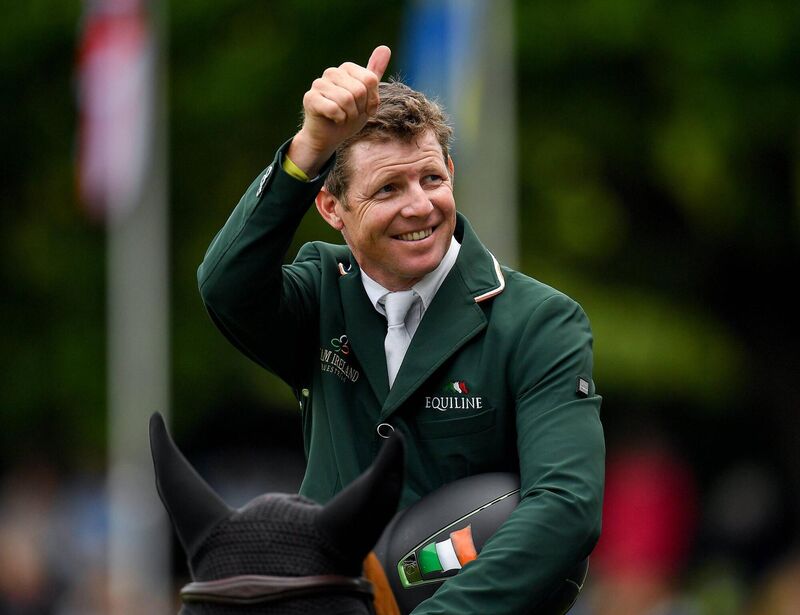
Nine riders would make it through to the jump-off, including one Jessica Springsteen, known in this country for being only the most recent member of her family to rock the RDS; Olympic champion Bessie Madden, world champion Devin Ryan and world number two, Martin Fuchs.
Fuchs showed why he’s world class, completing a clear-round in just 37.16 seconds, and with only one rider left, seemed the likely winner.
But once more the Swiss had to live with being second-best. With the last round of the day Sweetnam cleared it in 37.06 seconds on Alejandro.
Three weeks later Sweetnam teamed up with Cian O’Connor, Bertram Allen, and Michael Duffy for Ireland in the four-star Nations Cup and finished only second to the USA. Sweetnam was literally faultless over his two rounds on another magnificent horse he’s trained, Karlin Van’t Vennehof.
Last week then he was one of a quintet of Irish riders who swept up the top five spots and all but $13,000 (€10,917) of the $73,000 (€61,305) prize money at the Challenge Cup. At the moment seven Irish riders are ranked in the world’s top 50. With only four riders able to go to Tokyo, you wouldn’t envy chef d’equipe Michael Blake’s task of selecting a final squad but a lot of his counterparts would. The sport might have been bigger here in the past but it’s never been better here and it’s never been bigger everywhere else.
“The sport on a global level has grown hugely in the last 15 years. You can go to a big show in America nearly every week; right now we’re in Florida but then it’ll move to spots like Kentucky and around the country.
“And it’s the same on the continent in places like Holland, Belgium, Germany and France during the summer. In Ireland and England it might not be as big as it was the time of Eddie Macken and Harvey Smith when you’d have events like Millstreet and Salthill on the TV a lot and those riders were all household names.
But in terms of competitiveness, we’re now amongst the best in the world. We won the European team gold medal in 2017. We have a good shot at an Olympic medal. We’ve 11 riders ranked in the world top 100. We’re a potential superpower in the sport. There’s not many other sports about which you can say that.”
It’s common now for Irish riders to base themselves in the States, or at least for the winter anyhow, but that wasn’t always the case. When Sweetnam headed over there in 2004 it was the route less travelled by, at least for Irish showjumpers. He was a year out of college, having studied IT in UL, and while he wasn’t sure if he could carve out a career in showjumping he knew by then he didn’t want to make one in IT.
“When I was 22, 23, I wasn’t sure what I was going to do. I was an okay rider but it wasn’t as if everyone was saying: ‘Oh, Shane Sweetnam will be one of the best Irish riders.’ I wasn’t even thinking that way myself.”
He didn’t even go over with a grand plan. He initially just went over to Wellington in the heart of Palm Beach country to check out this Winter Equestrian Festival out for himself but essentially ended up staying. Margie Engle, a six-time World Cup champion, offered him a gig to ride and manage some of her younger horses, and after briefly going home to apply for the proper visa, Sweetnam returned to work full-time for Engle.
Within a couple of years he’d met and married Allison and together they went out and established their own farm, Sweet Oak. Today they employ close to 20 people, looking over 60 horses for multiple owners. It’s as much a way of life as a business; his eldest daughter Olivia, 12, is already competing nationally while little Lucy won her first small pony hunter classic last weekend. He even has it set up that his own parents, Jerry and Marie, now retired, stay in a house on the farm for two months of the year. It’s a while since we’ve heard America so frequently described as “the land of opportunity” but Sweetnam peppers the term regularly throughout an hour-long conversation, being the living proof of its veracity.
What’s brought him to another level in recent years is his ability to spot and improve a horse; after that, the riding kind of takes care of itself. The way he operates, he’s both a Tom Smith as well as a Red Pollard to any Seabiscuit. He speaks about horses the way you or I would about a
person: personality, relationships,
temperament, rapport, chemistry.
“Some are easier to match with than others. Sometimes you’ve a really good horse but maybe you’re not a good match for them and another rider is a more suitable match. Sometimes you click fast, and sometimes it takes longer. Like soccer players, some are easier to handle than others, but with others you have to be more patient.
“Normally the horse I like to go for is very sensitive, very alert to everything. It can take them a bit longer to learn their trade, but in the long run they tend to be faster and very competitive when they’re ready. Whereas some horses are very laidback and laid back. That suits some owners and riders but that normally wouldn’t be my type. I prefer those who are more electric.”
A breakthrough for him was 10 years ago when he came across a horse called Amaretto Darco, who elevated him to international class and the first alternate for Ireland’s team at the 2012 London Olympics.
“He gave me the experience I needed. I was green behind the ears but right from the start our partnership clicked and we were able to succeed quickly. He was a stallion, very consistent from the start. Had the heart of a lion. Because again, horses are like people, players. When the battle comes, some don’t want to go to battle. Whereas there are others who know this is a big day. The smart horses in particular. The real special horses turn up on those days because they know this is what they’ve trained for.”
He has several of those horses now in the likes of Alejandro and Karlin Van’t Vennehof; he spotted what they could before anyone else could and now it gives him the luxury of rotating them, keeping them fresh for the huge year that this is.
He makes a point to manage his own energy too. Although he’s no longer the bigger of the pair, you could see him being able to manage himself in any playful wrestle with his younger cousin Donncha. He’s in excellent physical condition, regularly going for 5k runs as well as hitting the gym. While it might have been something Harvey Smith would have given the two fingers to, these days you’ve to be in top shape to be world class. It’s just where the sport has gone, something you’ve to do if you want to go where he wants to go.
“Fifteen years ago if you went to a show you wouldn’t have seen anyone in the gym if there was a gym to see but now at a show in Europe you’ll see 10 or 15 riders in there working out. To be one of the best you’ve to make quick decisions. And like in any sport if you’re out of breath, it’s harder making those quick decisions.
“Your balance is also a massive factor when you’re riding so your core strength has to be better. And a lot of riders get lower back injuries as they get older because there’s a lot of friction on your back. For me personally I know if I didn’t work out it would really tell on my lower back, especially with all the travelling we do. But thankfully I haven’t had a back injury yet. I’m trying to prevent it and I’m managing it as best as I can.”
There are few athletes we’ve encountered who are as clinical and clear-minded as Sweetnam is. Every controllable he can control he tries to control it: The horse, himself, all the logistics. He finds there’s a comfort in it, that if he ticks all those boxes, he can live with whatever result comes or the horse might do.
“That moment before you start your round is very important but the organisation and the planning is what makes that night a lot easier. For that five-star we won with Alejandro, we’d planned that out months in advance. He’d have already jumped a four-star clear in December so we knew he had the experience for the grand prix.
“And you know what, even then you could do that class and be unlucky and knock one, but if everything else is right, you’ll get the result you want. So you have to accept that while you could be unlucky, you’re not going to be far off.
“When I was younger maybe I’d get too emotional or too physical which didn’t really help. You’ve to try to keep it very smooth. The horses have the talent so you don’t want to interfere with them.
“If it gets too physical or I’m too rough or too strong or too far away or too close or too fast, those little things make a massive difference jumping that height, so it’s about keeping it exactly like you imagined and trained and try not to change anything. And if I do that, then most of the time I won’t be too far away.”
He's taking the same approach to the Olympics. For as much as this is a multi-million dollar industry, as much as he’s a hard-nosed businessman, he won’t disguise that the prospect of Tokyo brings out the kid in him. Yet only four riders can go and only three can compete. Right now, he’s the third-highest ranked Irish rider, being 31st in the world.
But breathing down his neck are numbers 36, 39, 42, and 48.
“Hopefully we’ll get there and we win a medal. If we could do that it can make a career, just that one moment. If it doesn’t happen, will it ruin my life? No, but it is a dream. Yet it’s not my decision. It’s up the chef d’equipe and the high-performance committee to pick their team when the time is right.”
Until June, as he puts it, “All you can do is do your own best job.”
Keep doing that, and he won’t be far away. It’s already taken him a long way as it is.


Cancel anytime
CONNECT WITH US TODAY



Be the first to know the latest news and updates