Gearóid Towey: 'This massive wave lands and I don’t know which way is up. I felt like I was destined to drown'
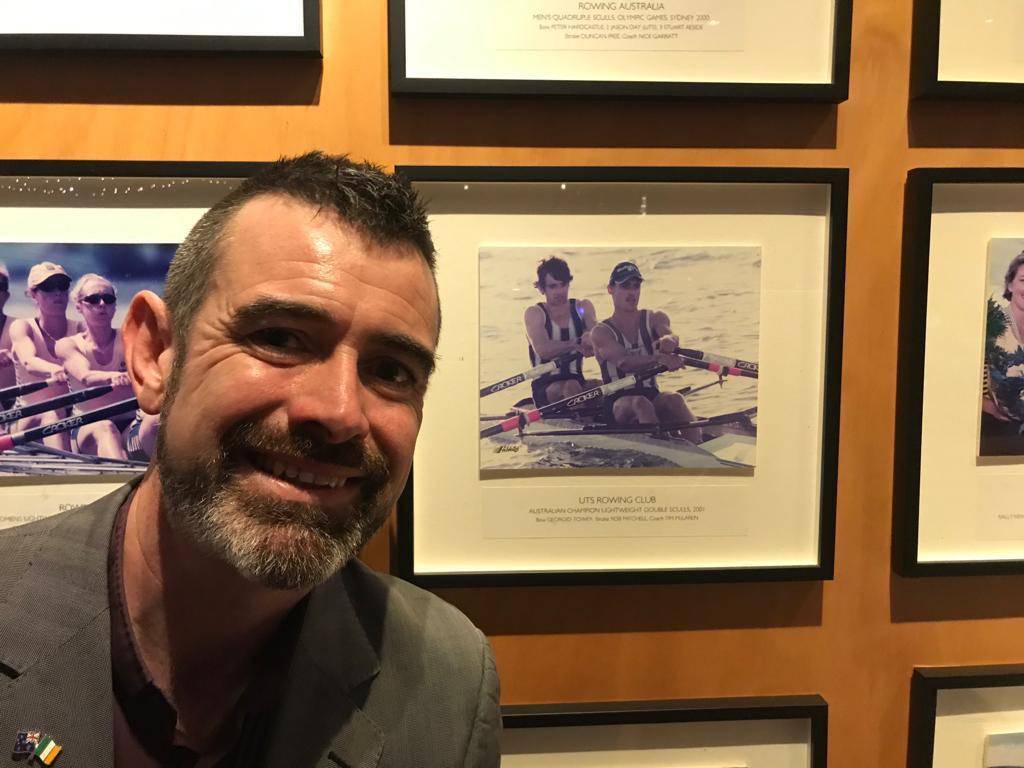
Gearóid Towey, who now lives in Sydney, in front of a picture of himself rowing for the UTS Rowing club in the city back in 2001. Towey founded Crossing the Line, a service to support athletes’ mental health, wellbeing, and transitioning to life after sport.
In recent years, Gearóid Towey has gradually become infatuated with UFC, or at least one certain aspect of it. It started when he heard the victorious middleweight Darren Till explain that his pre-fight dread was once so great that he was hoping for a serious injury in the build-up. Boy, did he know that feeling.
Earlier this year, he watched Dustin Portier describe his emotions in the dressing room prior to his win against Conor McGregor: “I felt bad. Flat. I didn’t want to be here…”
The Irish Olympian sat in his Australian home watching the post-fight interview and nodded knowingly. This was a sentiment that resonated. It tallied with his experience of elite sport. Something he is convinced every athlete experiences, but few talk about. In an era where positive thinking exponents are omnipresent, endorsing the opposite is strange. Yet, for him, it proved successful.
The Corkman is a former World Rowing champion and competed at three Olympics: 2000, 2004, and 2008. He is also an ocean rower and participated in the trans-Atlantic rowing race. Throughout it all, negative thoughts were a near constant.
“I don’t really buy into the whole thing that positive psychology is very important,” he admits with a shrug.
“We are always talking, having a self-talk that is generally positive. But when you are coming up to these races and you are on the water, your head goes... So, UFC fighters, I heard Darren Till say after a fight that he won recently that before it he was looking for a way to break his leg.
“I fully understand that. I think that is something everyone in sport feels but they don’t talk about it. Before a big race, you know there is a physical thing about turning yourself inside out.
“You know what? Good. That is important because that generates adrenaline, you need to be ready to run. Ready to fly.”
Towey is sitting in the Sydney sun, where he founded and runs Crossing the Line, an organisation dedicated to athlete mental health and transition out of sport. Over the course of two hours, he invites you to explore every crevasse of his extraordinary story.
Standing behind a curtain just before appearing in his first London play, starring across the Atlantic Ocean just before he attempted to cross it in a rowing boat, sitting in the lightweight fours just before his first Olympic race in Sydney, always feeling the same.
“I’ve won races where I was thinking before it, ‘fuck. I can’t do this.’ I wasn’t feeling it or whatever and then you get on the starting blocks and fly. That kind of flies in the face of the positive thinking spin.
“That is the thing about rowing and sport, there is darkness to tap into. There is something there that helps you. I know that flies in the face of what I do now, in terms of athlete wellbeing. For me, that is about preparing for transition. Being aware that it will be difficult and getting ready so you don’t have an identity crisis. That is the point of what we are doing.
“But while you compete, if you have something a little bit going on, if you are a little bit troubled or whatever in sport, that feeds into performance. That is why a bit of dysfunction is often beneficial in sport. It is about harnessing that while also looking after yourself. That is the conundrum. A lot of coaches love the fact athletes are screwed up.
“Then the negative aspects of that come to fruition when you retire.”
Was it his sport that produced this mindset or did the mindset mean he was well suited to the sport? A little from column A, a chunk from column B.
Rowing goes hand in hand with pain and punishment. All that physical toll does taxing things to the mind. Never enjoying it; learning to endure it.
He had a crucial advantage in that he was reared for this. Literally. It was a childhood spent alongside the Blackwater river. The family love affair started when his older brother, Martin, saw an army ad that featured rowing on TV and decided he wanted to try it. Then another brother, Davey, started, followed by sister Janette, another world champion. All the while, his father Gerry watched and wanted to help.
So, he read books, asked questions of anyone who could provide a helpful answer and when an 11-year-old Gearoid announced while watching rowing at the Seoul Olympics that he too wanted to do it, Gerry began to coach his youngest son, under the watchful eye of his mother Carmel.
Despite never in his life setting foot in a boat, Gerry raised and trained an Olympian rower. One primed to tolerate pain. And repetition. And pain.
Long distance cycling supplemented his training, the mountains of Munster were well-worn running routes.
“The hardest part is definitely the mind. You know physically you will put yourself there, you have to allow your body to do it. You can’t back off when you want to. There have been heaps of races where I have thought, ‘I don’t think I will be able to finish this.’ That is very common.
“Thor Nilsen, our national coach, he would say if you do not do it in training, you will not do it in a race. It won’t suddenly happen. You need to get used to pain. We did high lactic acid tolerance training. Hill running was great because within 30 seconds, you are screwed but you have to keep going. You learn how to manage that in your head. And then get to know your body and what it is capable of.
“Rowing is a tightrope walk, get to the edge and don’t fall off. You need to be teetering on that edge.
Within the Irish team, their training had to recreate this hardship. In 1996, they were brought to Sweden for a “hell” training camp. On the first day, everyone was brought in to do the dreaded Ergo test. Afterwards, beat bodies lay sprawled across the floor. Twenty minutes later, the instruction came: “Get up and do it again.” That is when the mind goes into overdrive and the negativity descends. When they completed it a second time, it left them with a tangible reference of how far their bodies could be pushed.
For Towey, there was no other way. There still isn’t. Housebound and restricted during Sydney’s 2020 lockdown, the 43-year-old lost interest in training and let things slide. Before Christmas, he decided to return to habits of old in order to fix it. A stringent regime. 1,000 calories a day. Hard work.
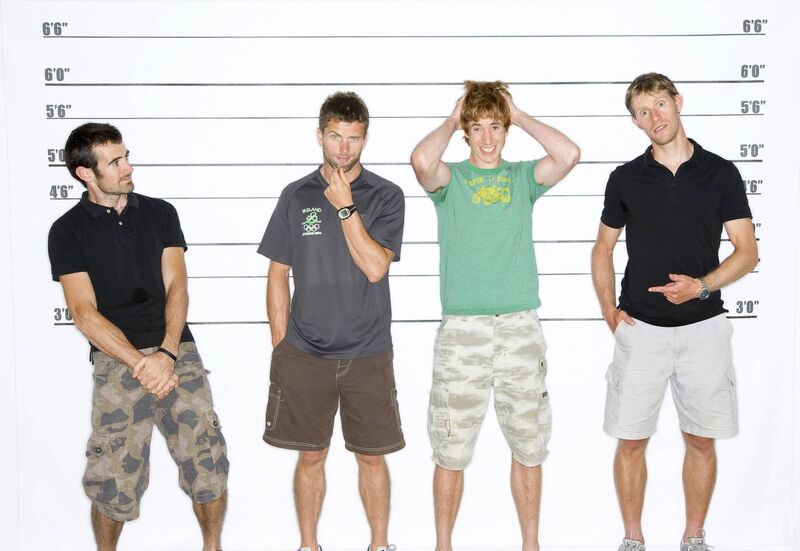
He dropped from 90kg to 82kg and his trim frame looks like it hasn’t a gram to spare. Yet when he raced, he weighed in at 69kg despite being over six foot tall. A reminder that during his career punishment was not confined to the boat, just getting into it was a challenge.
Was the reward worth the sacrifice? There is no doubt it was one hell of a stint, a world champion and three Olympics. Nevertheless, no medal there.
Whenever he sees Sam Lynch, his old lightweight partner in Athens, he can’t help but feel a pang of regret: “I am at peace with it, but at the same time… shit.”
It doesn’t matter that they posted their second fastest time. Few others will appreciate the standard of that race. The difference was marginal but there was a difference.
Which prompts the question, what could he have done differently? By now, commitment and drive are well established. That was not the problem.
There was the fact that he was training in Ireland, a country with notoriously poor infrastructure for elite sport.
The build-up to the 2000 Olympics was dominated by political issues and ticket problems. In 2005, the Irish Sports Council denied Towey funding because he was competing in the Atlantic Challenge rowing race.
In 2008, he campaigned heavily as part of the Save Fermoy Weir project, pleading with the government to reverse their decision to demolish the weir, lower the river and wipe out a sporting facility that was crucial to his career.
No understanding. Little support. A familiar tale in Irish sport. Was this the stumbling block?
“The lack of infrastructure was bad and good for us,” Towey explains.
“Because we were self-starters in many ways. We used to organise our own flights, our training camps. Sometimes they put someone in who was unsuitable for the manager job. They would get in the way and mess things up. I remember we got to an event in Germany and the hotel hadn’t been booked. We had to weigh in the next day. We knew then when we do this ourselves it goes perfect. As long as we have funds to book our flights and everything, we can do it.
In the off-season he flew off to Sydney, the start of a deep love for the city. There he trained with UTS Rowing club as they prepared for the regatta national championships. Setting his own standard, he’d arrive back in peak shape. You find a way, he stresses. Look at Sonia.
He saw her stomach a similar experience. When she was in control, she strived. Sometimes people ask if he is jealous of the facilities afforded to the likes of the O’Donovan brothers. When they do, he shakes his head and laughs incredulously.
“They work so hard. They work their asses off and they had the same coach all the way up. The same group around them. They live at home, they both study. Paul is studying to be a doctor, for God’s sake.
“It doesn’t matter what equipment you have; it can be fancy or a few rusty bars but if you have commitment as a group and accountability everyone working together, the rest doesn’t matter.
“People say to me, the national rowing centre they have is amazing! Do you wish you had that? They didn’t have that! That is a recent thing. They train in Skibbereen.
“They do not have more than what we had. They have a really good support network. Equipment matters, obviously. If you have a bad boat, you won’t go fast. The rest is graft.
To succeed at the highest level requires numerous different components: discipline, work ethic, talent, support, and luck. It is not always about money.
In Australia, for example, funding is readily available although at times he sees it wasted. A fixation on building facilities rather than pathways.
This is somewhat understandable. Success is a hard thing to achieve and even harder to understand. Sometimes it doesn’t go your way, a simple answer to a complicated situation. His life is a testament to that.
In 2005, Towey decided to participate in a rowing race across the Atlantic ocean. The idea had been there since he read a book in secondary school. The opportunity arose after he had competed at two Olympics and developed a good relationship with a sponsor, Red Bull.
He set off with his partner, Ciaran Lewis. After 40 days at sea, having endured two tropical storms and a hurricane on the way, their boat was smashed in a flash storm. They were 900 miles from land and hadn’t seen a ship in four days.
“I was always into adventures. I remember reading about it and it did sound horrific but… I loved doing night hikes and that kind of stuff.
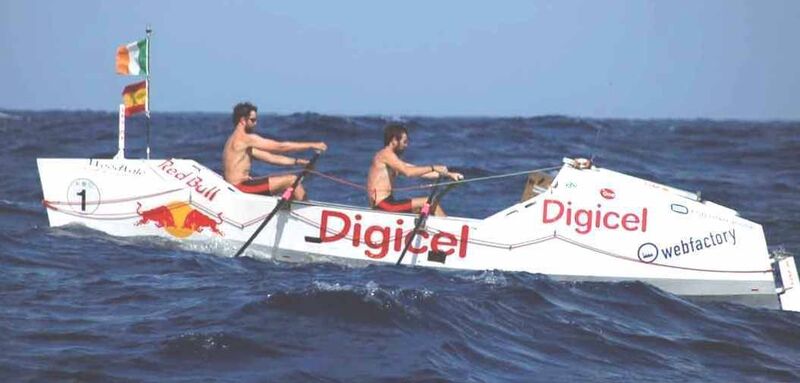
“It did excite me. It is kind of like that thing about the high pain threshold. It was such a different realm. The whole sleep deprivation. The shift system, living on a tiny boat for that length of time. I did stuff to prepare myself mentally.
“I did a multiday and night adventure race up in Scotland with a team. I wanted to experience not sleeping for three or four days. That was an extreme experience. It was like, we slept three hours in four days or something. So, we were getting full visuals. They call them the sleep monsters.
“I did that to experience it before I left so I wouldn’t shit myself when I was out there. Then the Atlantic was different. You rested every two hours; we would swap over. I never got visuals, but I got some audio hallucinations. I kept thinking I could hear my brother shouting at me.”
For the first few weeks, his biggest stress was no music. Both his main and emergency iPod had gone overboard early on and Towey was worried it would become tedious. In fact, when they were lost it helped him appreciate the experience. The sea and the sky combined to form a natural phenomenon. Sights and sounds that are hard to even fathom from the comfort of a curbside café.
Then a 10-metre wave came crashing down. Lewis was down below deck, Towey was rowing. His first thought; game over.
“It was surprisingly accepting. I had a second to accept my situation. I saw this massive wave land, and then I am under water. I don’t know which way is up. I felt like I was destined to drown. I remember thinking, ah, this is the way I’ll go out.”
Instead, they found a stroke of luck. The life raft was within reach and their rescue signal was received by a Spanish supertanker. After a few hours, they were pulled from the water by some dumbfounded fishermen.
“Everyone had life rafts. All the emergency equipment was positioned in a way you could access. We did a survive at sea course. All that is preparing you for the worst-case scenario. That is the reason that a calmness was there throughout the whole ordeal with the rescue and all that.
“The funny thing is, after it all, the fact I was still alive felt absolutely amazing, I could not believe it. That created a very positive feeling for me.”
If Towey sounds like someone with a deep understanding of how an athlete thinks, it is because it is now his passion and profession. Crossing the Line provides a service he saw as desperately required after suffering through his own retirement.
“It was only when I retired and started to talk to people that I realised there is a lot of pain out here. A lot of misdirection. Athletes are struggling to find the next thing. It is causing a lot of depression, suicide.
“I got a bit of a shock really. I expected there to be a website for athlete transition or depression, a site that explains things for you. I found a few little articles here and there. A couple of research papers but who is going to read them? That is when I thought what athletes need is a digestible resource that speaks to them in their own language, run by athletes.”
The key is understanding your drive. What is your motivation, and how do you stoke that post-sport?
“I think by nature athletes are risk takers. At that level, sport is about risk and reward. All that work, all the eggs in one basket. Sam and I wanted a medal in Athens, it didn’t happen. Part of why you do it is because it is a gamble. We are gamblers by nature even if you don’t think you are. Putting everything into one pursuit is a form of gamble.
“I always wanted to do drama, acting, or whatever. I could never do it even as an amateur because I was away all the time. I said I’d do it for a year at the end of my career if I could get into drama school.
“I auditioned before the Olympics. Got in and went to London. Anyway, I remember going out and being behind a curtain before my first play I remember saying to myself ‘This is exactly the same!’ I felt the exact same as I did before a race. What am I doing? Why did I do this to myself? You’ve invested so much, what if it doesn’t pay off? Then I went out, did my first scene, came back and I was pumping full of adrenaline. ‘This is like being a rower without the pain!’
“Gambling addiction. Substance addiction. It is the same, feeding the same thing. We try to help people understand that. Knowing that is really important. To say ‘that is how I am programmed.’ And that is okay. You just need to feed it in a healthy way. Develop the tools to do that.
“That is why we build up risk reward pathways. It won’t switch off when you finish. You will find other pathways. There are Olympians who become drug dealers. I am actually going to go and study law soon. In many ways, it is the same thing. A risk and reward. High stress and satisfaction.”
It is about understanding there is more to life after sport. Just look at Gearoid Towey.
His is some story, and it is not finished.
CONNECT WITH US TODAY



Be the first to know the latest news and updates