Tommy Martin: On the same wavelength - When radio and sports first combined
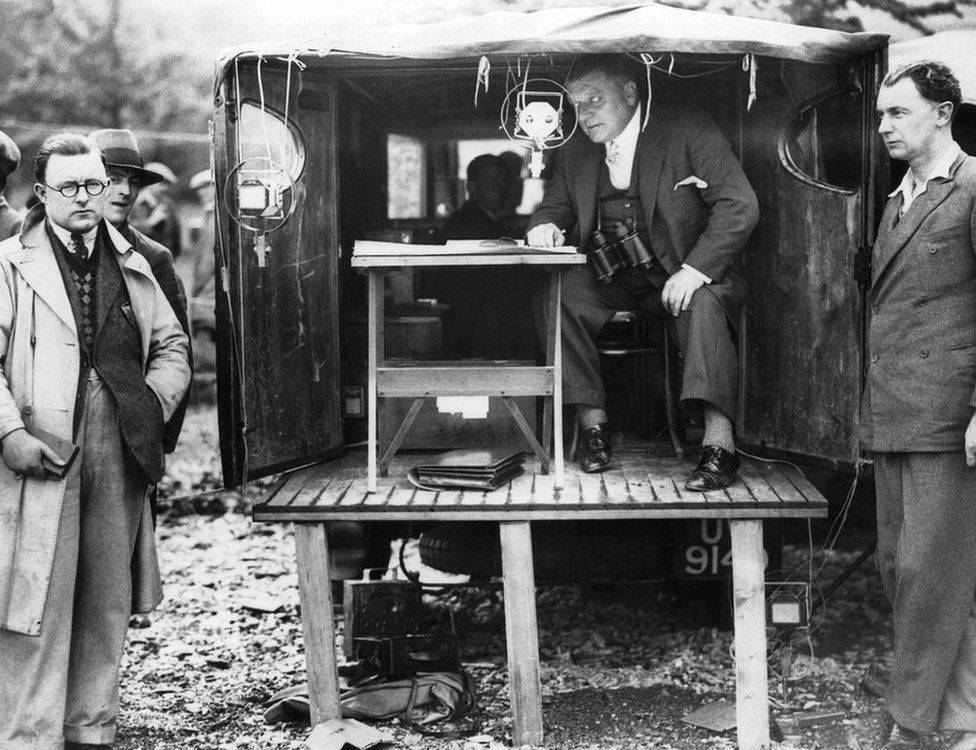
An early outside broadcast van in Loch Lomond, 1932. Via BBC archive.
Ninety-four years ago this week, Lieutenant-Colonel Henry Blythe Thornhill Wakelam took a phone call in his London office.
Teddy to his friends, Wakelam was a decorated war veteran but it was his sporting past that was of interest to this caller.
“Is this the same Wakelam who played rugger for the Harlequins?” asked the man.
“Yes,” Teddy replied.
“Good. My name is Lancelot De Giberne Sieveking. I am from the BBC and would like to see you at once on an urgent matter.”
The Beeb had just hired its first sports commentator.
Mind you, they were a bit late.
On April 11th, 1921 the fledgling station KDKA carried live commentary of a boxing match in Pittsburgh between Johnny Ray and Johnny Dundee – the first ever live sports broadcast. A local sportswriter called Florent Gibson called the action, beginning an era of innovation that shaped modern sport.
Still going today, a century ago KDKA was little more than a relay between factories of the Westinghouse electronics company in Pennsylvania. Radio had exploded in popularity in the years after World War One, driven by wartime advances in technology and the work of enthusiastic amateurs.
Companies making wireless sets figured they could boost sales by putting out music and news programs. That summer, RCA in New York wanted to use the world heavyweight title fight between Jack Dempsey and George Carpentier to showcase the potential of the new medium.
The broadcast was nearly a disaster. At the last minute, the venue’s owners in Jersey City refused permission to place a transmitter in the arena, so it was installed at a train station in nearby Hoboken instead. What listeners heard was the transmitter’s engineer parroting details of the fight, which he in turn was hearing from the ringside announcer down a telephone line. Though few owned a wireless set, hundreds of thousands heard the broadcast in bars and theatres and its success fuelled a boom in radio sales. A new frontier had been opened and sport was leading the charge.
Things moved more slowly in London, but in January 1927, Lance Sieveking was in a hurry.
Previously a private company, the BBC had only become a public corporation on January 1. One of the conditions of its Royal Charter was the right to cover major sporting events, something it had previously been prevented from doing by an agreement with news agencies who were worried about sales of evening papers.
Already behind the rest of the world, the fledgling Beeb wasted little time. The England versus Wales rugby international at Twickenham on January 15th would be first up and Sieveking’s job was to make it happen.
But where to start? Sieveking reached out to the old boy’s network. Wakelam was a fellow former public schoolboy and military man. The right sort. With just days to go before Twickenham, Sieveking arranged a test commentary, a schools match, with an audience of one: a blind man, helpfully provided by the veteran’s charity St. Dunstan’s.
Wakelam got the thumbs up. Few early recordings of him remain, but the legendary BBC cricket commentator John Arlott described him as "a natural talker with a reasonable vocabulary, a good rugby mind and a conscious determination to avoid journalese" – a decent endorsement of a commentator in any era.
Sieveking would also innovate. Pondering a way to help this new medium connect with listeners, he remembered a trip to New York, where he’d seen an electronic baseball field emblazoned on a Times Square billboard, with squares lit up by a telegraph operator to show where each ball had gone.
Sieveking adapted the squares for rugby, splitting the field into eight boxes. The commentator would be assisted by a number two, who would tell listeners which square the play was in and interject with other relevant information.
In the rush to pull it all together, proper listings for the match didn’t make that week’s Radio Times. So, to the bemusement of onlookers, Wakelam clambered into a small wooden box at the rear of Twickenham’s South Terrace and delivered his commentary. He was helped by a sign posted in his eyeline that read ‘Don’t Swear!’ It must have gone well, because a week later, Wakelam and his trusty number two, C.A. Lewis, made history again. That Saturday afternoon, Arsenal’s First Division meeting with Sheffield United became the first football match to be broadcast on British radio.
This time the Radio Times published a plan of Highbury Stadium, sketched with Sieveking’s grid system.
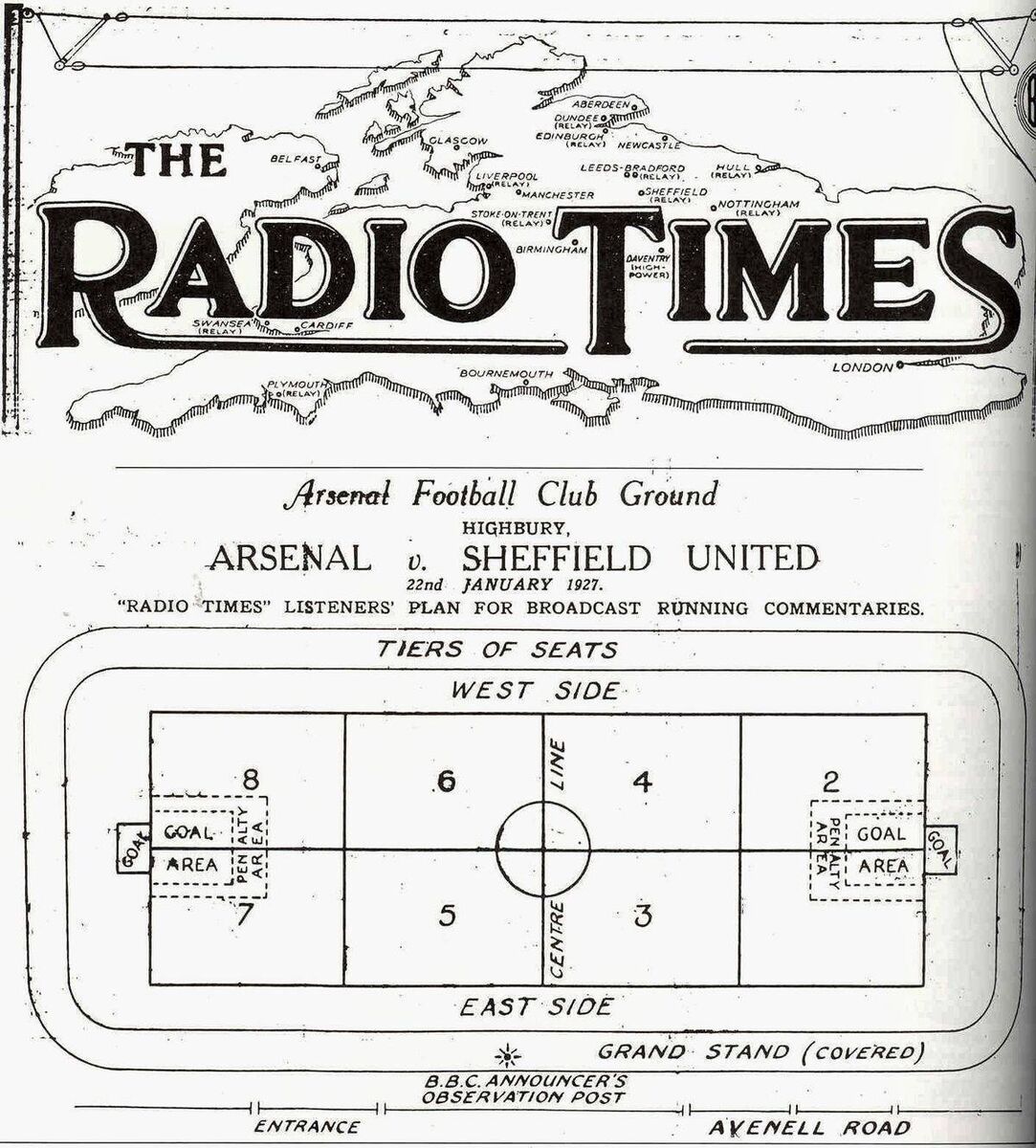
“A running commentary on the match will be broadcast," it explained. “Listeners will find our plan of the ground helpful in following the course of the match on their sets. It is to this plan that the announcer will refer in reporting the to-and-fro of the game.” And so, very politely, the sports radio revolution broke more new territory.
In Ireland all this must have seemed old hat. 2RN, the forerunner of Raidio Éireann, had been established in January 1926 and in August of that year they beat the Beeb to the punch with live sport.
When Kilkenny took on Galway in the All-Ireland hurling semi-final, Paddy Mehigan, the leading GAA journalist in the country, stepped up to a strange contraption, 20-odd pounds of metal anchored by four ship’s batteries, positioned on the sideline under the Hogan Stand.
Better known as ‘Carbery,’ the pseudonym under which he wrote in the , the garrulous Mehigan was a natural.
“Without much ado,” he later wrote, “I fired away and found I could spout freely enough, particularly as soon as the game, which I was so familiar with, started.” His flow was aided, according to Jimmy Mahon, his technician on the day, by an occasional sip from a Baby Powers.
The broadcast was one of the first of its kind in Europe and GAA would dominate 2RN’s early coverage. While relays of the FA Cup final were taken from London, they would not broadcast soccer from Dalymount Park until 1935; the first domestic Irish horse race covered was the 1936 Irish derby.
This caused ill-feeling among followers of other sports, but Mehigan’s voice on a big GAA day became a fixture of Irish life, a forerunner of Michael O’Hehir’s impact.
Eamonn De Barra, another 2RN commentator of the time, told of a Munster Hurling Final in the late 1920s being relayed via a gramophone from the window of Brabant’s wireless suppliers on Patrick Street. A huge crowd had gathered to cheer on Cork, then spearheaded by star forward Mick ‘Gah’ Ahern and his brother ‘Balty’.
As Mehigan described the action in the latter stages, tension grew. Balty seemed to be dallying in possession, so a frustrated voice in the crowd shouted: “Carbery, will you tell him to let it into ‘Gah’!”
In Britain, the BBC made up for lost time.
The nation was soon gripped by coverage of major sports, though the upper-class background of BBC executives explained why events like the Boat Race, of little interest to the public at large, became a permanent fixture in the schedule.
Voices like Wakelam’s were soon famous, as were the number twos, known as ‘Dr. Watsons’. The ‘squares’ caught on as well, much to the annoyance of one of Sieveking’s successors, the even more wonderfully named Seymour Joly de Lotbinière, better known as ‘Lobby’.
Sieveking’s system, often credited with originating the phrase ‘back to square one,’ had reached the point of cliché by the time Lobby took over the BBC’s burgeoning outside broadcast department in the mid-1930s. A review of the use of ‘squares’ found that they had become “a Music-Hall joke [and] that it’s constant repetition is irritating.” Squares were phased out in the years before World War Two, but Lobby’s impact on sports commentary is even more profound. He was the first producer to think of commentary as an art, breaking it into its component parts, scrutinising his staff so that they achieved “the commentator’s first duty…to make listeners feel that they have left their own fireside - that they really are looking on at something actually in progress.”
The legacy of the early BBC pioneers inspired an emerging post-war generation. New talent like Brian Johnston, Murray Walker, Kenneth Wolstenholme and Harry Carpenter, trained in Lobby’s hard school, achieved legendary status in the new medium of television, defining the art of commentary themselves for a new generation.
The spirit of innovation that marked the early days of sports broadcasting continues to this day. The technological wizardry of modern sports coverage would have been unimaginable to those wireless adventurers of a century ago, yet it is driven by the same desire to communicate the thrill of the action to a faraway, enraptured audience.
And a good commentator remains the first person to call.
CONNECT WITH US TODAY



Be the first to know the latest news and updates