After a year of chaos, Ireland's Olympic ambition somehow remains on track

Ireland has already qualified 52 athletes for the Olympic Games. Cathal Dennehy caught up with three of Ireland’s leading medal hopes to see how preparations are going
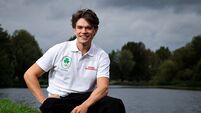
Sanita Puspure, Rhys McClenaghan, and Brendan Boyce. Pictures: Sportsfile

Sanita Puspure, Rhys McClenaghan, and Brendan Boyce. Pictures: Sportsfile

Here they go again — Ireland’s top athletes about to greet the New Year with giddy anticipation, their Olympic dream deferred, but not yet denied.

It’s just under seven months until the Games will – *holds breath* – get under way in Tokyo, and after a marathon of waiting since Rio 2016 that time should pass by at a relative sprint. Ireland has already qualified 52 athletes for the Games, a number that will rise significantly over the next six months.

After a year of chaos, the one constant in their lives has been commitment, an unwavering belief that every gym session in the back garden, every mind-numbing appointment on Zoom, and every lonely lockdown workout they’ve grinded through will eventually come to fruition. Cathal Dennehy caught up with three of Ireland’s leading medal hopes to see how preparations are going.

The Rower: Sanita Puspure

Team Ireland gymnast Rhys McClenaghan at the National Gymnastics Training Centre in the Sport Ireland Campus during the summer. 	Picture: Ramsey Cardy/Sportsfile
Team Ireland gymnast Rhys McClenaghan at the National Gymnastics Training Centre in the Sport Ireland Campus during the summer. Picture: Ramsey Cardy/Sportsfile

During the height of it, Sanita Puspure would head to the roof of her apartment complex in Ballincollig and sit, alone, on an ergometer — a machine she couldn’t quite fit anywhere else in the home she shares with her husband and two children.

Back and forth she’d go, hour after hour, day after day, without a scintilla of knowledge when all that toil would find an outlet.

“I found that bit really, really hard,” she says. “Not to have anything to look forward to during the summer, but still pushing yourself to the max. I didn’t see the point.”

And yet, she never missed a session. Not one.

I might not have been very motivated for them or applying myself at 100% — maybe it was 90 some of the days — but I did get through them.”

Which was all anyone could do this year, even a two-time world champion like her: get through it.

When it rained, as it often did, she and her husband tried to erect a tarp over the rowing machine on the roof – which didn’t really work — but still the work got done. It was almost three months before Puspure got back on the water, able to return to her usual training base at the National Rowing Centre in Cork. She only got seven weeks of proper training in before the European Championships in Poznan, Poland in October.

Puspure went there expecting nothing, but she again blew her rivals away in the women’s single sculls to earn back-to-back European titles, adding to the back-to-back world titles she won in 2018 and 2019.

She had two seconds to spare over the silver medallist, but as good as that was, Puspure knows her fitness will need to rise to a different plane again next summer. “Physiologically, I definitely need to have a bit more than seven weeks’ training to fight for an Olympic medal,” she says.

The Latvian-born rower, who moved to Ireland in 2006, is in the thick of that work at the moment, repeating the same programme she did last winter except with slightly more volume. How many kilometres does she cover in a typical week?

“I’ve stopped counting,” she laughs. “But it’s a lot.”

Much has changed in her set-up since the last Olympics. Former coaches Don McLachlan and Sean Casey both failed to have their contracts renewed with Rowing Ireland in recent years, while the man who took over in 2018, David McGowan, resigned as Rowing Ireland’s High-Performance Coach in September. Puspure has since been coached by High-Performance Director Antonio Maurogiovanni.

“He’d always been involved in coaching me at camps so it wasn’t anything unfamiliar,” she says.

She turned 39 last week, and while the mother of two remains as dominant as ever, there’s no denying that having the Olympics kicked 12 months down the road wasn’t ideal. How will she look back on this year?

“It was really long, I want 2020 to be over,” she says. “Winning Europeans was a good thing but the longer all this Covid thing drags on, the more it’s a reminder how we went from having plans this year to not knowing what’s happening at all. But like anybody else, it’s trying to make the most of what we have.”

There remains major unfinished business for Puspure at the Olympics. In London 2012 she finished 13th in the women’s single sculls, while four years later in Rio a viciously strong quarter-final draw saw her hopes of reaching a final quickly dashed, Puspure again forced to settle for victory in the C-final.

“Seeing how I was racing the last couple of years, I definitely think I’ve something to prove at the Olympics but recent events have put things in perspective,” she says. “Sport — it’s important but it’s not the most important thing in the world. If we get to go, great.”

She picked out two key staging points on the path to Tokyo in 2021: the European Championships in Italy in April and a World Cup event in Switzerland in May. As for what she hopes for in Tokyo, now less than seven months away?

Well, like any practitioner of good sports psychology — Puspure works with Kate Kirby at the Sport Ireland Institute — she’s not focused on the destination as much as the journey.

“Let’s not look that far ahead,” she says. “Let’s see what next week and the week after bring. All the things need to be in place before we get to Tokyo, but that’s the cherry on top. It’s the things we do before then that matter the most.”

The Gymnast: Rhys McClenaghan

Team Ireland gymnast Rhys McClenaghan at the National Gymnastics Training Centre in the Sport Ireland Campus during the summer. 	Picture: Ramsey Cardy/Sportsfile
Team Ireland gymnast Rhys McClenaghan at the National Gymnastics Training Centre in the Sport Ireland Campus during the summer. Picture: Ramsey Cardy/Sportsfile

After a year of chaos, his ambition has stayed the same.

“It’s to go out and win,” says Rhys McClenaghan. 

I’m not shy in saying that because that is my goal. That’s what’s in the back of my head when I train — these long hours and long days I’ve been doing since I was six years old.”

At the age of 21, those days are now longer than ever, all flexed and contorted to fit around the target of him becoming the seventh Olympic champion for Ireland. At the Sport Ireland Campus in Abbotstown, a typical day sees McClenaghan do a four-hour gymnastics session under the watchful eye of his coach, Luke Carson, before he heads across to the gym to complete more ancillary work. What hours remain are typically filled with appointments at the Sport Ireland Institute with physios, nutritionists, sports psychologists.

“It’s full-on but it’s something I love to do,” he says. “So I’d never change it.”

He gets a rest day every Saturday, during which he’ll often head back up the M1 to his home in Newtownards, County Down, to catch up with his family.

During the first lockdown in March, the only training facility available to him was his back garden, and McClenaghan did his best to simulate his routine there, even if safety precautions meant it wasn’t fully possible. To compensate, he and his father built an extension on their house, a 12-foot box room into which they placed a pommel horse.

“That’s where I lived through lockdown,” he says. “I thought it’d be a good time to learn new skills.”

When the Olympics were struck off the calendar in March, he promised himself the year wouldn’t go to waste. Quite the opposite.

“I’ve definitely improved, I told myself it’s one year of getting better,” he says. “I’ve upgraded my routine, I’ve perfected my techniques and everything is coming together now; we’re consolidating a more difficult and challenging routine for Tokyo.”

McClenaghan hasn’t competed in an official competition since October 2019, when he became the first Irish gymnast ever to win a World Championships medal, taking pommel horse bronze in Stuttgart. Like many others, he chose to opt out of the European Championships in Turkey earlier this month, but to simulate the same thing at home, he brought judges to his training centre and went through the very same event format.

“I won my pretend competition,” he laughs.

At times this year he struggled, like everyone else, to haul himself through the daily grind, and when things got tough it was a FaceTime call with a friend in California that pulled him out of his slump.

“She was brutally honest with me, telling me: ‘There’s gymnasts out there who are your rivals and they’re working right now, and you’re not, you’re sitting on your butt.’ I respond well to those harsh realities. The big thing I took out of the lockdown was learning how to self-motivate, to find energy internally without any external factors. You don’t have training partners, your coach by your side telling you what to do — it all comes from yourself.”

In June he got the call to say he could return to Abbotstown and things have been easier ever since. There’s still a world of uncertainty in terms of competitions in 2021 — few sports were hit harder in 2020 than gymnastics — but he hopes to get back at it in World Cup events in the coming months before targeting the European Championships in Basel, Switzerland in April.

“Hopefully these are far away enough that things will start to get better, and hopefully cases will go down for everybody’s sake, not just sport,” he says. “We’re all wishing the same thing.”

McClenaghan typically thrives amid the pressure of a packed arena but it seems unlikely that will be the case in Tokyo, but whether the stands are empty or not will make little difference once he hops up on that pommel horse. As a kid, he had a belief that he’d grow up to become an Olympic champion and nothing that’s happened in the intervening years has convinced him it’s unrealistic.

“That vision has stayed strong,” he says. “It motivates me in training, pushes me that extra bit because I know how difficult it is to get the Olympic gold medal. It means I have to work harder and be better than everybody in the world — everybody.”

The Athlete: Brendan Boyce

Racewalkers David Kenny, left, and Brendan Boyce with coach Rob Heffernan, centre, during a training session at Fota Island, Cork. 	Picture: Eóin Noonan/Sportsfile
Racewalkers David Kenny, left, and Brendan Boyce with coach Rob Heffernan, centre, during a training session at Fota Island, Cork. Picture: Eóin Noonan/Sportsfile

It wasn’t official, but for Brendan Boyce that wasn’t the point. On the last Saturday before Christmas, the 34-year-old Donegal race walker ripped through 30 kilometres on the roads around Páirc Uí Chaoimh, covering the distance in two hours, 11 minutes and five seconds.

That’s 3:04 marathon pace — walking.

It was three minutes quicker than he’d ever managed, proof that Boyce’s dreams of an Olympic medal are anything but delusional.

In a year when race opportunities were few and far between, Boyce and his coach Rob Heffernan decided to make something happen on their doorstep. With race permits still somehow out of the question, even for an elite handful, they recruited official timekeeping equipment, course measurers, and race walk judges to lend their makeshift event a sense of authenticity.

“It was really good,” said Boyce, who finished sixth in the 50km race walk at the World Championships in Doha last year. 

There’s no reason I can’t be challenging for medals (at the Olympics). Such a big PB at 30K gives me confidence I can go a lot faster.”

For Boyce, the key to 2020 was to carry on as best he could, or “drive it on”, as Heffernan likes to tell him. When the Olympics were postponed in March, the pair continued preparing for a race effort in May, just as they would in a normal year.

During that time trial he walked the marathon distance in 3:08 — also a personal best — before targeting a race in Sweden in August and one in Lithuania in September. After that he took a couple of weeks off, then slowly built some basic fitness through October before the serious work began on November 1.

“We trained as much as we would have in a normal year so I don’t feel I’ve been disadvantaged in any way,” he says. “Hopefully it’s another year stronger.”

At this time of year, Boyce is in the gym two or three days a week, steeling his body for the brutal training that will come later, and he’s logging 130km of walking a week. Come the summer that will climb closer to 200km as he begins his specific training blocks ahead of the Olympics.

It will, unfortunately, be his last chance to compete in his beloved event at the Games, with the organisers of Paris 2024 deciding last month to drop the 50km for the next edition. Boyce could see it coming, yet that didn’t soften the blow.

“Most athletes train for 10 to 15 years for the Games and you’ll have some who’ve been training specifically for 50K for Paris and now their event is gone,” he says. “They’ve wasted years of their life trying to achieve something that’ll never happen. It’s very disappointing for younger athletes. Paris would still have been on my radar, though I’d have been hoping Tokyo was when I’d be at the peak of my powers, so we’ll go at Tokyo even harder now.”

Due to the carnage that unfolded in the marathons and race walks at the World Championships in Doha last year, which were staged at midnight in stifling heat, those events at the Olympics have been moved to Sapporo — 800km north of Tokyo where the temperatures are typically a few degrees cooler. Boyce was initially annoyed about being cut off from rest of the Games, though since the pandemic struck, he has changed his outlook.

“They’re talking about restricting athletes in the village so being in Sapporo might be of benefit, we’re isolated in smaller numbers,” he says. “But at this point, I’ll take anything.”

It’s a feeling familiar to many Olympians, who have had to bide their time more than most in sport. Boyce plans to start the year off with a four-week training camp at altitude in Potchefstroom, South Africa, though with uncertainty in the air he admits “the rug could be pulled” on that trip any day.

If he can’t get away he’ll continue his usual routine in Cork, sleeping in an altitude tent to simulate the thin air and he’ll begin ticking off the weeks, one by one, that take him closer to his goal. As hard as 2020 has been, to finish it on a strong note gives him renewed belief about what’s possible.

“It’s a bonus when you can do a result off base training then hopefully when you add on everything else, it’ll give another few per cent,” he says. “I’m excited for what can happen next year.”

x

More in this section

Sport

Newsletter

Sign up to our daily sports bulletin, delivered straight to your inbox at 5pm. Subscribers also receive an exclusive email from our sports desk editors every Friday evening looking forward to the weekend's sporting action.

Cookie Policy Privacy Policy Brand Safety FAQ Help Contact Us Terms and Conditions

© Examiner Echo Group Limited