The Big Interview with Timmy McCarthy: 'My mortality had been challenged - then my humanity was'
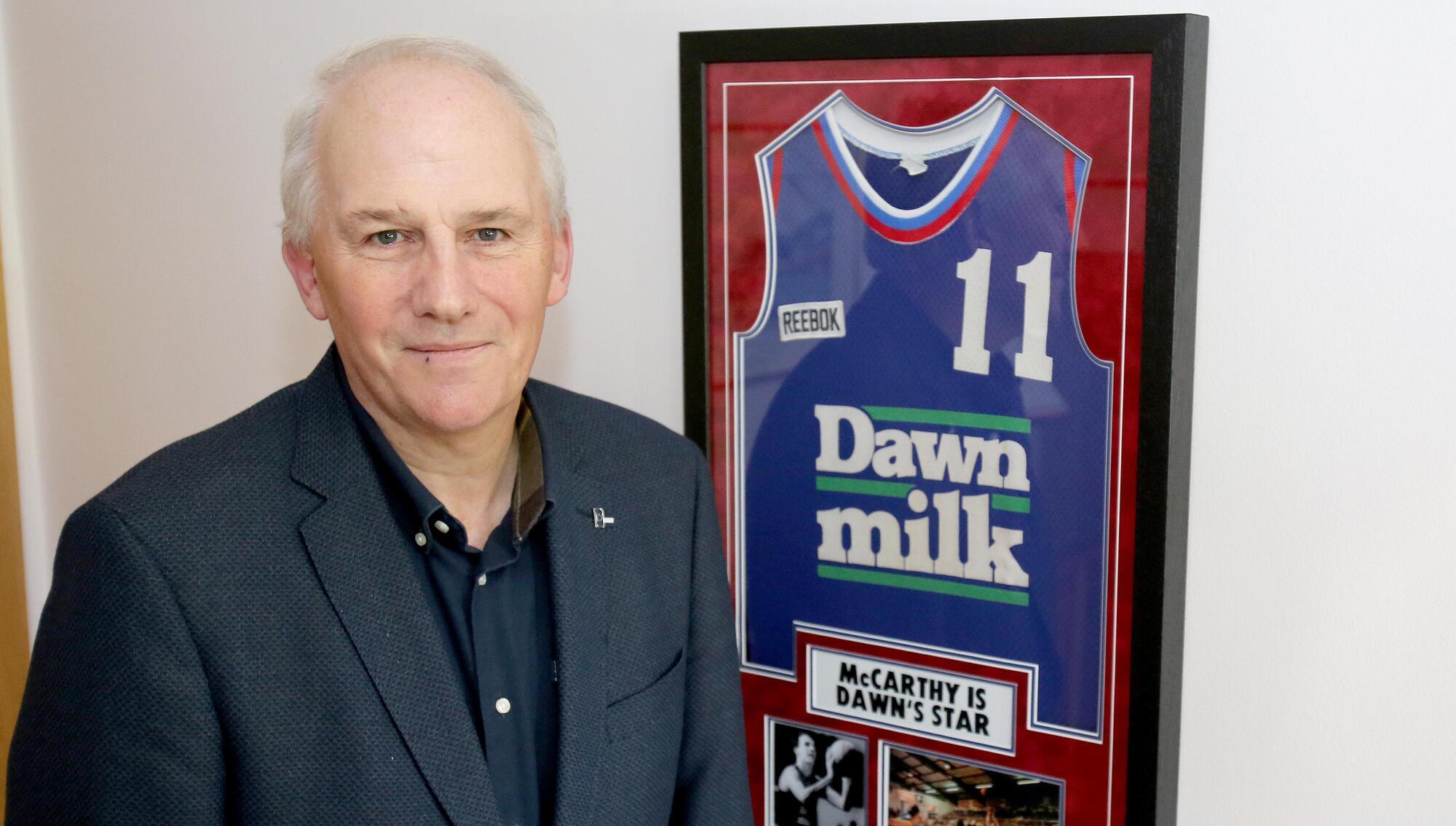
Two years after a prostate cancer diagnosis, Irish basketball legend Timmy McCarthy is back living as normal and full a life as he could wish for. “I wanted to keep on this planet as long as I could and do everything I could do to enjoy time with my family."
The Big Interview with Timmy McCarthy: 'My mortality had been challenged - then my humanity was'

Basketball legend Timmy McCarthy: I wanted to keep on this planet as long as I could and do everything I could do to enjoy time with my family

Maybe it’s because he played and coached in the one team sport where the clock works not just in seconds but milliseconds – like when he ghosted in to receive a Jasper McElroy pass and scored on the buzzer to win a national championship semi-final against Dublin St Vincent’s in a packed Neptune Stadium back in ’85 – but Timmy McCarthy remembers exactly the date and time when he and his wife Anne sat down in front of Dr Eamonn Rogers.

It was 11.01am on February 28, 2018, a day when the country was in the grip of a big freeze. The previous year McCarthy had found he was going to the bathroom at a frequency that was becoming “ridiculous”. He went to his GP and some specialists for a range of check-ups and scans that showed up nothing of concern, but then Rogers, a consultant urologist, suggested he undergo a biopsy, as he put it, “just to be sure to be sure to be sure”.


Now Rogers was sure all right.

“I have bad news for you,” he said. “I’m really sorry to have to tell you this but you have prostate cancer.” 

And not just any form of it. On the Gleason scale, McCarthy’s was registering as the most aggressive kind possible.

McCarthy, just shy of his 58th birthday at the time, broke down in tears, squeezing Ann’s hand. And cried some more.

“Your mortality is brought right to your face. And all the things you’ve done in your life – captaining and coaching the Irish senior team, winning leagues and championships with Blue Demons – they’re all irrelevant when you’re sitting in front of someone telling you have the most aggressive form of prostate cancer there is.”

Except those experiences would prove to have some relevance. 

The lessons from them would inform and sustain his recovery. 

It’ll be 25 years ago this December when McCarthy was involved in undoubtedly the most dramatic derby in Kerry basketball history.

A few days after Christmas, the old Presentation gym in Killarney was packed to the rafters for the clash of hometown St Paul’s team and Tralee Tigers, coached by McCarthy. Tralee at the time were near the top of the table in their pursuit to bring a first men’s Superleague title to the town but at half-time trailed by 28 points. Emotion as well as their arch rivals was clearly overwhelming them. The game seemed over. Killarney certainly seemed to think so.

“Between both dressing rooms there were air vents which were slightly open,” recalls McCarthy, “and I could hear the Killarney guys hollering and hopping next door. So I told my team to be totally quiet and then I opened the vent fully. And for a good three minutes we listened to them basically laughing at us, dunking on us.

“Then I closed the vent. ‘Right, that’s what we’ve created with our performance. But this game is not over. We have two quarters to resolve this. We’re going back to running our sets and playing our game.

And I promise you if we get this back to 12 points by the end of the third quarter, we will win.

Sure enough, after Tralee had listened to Killarney’s yelping, Killarney would in turn hear Tralee’s footsteps. By the end of that third quarter, the deficit was down to 10.

By the end of the fourth, it was down to zero.

A match that began at 8.15 only finished up half an hour shy of midnight between all the periods of overtime and breaks in play to wipe the condensation off the floor. By the night’s end, it was Tralee who emerged victors, by a single basket, and by the end of the season, they were league champions as well.


                            'I told my team to be totally quiet and then I opened the vent fully. And for a good three minutes we listened to them basically laughing at us, dunking on us'
'I told my team to be totally quiet and then I opened the vent fully. And for a good three minutes we listened to them basically laughing at us, dunking on us'


For all the polish and structure McCarthy brought to Tralee that year, that never-say-die defiance was probably his greatest if most underestimated gift to them. It was the only way he knew how to operate.

He was a son of Blue Demons with whom he won three national leagues and four national championships in a stellar career. More, he was a child of the northside of Cork.

During one nine-year stretch that would take up most of the 80s and the first couple of seasons of the 90s, there were only two Irishmen to win a Superleague medal that were neither born nor raised within a two-mile radius of the Parochial Hall: McCarthy’s Demons’ teammate, Gerry Wheeler from Portarlington, and his Irish international colleague, Seamus Woods, from Limerick who enhanced a magnificent Neptune team.

For McCarthy, that was no accident. While it’s now 20 years since he left Cork to live and work in Athlone, he has regularly shown a slide of the church of the Ascension in Gurranabraher in his

presentations as a chief executive and executive consultant to multiple companies. He grew up under its shadow and that of the Hall. That’s who he is.

“On the northside we’re very clear where we’re from. We’re working class, so we’re very prepared to help each other and support each other. When I was growing up, my mother and the neighbours would help each other out; they all knew each other’s kids, they’d all help out with feeding them and looking after them. When I later moved to the southside, it wasn’t like that.

“On the northside, we didn’t have much – but we had so much. We didn’t have the trappings of wealth or luxury but we had the gift of love and affection and friendship and camaraderie. I see that in someone in like Roy Keane. He got that from his parents and community. With St Mary’s [soccer team that McCarthy played with] we’d play against teams from the southside who would have better boots and dressing rooms while we’d change on the side of the road but we just got on with it and tried to do the best that we could with what we were given.

We never took anything for granted. We just made sure we enjoyed what we had today.

“When I was in my teens a friend of mine who was a similar age to me died very unexpectedly and I was finding it very hard at the time to handle it. And my grandmother, God rest her soul, was very philosophical, and she said to me, ‘Life is this wheel and you don’t know how long you have on it until you step off it and die, but all you’re asked to do is leave the wheel a little bit better off.’ And to me, that’s the people of the northside of Cork.

"Just trying to be a little bit better within ourselves and to make things that bit better for the people and community around us.”

Although he’d go on to be the head of sales or CEO of multiple leading companies and has several third-level qualifications to his name, McCarthy never sat the Leaving Cert.

He left school at 15 to work on the yoghurt-production line of the old CMP Dairies where his father was a supervisor. With his shift being earlier than his dad’s, he’d walk an hour to get to work, then another hour back home where at the end of the week he’d hand over to his mother half his salary.

After another job then making wheel moulds for articulated lorries, he landed a job in his early 20s as a sales rep for New Ireland Assurance; as a senior basketball international, he had the profile and self-confidence for the job.

“I can still remember coming home to tell my parents, God rest their souls, the news and seeing the pride and smile of my mother: that her son had got a job on the South Mall and would now be wearing a suit.”

Knocking on doors trying to sell insurance would have daunted a lot of people elsewhere but not McCarthy; on the beat he had, there was little cold calling, only warm receptions.

The people of the northside were incredibly good to me. They paid their insurance because they now had Maggie Kelly’s son collecting it; they didn’t want to be in arrears with Maggie Kelly’s son and leave her and him stuck. And they bought a lot of insurance from me.” 

Even the Neptune households did. Tom O’Sullivan’s mother on the Cathedral Road always made him welcome and was a loyal customer for years. He might have been one of ‘them’, being from Demons, but he was still one of ‘us’.

I was a Norrie. And they were going to do their best to support one of their own.

There was an edge to the people too though as well as a warmth, and that transmitted itself to the sports arena, especially the hardwood.

“I always talk about the northside of Cork being like Munster rugby in its golden period. Leinster were more nonchalant and classy and probably more skilful but Munster rugby was about heart, leaving it all on the field. And for us it was about leaving it all on the floor.

"Diving on the floor. Dive On Glass some people called it. We wanted to be successful. We didn’t have the advantages that we perceived others had.

"It didn’t mean they had them, just that we perceived that they did. And growing up where we did, that was embedded into us. It didn’t matter if you played for Demons, Neptune or the North Mon. You dived on glass.”

After being told at 11.01am on February 28, 2018 that the hand he had been dealt with was the most aggressive form of prostate cancer there is, McCarthy tried to apply some of the advice he gives multiple chief executives in his work at the McCarthy Consultancy: control the controllables.

Dr Rogers had told him he’d be meeting a surgeon the following week. The most important thing between that appointment and this one with Rogers was to inform his children and family of his news.

First was Karen, his daughter, who had just beaten the snow and managed to get back home from college in Limerick where she was studying physiotherapy.

“It was the hardest thing I’ve ever had to tell anyone. Because Karen is my princess; I’ve always called her Princess, ever since she was a child, and I still call her that even though she’s now an adult. And this was the first time in her life that her dad couldn’t fix something for her.

"I couldn’t fix this cancer. I had to depend on other people to fix this cancer. So we just held each other for the longest time in the hallway in our house.”

Then he rang his sons, Brian and David, snowed in in their houses in Ferbane and Moate respectively; that wasn’t easy either, though at least they were surrounded by their wife and children. McCarthy was 29 when he retired from basketball. He was at the peak of his powers at the time, captain of the national team and just been voted Irish player of the year, and just won the national league with Demons.

It wasn’t so much that he wanted to go out on top. It was that he wanted to spend more time with his young family. 

“I’m so glad I made that decision. But 29 years on again, here I was, diagnosed with cancer, with a similar ambition. 

I wanted to keep on this planet as long as I could and do everything I could do to enjoy time with my family. I was very clear on that.

"I’d get bad thoughts but once they came in, I kicked them out. I was going to do everything I could to get through this.”

The following week he underwent robotic surgery by the masterful Paddy O’Malley. So aggressive was the cancer in McCarthy’s prostate – 95% of it was covered with a tumour – the surgery lasted three times longer than the average prostate procedure.

While on the outside it looked as if McCarthy had undergone minor surgery, internally it had been severe. O’Malley was happy with the surgery but that didn’t make McCarthy immune from its consequences.

“First, my mortality had been challenged; then my humanity was. I was incontinent. I remember being helped out of the bed by the physiotherapist and I saw I was wearing nappies and so I had all these emotions.”

But still he pressed on. He had to wait six weeks before he could start his chemotherapy but in the intervening period he worked and exercised, walking, even playing a bit of golf.

“I’m so glad I made that decision (to retire). But 29 years on again, here I was, diagnosed with cancer, with a similar ambition." 

“I didn’t want to put my body in any jeopardy that would hamper my recovery but I wanted to feel normal.”

Then he underwent 18 weeks of chemo. Again there were major side effects. Diarrhoea. Constant fatigue. Not being able to taste his food. Pins and needles in his fingers and toes. But still he kept putting one foot in front of the other, trying to make him and the day that bit better than the one before.

“I said to my oncologists Macon Keane and Cormac Small, when I’m feeling fatigued, I’m going to go for a smaller walk, but I’m never not going to go for a walk. I might play 12 holes of golf, or 18 holes, depending on how felt. 

"Before the surgery, I used to be able to hit a seven iron about 150 yards. I might have only been hitting 90 yards during the chemo, but as I’d say when I hit a bad golf shot, a bad golf shot is better than a good dose of chemotherapy!”

He kept controlling the controllables. He followed his new nutrition plan to the letter, likewise all those pelvic floor exercises, he was recommended to do three times a day by his medical team: again, the discipline of being an international athlete and coming back from a cruciate injury in the mid-80s stood to him.

The radiotherapy cycle was also successful while only last month he completed two years of hormone treatment.

His oncologist told him he’d never be able to say to him that he’d ever be cancer free again but at 60, Timmy McCarthy is back living as normal and full a life as he could wish for. Although he’s lost 15 yards with that seven iron, his handicap has dropped two shots as well.

While with Covid, work is down roughly 50% on what it was, he’s still an executive coach to CEOs and a consultant to businesses and coaching clients how to communicate; long before the rest of us ever heard of Zoom, McCarthy was already coaching people how to communicate “through glass”.

And he’s coaching kids and teams too. A highlight during lockdown was taking three of his eight grandchildren for an all-day camp – starting at 10am, finishing at 4.30pm – and going through all the fundamentals of basketball with them: passing, ball-handling, shooting, making sure their follow through looked “like a swan”. 

McCarthy has the distinction of coaching a variety of Irish national teams, and winning national or international honours with every team he’s coached – a Roy Curtis tournament win with Blue Demons in ’92, that Superleague title with Tralee in ’96, an U19 National Cup with Demons in ’97 – but off Broadway he also coached Brian and Karen to All Ireland schools and Community Games titles with their teams in Kiltoom and Athlone.

Now coaching another generation of McCarthy, even if it was for just one day, was something else to treasure.

This summer he also coached the local team, St Brigid’s, to a Roscommon county championship. Only a handful of the 2013 All-Ireland winning team were around but under the management of Benny O’Brien, and some valuable coaching nuggets from McCarthy, a strikingly young team delivered the club its first county title since 2017.

McCarthy has assisted several GAA teams through the decades.

In 1988, upon the recommendation of his good friend Ger Cunningham, he was the physical trainer of the St Finbarr’s team that won the senior Cork county hurling championship. In 2016 then he was part of David Power’s coaching staff in Wexford.

Although Wexford just missed out on promotion from Division Four that year, McCarthy takes pride in the fact they were the leading scorers across all the divisions that season and also incurred less black, yellow and red cards than any other team in the country that season.

Some of the same principles are being embedded with Brigid’s: don’t just pass, move. Earn the right to take a shot. Defensively, don’t just hit your man, defend him – win the first ball; if you’re close enough to foul, you’re close enough to tackle. All being good, he’ll coach again in 2021.

He was meant to commentate his fifth Olympic Games for RTÉ this summer, but unfortunately there was to be no Downtowns from Tokyo. Which probably means the last time you probably heard him was Rio.

In recent years he was commentating Euroleague games for Fox Sports viewers in Africa, typical of the varied, unpredictable life he’s had, bemusing and entertaining them with his unique catchphrases.

Next year, all being good, we’ll hear him going BoomShakaLaka again, even if it’s communicating through glass.

Either way, he’ll continue to dive on glass and pelvic thrust and whatever else it takes to be around for it and much more.

x

More in this section

Sport

Newsletter

Latest news from the world of sport, along with the best in opinion from our outstanding team of sports writers. and reporters

Cookie Policy Privacy Policy Brand Safety FAQ Help Contact Us Terms and Conditions

© Examiner Echo Group Limited