Paul Rouse: Roy proves that you can’t keep a good man down
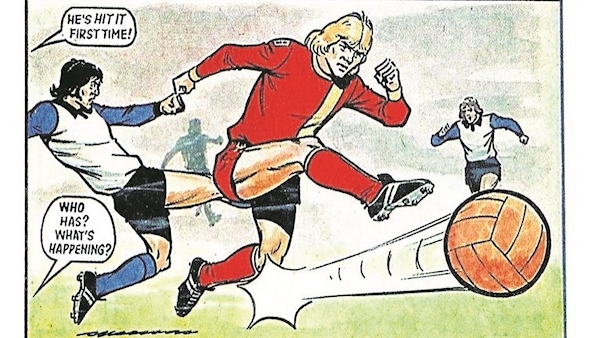
It cannot be easy to play at the top level of English soccer for more than six decades.
But the great Roy Race is still going strong.
Roy made his debut for Melchester Rovers back in 1954. He was then just another young footballer trying to make his way in the game and his first steps were traced in the pages of the comic.
That comic — ‘a sport and adventure picture story weekly’ Roy made his debut for Melchester Rovers back in 1954 was launched on September 11, 1954.
Boys’ Adventure Comics were a hugely popular type of comics in Britain during the 1950s and 1960s. Their combined sales reached beyond 500 million a year and they became the staple reading fare of a generation of young readers.
The comics came in a variety of forms and many focused heavily on stories of British heroism, not least during World War II.
‘ ’ featured in that first edition of in 1954 — and he went on to become the best player in English soccer history.
The comic traced his emergence from schoolboy soccer in the 1950s, before he truly flourished in the 1960s when he matured into a rugged, square-jawed hero, a shock of blond hair sitting gloriously on his head.
Of course, his image changed over the years: his hair got longer and then shorter and then longer; sideburns came and went; and his shorts went high up the thigh and then back down again.
It was only in 1976 that ‘ ’ graduated from the pages of .
Then, for more than 800 issues, Roy Race grew to become an iconic figure in modern English culture, with his own comic.
This transcended sport. Someone who had achieved the impossible was considered to have engaged in ‘real Roy of the Rovers stuff.’
At its peak, the comic sold one million copies a week in Britain and Ireland. Its arrival into shops on Saturday mornings was a vital moment in early lives of many children.
Naturally, Roy Race stood for something more than just being a star player. He believed in ‘playing the right way’. That is to say, his soccer was a triumph of style and of fair play.
In the context of English soccer in the 1970s and 1980s, this was no mean achievement. Rarely has a man so successful been so entirely out of keeping with the mores of his age.
As he grew from boy to man, Roy married his childhood sweetheart Penny Laine and they had three kids.
All the while he was starring for Melchester Rovers as they rose through the ranks of English soccer, winning leagues and cups. Indeed, Roy Race won some nine league titles, eight FA Cups, three League Cups, three European Cups, one Uefa Cup, and four Cup Winners’ Cups.
At the heart of these successes was his capacity to score the last-minute winner.
Naturally, all of this success earned Roy the call to play for the national team.
Eventually, in 1978 he was prevailed upon to become player-manager of England. The team he selected depended heavily on his teammates at Melchester Rovers, but also included stars of the English games such as Trevor Francis.
But it was not all glory. Part of Roy’s greatness was his capacity to overcome adversity.
In an edition entitled ‘The Great Melchester Massacre’, the Rovers’ bus was attacked by terrorists in the (previously unknown) Middle Eastern country of Basran. Most of the squad was killed and Roy himself was a lucky man to escape.
There’s no room here to set out the sheer scale of things that went wrong for Roy in his career.
There were repeated kidnappings. The summer tours to South America proved particularly risky — no sooner would the players be off the plane than kidnappers would be binding their hands in rope and writing ransom notes.
But, even worse than the kidnappings were the shootings — most particularly the outrageous attempt on Roy’s life in December 1981 when he was shot and almost died.
“Who shot Roy Race?” became one of the great questions of the age.
It was a year after JR Ewing was shot in Dallas. There was also the trauma of the earthquake that followed from a collapsed mine which destroyed Mel Park. Melchester Rovers were forced to play their games at Wembley. There was enormous exuberance (and relief) when they were able to return to a rebuilt Mel Park in February 1989.
The 1990s were tough for Roy. It is true that soccer was remade in that decade but Roy of the Rovers struggled to keep pace. His son, Rocky, made it into the team, but the reality was that comic books could not now compete with video games and other more hi-tech pastimes which became central to modern popular culture. The ‘Fifa International Video Game’ of the mid-1990s offered too much competition.
A Roy of the Rovers computer game was released for play on early computers but it didn’t really take off.
Attempts to keep pace with more modern storylines did not bring any joy. In the mid-1990s, the comic moved from weekly to monthly.
And then it was pulled altogether, before making a comeback in 1997 as part of the ‘Match of the Day’ magazine.
In the end, and in the aftermath of a shocking helicopter crash which left him needing to have his left foot amputated, the career of Roy of the Rovers was ended in 2001.
There seemed no way back.
But, where Roy of the Rovers is concerned, the mere amputation of a foot could never prove too much of a challenge. And so it is that Roy is back now — and he’s young again.
Roy’s new life in the graphic novels is the product of the efforts of a new publisher, Rebellion.
Roy Race is a part-time carer for his disabled father trying to make his way into the game with Melchester Rovers. The club is mired in the lower leagues — the perfect environment for a teenage prodigy to launch a glorious career.
The new novels also show the young striker trying to cope with the demands of social media, of agents and of the challenges of modern celebrity.
Entitled ‘Kick-off’ and ‘Foul Play’, they also have Roy back doing what he does best — scoring goals.
Accompanying the novels is a new collection by Andy Jacobs entitled simply ‘Roy of the Rovers’. This book charts the making of a modern footballing institution as a sort of ‘Roy of the Rovers 65th Anniversary Special.’ There are goals and glory and it is all bathed in the warm glow of nostalgia for a time and for a type of person that only ever existed in the pages of comic books.
Most of all, the comics are just harmless fun and reading them a fine way to pass time.


CONNECT WITH US TODAY



Be the first to know the latest news and updates