Dreaming of football’s alternative reality
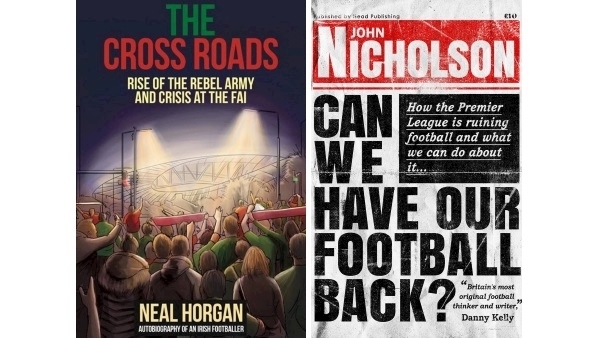
Two new football books. Written by two dreamers. Coming from very different angles.
First to Can We Have Our Football Back? How the Premier League Is Ruining Football And What We Can Do About It, by John Nicholson.
John wants us all to stop paying for football on TV.
His is a book about a queasy feeling, an existential despair, a sense that “things feel sick, feel askew, feel out of whack with reality”.
“There is an empty gnawing void in the pit of our stomachs which we never used to have but now is with us always. The consequent toxins it has released into the cultural, political, ecological and sporting water table of English football have poisoned us.”
Nicholson pins it all on the Premier League, “a massive amoral money pit into which billions have been thrown in wages and transfer fees, all predicated on one thing: paywall TV. It is the foundation stone at the core of the footballing skyscraper”.
It’s a sentiment echoed this week by former Crystal Palace chairman Simon Jordan, who described the Premier League as “the root of all evil”, which has created a “wasteland” of everything besides itself, due to the “drip-down effect” of inflated wages and fees.
Nicholson dreams of “a revolution that replaces extremism with modest reason”. He wants an end to the skewed reality that has destroyed competition across all of Europe’s top leagues.
He is certain this will, in turn, deflate the hysteria and hyperbole and panic and abuse that characterises Premier League life. And he has selected the people to carry his fight.
“You and me. We laid those foundations with our money. Never forget that this is an empire we created. Never forget that we keep it going. Never forget that we can come together to stop it. Any. Time. We. Want. We have the power. The time has come to use it.”
Nicholson argues a relatively small core of pay TV customers is propping up this pyramid scheme, which doesn’t even make money for the broadcasters. And when his army of dissenters collapse the whole house of cards, he would impose sensible wage caps to negate the purchasing power of oligarchs and petrodollars. In his utopia, government would then ringfence football on terrestrial TV, protect it as a public good.
In the book, football industry insiders line up to, anonymously, decry obscene wealth.
We hear about players who guiltily drop rolls of notes into beggars’ cups, who finance ‘inner circles’ of 200 people.
We hear of paranoia and anxiety: “I’m an ugly fucker, why have I got this beautiful wife? Money. That’s why.”
And a two million a year Premier League journeyman voices the ennui Watford’s players may have been feeling before, during and after last week’s 8-0 mauling.
“When I’ve played Manchester City, there was so little chance of my team winning that we might as well have not bothered. The gap between the top sides and the rest is huge. Bigger than I ever remember it. They just buy all the best players. It’s no more complicated than that.”
An uncomplicated to unravel, Nicholson insists.
“Everything we know to be reality is but a construct of billionaires and global corporations; a matrix they built from our money which they sell to us as an immutable, unchangeable reality.”
Perhaps he never convincingly makes the case why the billions are better resting with oligarchs than in the pockets of talented people, often from poor backgrounds, who have topped the world’s only genuine meritocracy, and will spread those billions guiltily into begging bowls, or feed them back into the economy via the kind of £6,500 backpack James Maddison was pictured wearing last week.
Still, his case is partly made for him if you observe events at Stamford Bridge lately, once a toxic cesspool poisoned by purchased Premier League glory. Now, banned from buying players, and regularly losing matches, but clinging to a fresh identity, the place has never seemed happier.
Neal Horgan is a dreamer who closes his book by sharing a dream he had last year.
The Cross Roads is the third book in Horgan’s trilogy, part autobiography, part state of the League of Ireland nation address, told through Cork City’s travails and triumphs.
He writes from a very different place to John Nicholson, where there is not much money to throw into begging bowls. Yet there is the same belief in football’s ability to survive anything, as well as anger at the course it has taken. The dream sequence rounds off a vexed, rigorous prod at the League of Ireland’s glass ceiling, which examines how the FAI reached crisis point and why even City always finds itself a season or two of bad results from the edge of a familiar abyss.
In the dream, Neal is one of a few League of Ireland players called into an extended Ireland squad for a series of friendlies. He is uncomfortable, feels out of place. “Kevin Kilbane and a few others wonder who we are.”
The scene is the Aviva Stadium dressing room, day of the game. Martin O’Neill,
naturally, hasn’t yet hasn’t named his team. Obstacles pile up. Kilbane takes his boots by mistake so Horgan has to warm up in oversized astro runners. O’Neill doesn’t appear too concerned. The sense is Horgan won’t be central to the day’s operation.
The warm-up becomes a full-size game. Probables v possibles vibe. Horgan strives to impress, crocks Wes Hoolahan with a tackle, which impresses no-one.
Has he done enough to make the matchday squad? He wakes up before he can read O’Neill’s teamsheet.
It is a charming dream, schoolboy innocence surviving in an old pro who has won the League of Ireland.
And it’s one he has interrogated for what it means.
“That dream is what it’s all about. All the money issues, all the hustling for positions of power in the FAI, the outlandish payments, City’s falling and rising — they all get in the way of the dream.
“I was never meant to be for me. But for a better player than me, perhaps the difference between living out that dream and not doing so was their club going under, or the lack of development of the LOI, or the lack of faith from the FAI or their representatives in our own talent.
“That’s the dream, for a player to feel comfortable and seriously contribute to the Irish national side without having to leave the country.
“Imagine crowds of five to 10 thousand every second week at all the top clubs on the island.”
Horgan’s anger is chiefly targeted at the FAI, insisting it has never believed in professional football here, never provided the necessary support structure. But it’s true too that people have some control of their own realities.
Writing this week on backpagefootball.com, Paul Little made the case that marketing campaigns and improved facilities at League of Ireland grounds will never be enough.
Instead, his piece — pessimistically titled ‘Build it and they still won’t come’ — calls on the same army of change agents as John Nicholson, perhaps after they’ve switched off Sky. “The onus is on you, if football is your game, to take an interest, to invest a bit of your time and a little of your money through a turnstile. No other grand plan is required.
“The football public has the power — it always has.”
- The Cross Roads by Neal Horgan will be available at www.sportsproview.com and Amazon.co.uk from October 4. It will be available in Turner’s Cross from October 18 for a special launch price of €10. Can We Have Our Football Back?, by Head Publishing is available now.